
News & AnalysisCareer

A fall of roughly 2% on Tuesday leaves Dogecoin (DOGE) trading around $0.0550. November alone has brought losses of over 27% for the largest meme coin by market capitalisation, taking its year-to-date decline to about 67.5% and highlighting the wider cryptocurrency sell-off.

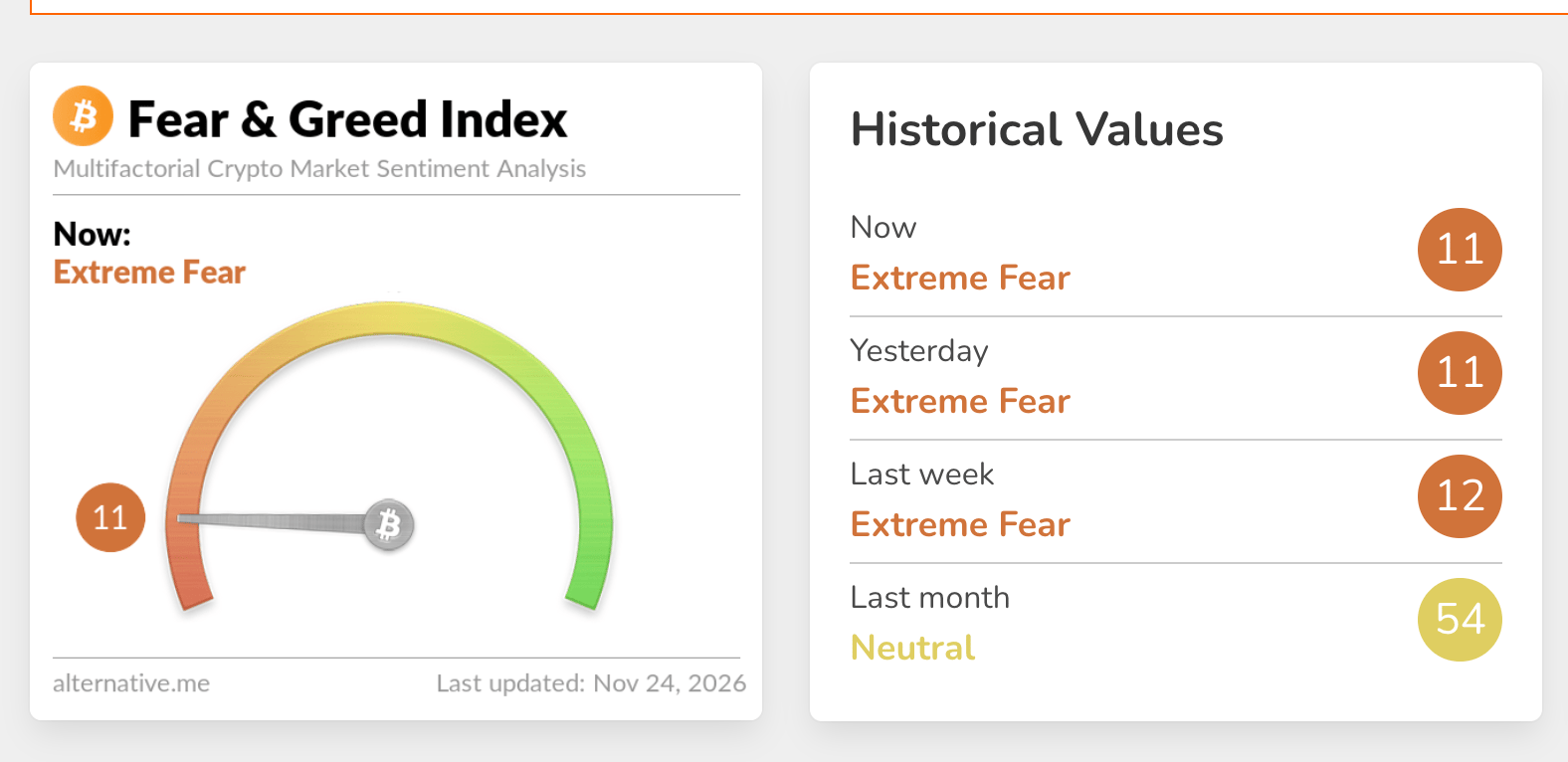
A reading of 11 keeps the Fear & Greed Index in Extreme Fear territory on Tuesday, reflecting the continued lack of demand for Dogecoin. Although unchanged from the previous day, the reading is well below last month’s 54 in the Neutral range. With demand remaining weak, sellers retain firm control and the prospect of an immediate rebound diminishes.
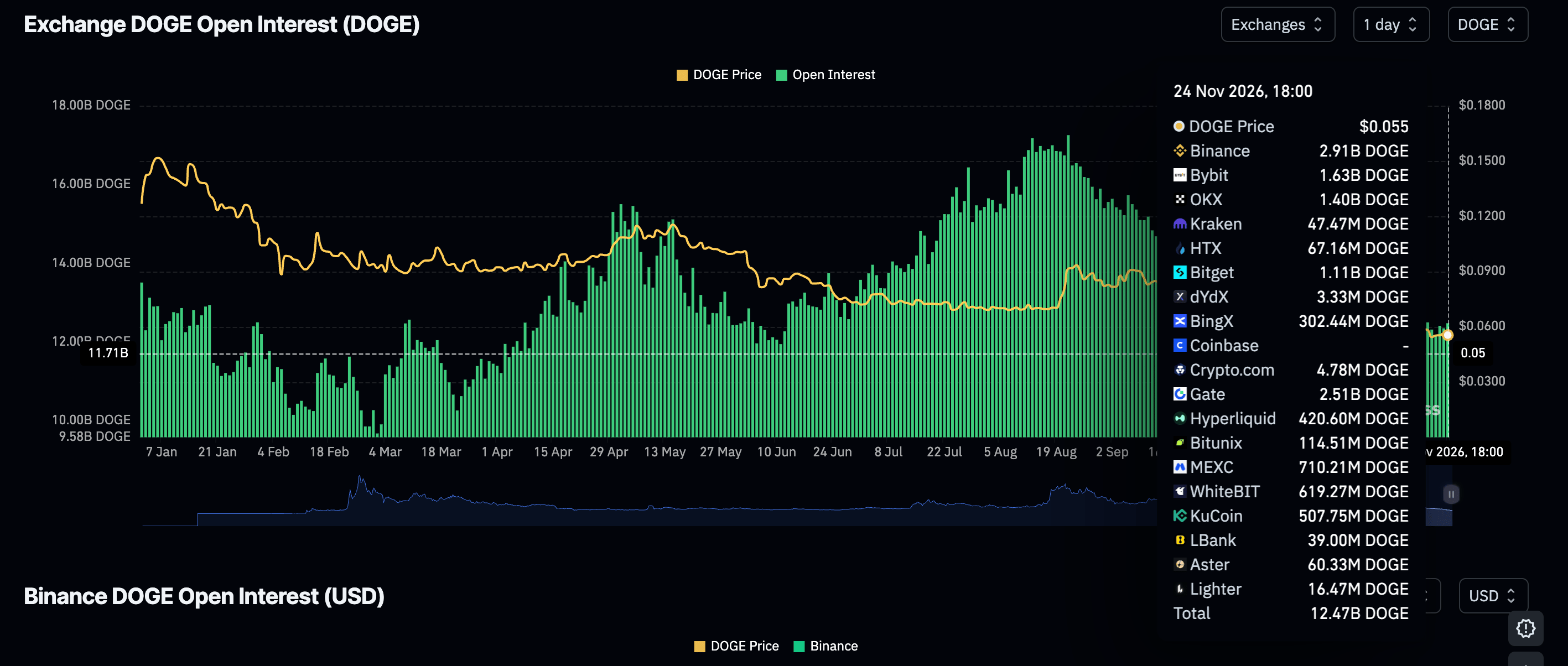
Tuesday’s perpetual futures Open Interest (OI) averages 12.5 billion DOGE, only marginally above the previous day’s 12.4 billion DOGE, as derivatives trading echoes the weakness signalled by the index. In a broader comparison, OI remains well below October’s highs of 16.6 billion DOGE and August’s 17.3 billion.
Weak retail demand points to limited confidence among traders in the meme coin’s ability to maintain a near-term rebound. Investors are cutting their risk exposure and moving to the sidelines, emboldening bears to drive prices down and prolonging the correction.
At $0.0549, Dogecoin continues to retreat below every major Exponential Moving Average (EMA), strengthening the short-term bearish outlook. Overhead resistance comes from the SuperTrend signal at $0.0651, while reclaiming the descending resistance trendline is projected to require a move above $0.0659. The broader downward pressure is also evident in the 50-day, 100-day and 200-day EMAs, which are grouped between roughly $0.0705 and $0.0848.
A Relative Strength Index (RSI) reading of 27 points to ongoing, albeit not extreme, oversold conditions. Meanwhile, the Moving Average Convergence Divergence (MACD) indicator remains below zero: bearish momentum still dominates, even as the pace of the decline starts to ease.
The first hurdle is the SuperTrend level of $0.0651, ahead of the descending trendline breakout area around $0.0659. A move beyond these levels would bring the 50-day EMA at $0.0705 into view, followed by the 100-day EMA at $0.0762 and the longer-term 200-day EMA at $0.0848. Together, these levels form a substantial supply zone that DOGE must clear to move away from a bearish bias.
The daily chart shows no nearby structural support beneath the current price. Unless fresh buyers emerge, additional selling would therefore expose the pair to new lows.
(The technical analysis of this story was written with the help of an AI tool. Know more.)
An increase in Open Interest is linked to greater liquidity and fresh capital entering the market. It is regarded as a sign of improving efficiency and a continuation of the prevailing trend. By contrast, falling Open Interest is taken to indicate liquidation as investors exit the market. The resulting decline in overall demand for an asset reinforces bearish sentiment among investors.
By raising the liquidation risks traders face, funding fees narrow the gap between an asset’s spot price and its futures contract prices. Persistently high, positive funding rates signal bullish sentiment among market participants and expectations of a price increase. Conversely, a persistently negative funding rate points to bearish sentiment towards an asset: traders anticipate a fall in the cryptocurrency’s price, and a reversal into a bearish trend is likely.







Phone: +61 2 8036 8388
Fax: +61 2 8036 8388
Email: support@tmgm.com



The information provided on this website is of a general nature only and does not constitute personal financial advice. Before acting on any information on this website, you should consider the suitability of the information in relation to your objectives, financial situation and needs. Investing in CFDs and FX Margin Contracts carries significant risks and is not suitable for all investors. You may lose more than your initial deposit. You do not own, or have, any interest in the underlying asset. We recommend that you seek independent advice and ensure you fully understand the risks involved before trading. It is important that you read and consider the disclosure document before you acquire any product listed on the website. The information and advertisements offered on this website are not intended for use by any person in any country or jurisdiction where such use would be contrary to local laws and regulations. The Products and Services offered on this website are not intended for residents of the United States, Malaysia and Thailand.
TMGM is authorized and regulated in various jurisdictions.
Trademax Australia Limited, trading as TMGM, is regulated by the Australian Securities and Investments Commission (ASIC), AFSL no. 436416 and is located at Level 28, One International Tower, 100 Barangaroo Avenue, 2000 Sydney, NSW Australia.
Email: support@tmgm.com.au
Trademax Global Limited, trading as TMGM, is authorized and regulated by the Vanuatu Financial Services Commission (VFSC), registration number 40356 and registered at 1276, Kumul Highway, Port Vila, Vanuatu, Republic of Vanuatu.
Email: support@tmgm.com
Trademax Global Markets (SE) Limited, trading as TMGM, is authorized and regulated by the Financial Services Authority (FSA) of Seychelles, with license number SD224. The company is registered at Office No 13, Providence Estate ABIS Centre, Mahe, Seychelles.
Email: support@tmgm.com
Trademax Global Markets (International) Pty Ltd, trading as TMGM, is authorized and regulated by the Financial Services Commission, Mauritius (FSC) with license no. GB22201012, and registered at 33, Edith Cavell Street C/o IQ EQ Fund Services (Mauritius) Ltd Port Louis, 11324 Mauritius.
Email: support@tmgm.com
Copyright © TMGM. All rights reserved


