
News & AnalysisCareer

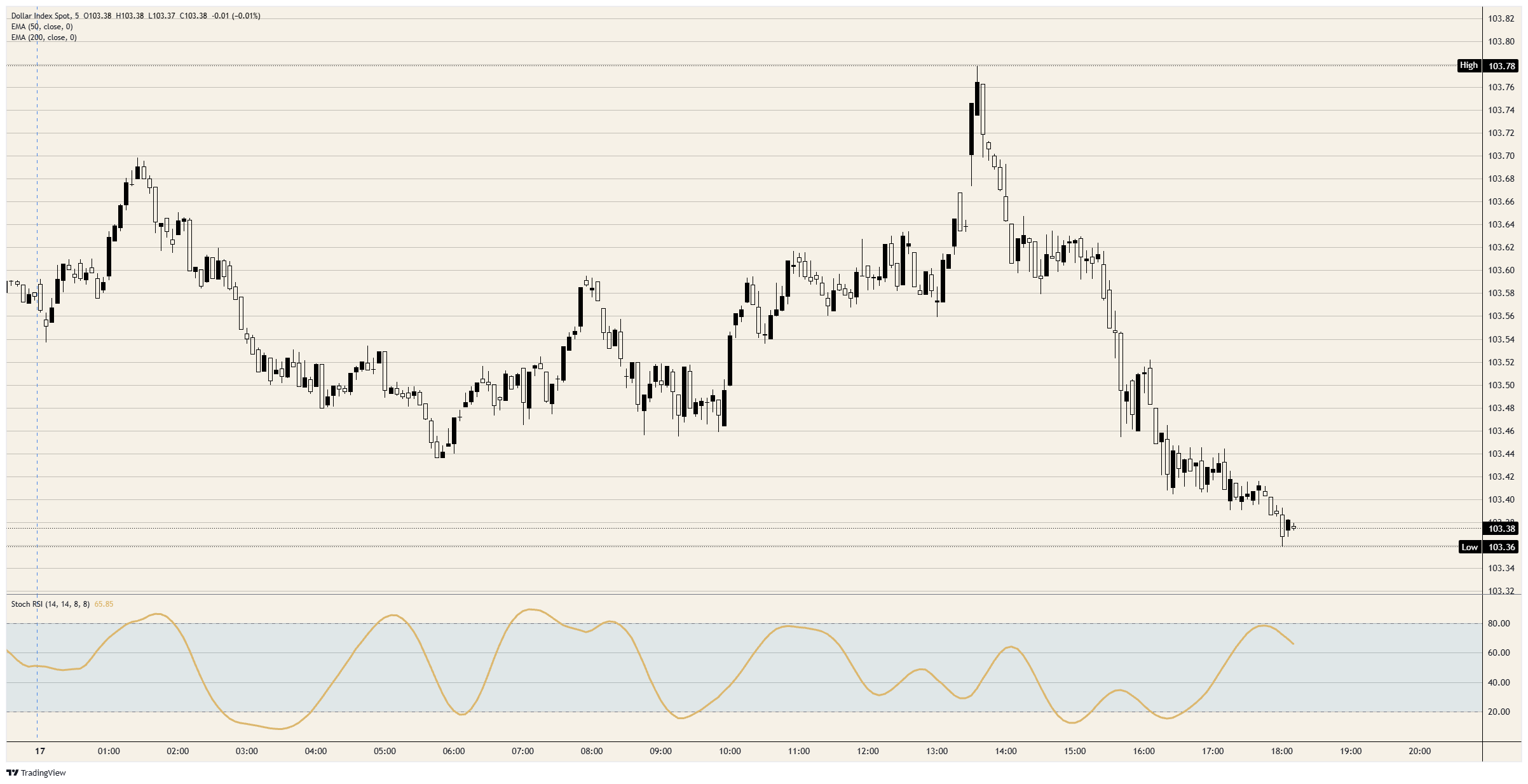
October retail sales briefly pushed the Dollar Index to just below 103.80, its highest level since April 2025. That 19-month high proved short-lived: the entire surge had unwound before the next release, industrial production. A further decline has since brought the index to around 103.40, leaving it on course to end a five-session run of gains.

A 0.2% increase in October retail sales masked a 0.6% rise in the control group, while the latter's September advance was revised higher to 0.5%. Import prices increased by 1.1% for the second consecutive month. With a December Fed rate rise already fully priced in and CME FedWatch putting the probability of a quarter-point move at close to 91%, the strong figures offered little additional support for the Dollar.
Following a 0.7% increase, industrial production contracted by 0.4% in October, while the homebuilder sentiment index declined from 29 to 25. Treasury yields surrendered their gains for the session, leaving the 10-year yield near 5.13%. The homebuilder reading marked the start of the Dollar's second leg lower. That decline persisted after Cleveland Fed President Hammack said inflation was heading in the wrong direction.
At 19:00 GMT on Wednesday, the Fed will release minutes from its 27–28 October meeting, at which it left its rate unchanged at 3.75%-4.00%. New York Fed President Williams is also due to speak on Wednesday. Thursday brings appearances by Cleveland Fed President Hammack, Chicago Fed President Goolsbee and Philadelphia Fed President Paulson. A rate rise on 9 December is already fully priced in, leaving scope for their remarks to influence expectations of a half-point increase, currently assigned a probability of around 9% by CME FedWatch.
Tuesday's corporate calendar includes results from Nvidia (NVDA) at 21:20 GMT. According to analysts at ING, losses in US technology shares have reached enough other equity markets to support safe-haven demand for the Dollar. Thursday's weekly jobless claims release is scheduled for 13:30 GMT.
Back within Monday's trading range, the index has retraced less than a fifth of its advance from the 10 November low near 101.50. It remains above the 14 October peak, just below 103.00, which it broke through on 12 November. The 50-day Exponential Moving Average (EMA) stands near 101.70, while the 200-day EMA is close to 100.40.
As well as being the official currency of the United States of America, the US Dollar (USD) serves as the ‘de facto’ currency in a significant number of other countries, circulating alongside their local banknotes. No other currency is traded more heavily worldwide. According to 2022 data, it accounts for more than 88% of global foreign exchange turnover, equivalent to average daily transactions of $6.6 trillion. The British Pound lost its position as the world's reserve currency to the USD after the Second World War. Gold backed the US Dollar for most of its history, until the Gold Standard ended with the Bretton Woods Agreement in 1971.
Monetary policy, set by the Federal Reserve (Fed), is the single most significant influence on the US Dollar's value. Price stability, meaning control of inflation, and full employment form the Fed's dual mandate. Adjustments to interest rates are its main means of pursuing those objectives. The Fed will increase rates when prices are climbing too rapidly and inflation exceeds its 2% target, supporting the USD. Conversely, inflation below 2% or an excessively high unemployment rate may prompt the Fed to cut interest rates, putting downward pressure on the Greenback.
Faced with extreme circumstances, the Federal Reserve may print additional Dollars and introduce quantitative easing (QE). Through QE, the Fed sharply expands the supply of credit in a financial system that has become blocked. This unconventional policy is used when credit has dried up as banks refuse to lend to one another for fear that a counterparty might default. It is a measure of last resort when interest-rate cuts alone are unlikely to deliver the required outcome. During the Great Financial Crisis in 2008, QE was the Fed's preferred response to the credit crunch. The process entails printing additional Dollars to purchase US government bonds, mainly from financial institutions. The US Dollar generally weakens as a result of QE.
Under quantitative tightening (QT), the reverse of QE, the Federal Reserve ceases purchases of bonds from financial institutions. It also refrains from using the principal repaid on maturing bond holdings to make new purchases. This process is generally supportive of the US Dollar.







Phone: +61 2 8036 8388
Fax: +61 2 8036 8388
Email: support@tmgm.com



The information provided on this website is of a general nature only and does not constitute personal financial advice. Before acting on any information on this website, you should consider the suitability of the information in relation to your objectives, financial situation and needs. Investing in CFDs and FX Margin Contracts carries significant risks and is not suitable for all investors. You may lose more than your initial deposit. You do not own, or have, any interest in the underlying asset. We recommend that you seek independent advice and ensure you fully understand the risks involved before trading. It is important that you read and consider the disclosure document before you acquire any product listed on the website. The information and advertisements offered on this website are not intended for use by any person in any country or jurisdiction where such use would be contrary to local laws and regulations. The Products and Services offered on this website are not intended for residents of the United States, Malaysia and Thailand.
TMGM is authorized and regulated in various jurisdictions.
Trademax Australia Limited, trading as TMGM, is regulated by the Australian Securities and Investments Commission (ASIC), AFSL no. 436416 and is located at Level 28, One International Tower, 100 Barangaroo Avenue, 2000 Sydney, NSW Australia.
Email: support@tmgm.com.au
Trademax Global Limited, trading as TMGM, is authorized and regulated by the Vanuatu Financial Services Commission (VFSC), registration number 40356 and registered at 1276, Kumul Highway, Port Vila, Vanuatu, Republic of Vanuatu.
Email: support@tmgm.com
Trademax Global Markets (SE) Limited, trading as TMGM, is authorized and regulated by the Financial Services Authority (FSA) of Seychelles, with license number SD224. The company is registered at Office No 13, Providence Estate ABIS Centre, Mahe, Seychelles.
Email: support@tmgm.com
Trademax Global Markets (International) Pty Ltd, trading as TMGM, is authorized and regulated by the Financial Services Commission, Mauritius (FSC) with license no. GB22201012, and registered at 33, Edith Cavell Street C/o IQ EQ Fund Services (Mauritius) Ltd Port Louis, 11324 Mauritius.
Email: support@tmgm.com
Copyright © TMGM. All rights reserved


