
News & AnalysisCareer

A fresh 19-month low near 1.0985 is reached by the Euro (EUR) against the US Dollar (USD) in Tuesday’s European session. Persistent pressure on the major currency pair reflects the US Dollar’s outperformance, underpinned by a marked rise in demand for the currency as a safe haven.

Having reached a fresh 19-month peak of 103.70 earlier in the day, the US Dollar Index (DXY) remains close to that level at the time of writing. The index tracks the Greenback against a basket of six major currencies.
The recent “drop in US tech stocks has done little to dent the Dollar’s strong momentum.” That is the assessment of analysts at ING, who attribute much of the resilience to the fact that “the sell-off has spilled over sufficiently into broader US and global equities for the Dollar to benefit from its safe-haven role.”
A renewed bout of pressure on AI-related stocks could nevertheless make it more difficult for the Dollar to extend its gains. ING cautions that “we still think further weakness in tech/AI stocks should make additional greenback appreciation less sustainable as it drives more dovish Fed repricing,” pointing to the potential limits to the currency’s current strength.
Next on investors’ agenda are October Retail Sales figures from the United States (US), due at 13:30 GMT, alongside the minutes of the Federal Open Market Committee (FOMC) October policy meeting, scheduled for release on Friday.
Setting out its expectations, ING says that “October US retail sales are due today. Expectations are for a slowdown from September, but still slightly positive MoM growth: 0.1% in the headline and 0.3% ex auto and gas. October industrial production is also expected at 0.1% MoM.” The bank nevertheless plays down the likely influence of the data on markets, observing that “these aren't tier-one releases, and equity market dynamics still have a greater chance of driving FX moves today.”
For the Euro, attention centres on November’s German ZEW Survey – Economic Sentiment release at 10:00 GMT. The key sentiment measure is forecast to rise to 29.0, compared with October’s reading of 28.1.
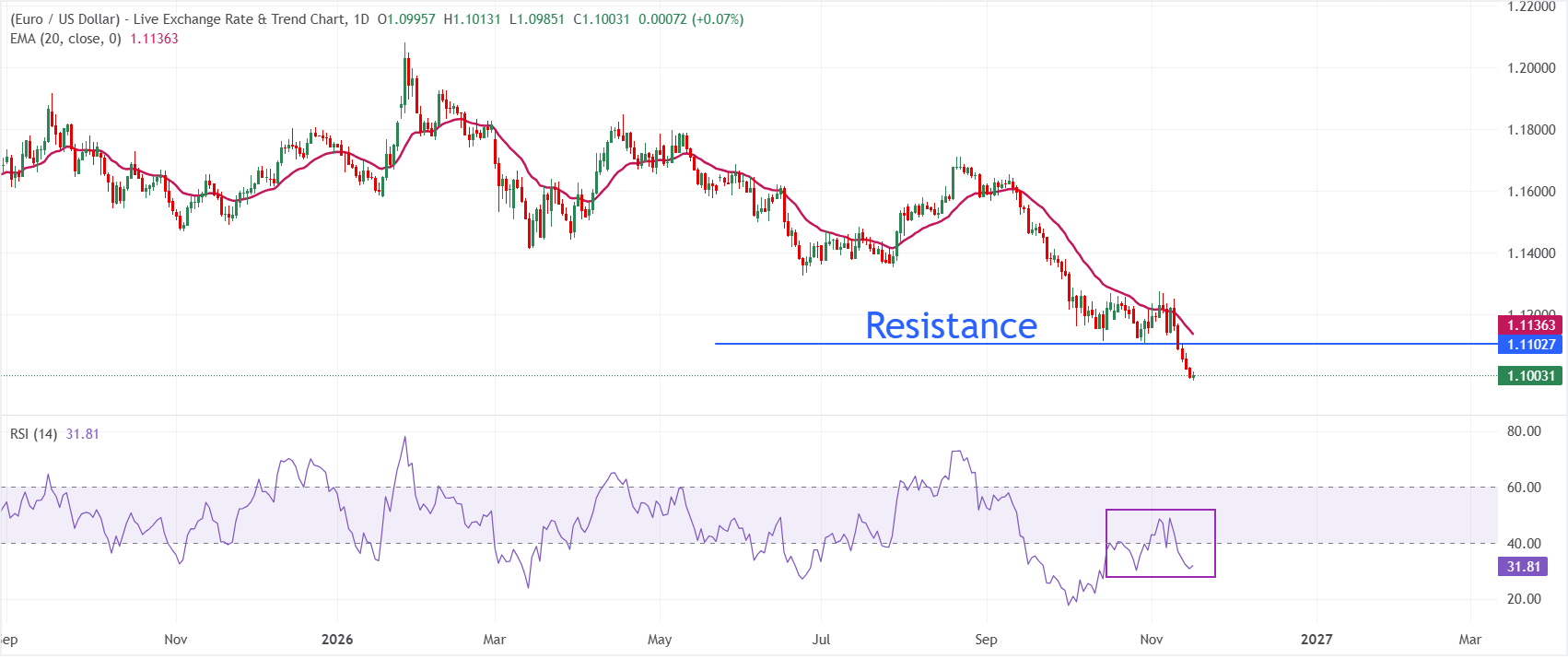
Trading at 1.1003 on the daily chart, EUR/USD retains a bearish near-term outlook below its 20-day exponential moving average (EMA) of 1.1136. With the pair firmly beneath this dynamic resistance, rebounds are likely to face limits as downward pressure continues. At 31.8, the Relative Strength Index (RSI) sits just above oversold territory. This suggests stretched conditions, though it does not yet point to a convincing recovery.
Any corrective rebound would first encounter resistance at the 20-day EMA of 1.1136. Should EUR/USD close above that level on a daily basis, the prevailing bearish bias would ease, allowing scope for a wider recovery. Without a move back above it, however, the balance of risks remains tilted towards further declines, despite the lack of clearly defined support levels nearby.
(The technical analysis of this story was written with the help of an AI tool. Know more.)
Published by the Zentrum für Europäische Wirtschaftsforschung, the Economic Sentiment indicator gauges institutional investor confidence. It captures the difference between the proportion of investors expressing optimism and the proportion of analysts expressing pessimism. An optimistic outlook is generally viewed as positive, or bullish, for the EUR; a pessimistic outlook is generally regarded as negative, or bearish.
Find out more.Forthcoming release: Tue 17 Nov 2026 10:00
Publication frequency: Monthly
Consensus forecast: 29
Previous reading: 28.1
Data source: ZEW - Leibniz Centre for European Economic Research







Phone: +61 2 8036 8388
Fax: +61 2 8036 8388
Email: support@tmgm.com



The information provided on this website is of a general nature only and does not constitute personal financial advice. Before acting on any information on this website, you should consider the suitability of the information in relation to your objectives, financial situation and needs. Investing in CFDs and FX Margin Contracts carries significant risks and is not suitable for all investors. You may lose more than your initial deposit. You do not own, or have, any interest in the underlying asset. We recommend that you seek independent advice and ensure you fully understand the risks involved before trading. It is important that you read and consider the disclosure document before you acquire any product listed on the website. The information and advertisements offered on this website are not intended for use by any person in any country or jurisdiction where such use would be contrary to local laws and regulations. The Products and Services offered on this website are not intended for residents of the United States, Malaysia and Thailand.
TMGM is authorized and regulated in various jurisdictions.
Trademax Australia Limited, trading as TMGM, is regulated by the Australian Securities and Investments Commission (ASIC), AFSL no. 436416 and is located at Level 28, One International Tower, 100 Barangaroo Avenue, 2000 Sydney, NSW Australia.
Email: support@tmgm.com.au
Trademax Global Limited, trading as TMGM, is authorized and regulated by the Vanuatu Financial Services Commission (VFSC), registration number 40356 and registered at 1276, Kumul Highway, Port Vila, Vanuatu, Republic of Vanuatu.
Email: support@tmgm.com
Trademax Global Markets (SE) Limited, trading as TMGM, is authorized and regulated by the Financial Services Authority (FSA) of Seychelles, with license number SD224. The company is registered at Office No 13, Providence Estate ABIS Centre, Mahe, Seychelles.
Email: support@tmgm.com
Trademax Global Markets (International) Pty Ltd, trading as TMGM, is authorized and regulated by the Financial Services Commission, Mauritius (FSC) with license no. GB22201012, and registered at 33, Edith Cavell Street C/o IQ EQ Fund Services (Mauritius) Ltd Port Louis, 11324 Mauritius.
Email: support@tmgm.com
Copyright © TMGM. All rights reserved


