
News & AnalysisCareer

The Euro (EUR) faces French-German yield spreads of 175 bps, close to the record reached during the 2011 crisis, while a firm Federal Reserve (Fed) adds to the pressure. Drawing on Italy's 2018 budget turmoil, Brown Brothers Harriman (BBH) warns that further spread widening could push EUR/USD down to 1.1000. Yet ING finds the pair notably resilient in the face of rising energy prices and France's unresolved budget crisis. It attributes that performance to a gradual reduction in large, concentrated positions in US technology shares and the US Dollar (USD). Taking a longer-term perspective, Commerzbank considers ECB Chief Economist Philip Lane's call for a greater international role for the Euro. Thu Lan Nguyen welcomes the potential improvement in monetary policy transmission but cautions that it would not ensure price stability.

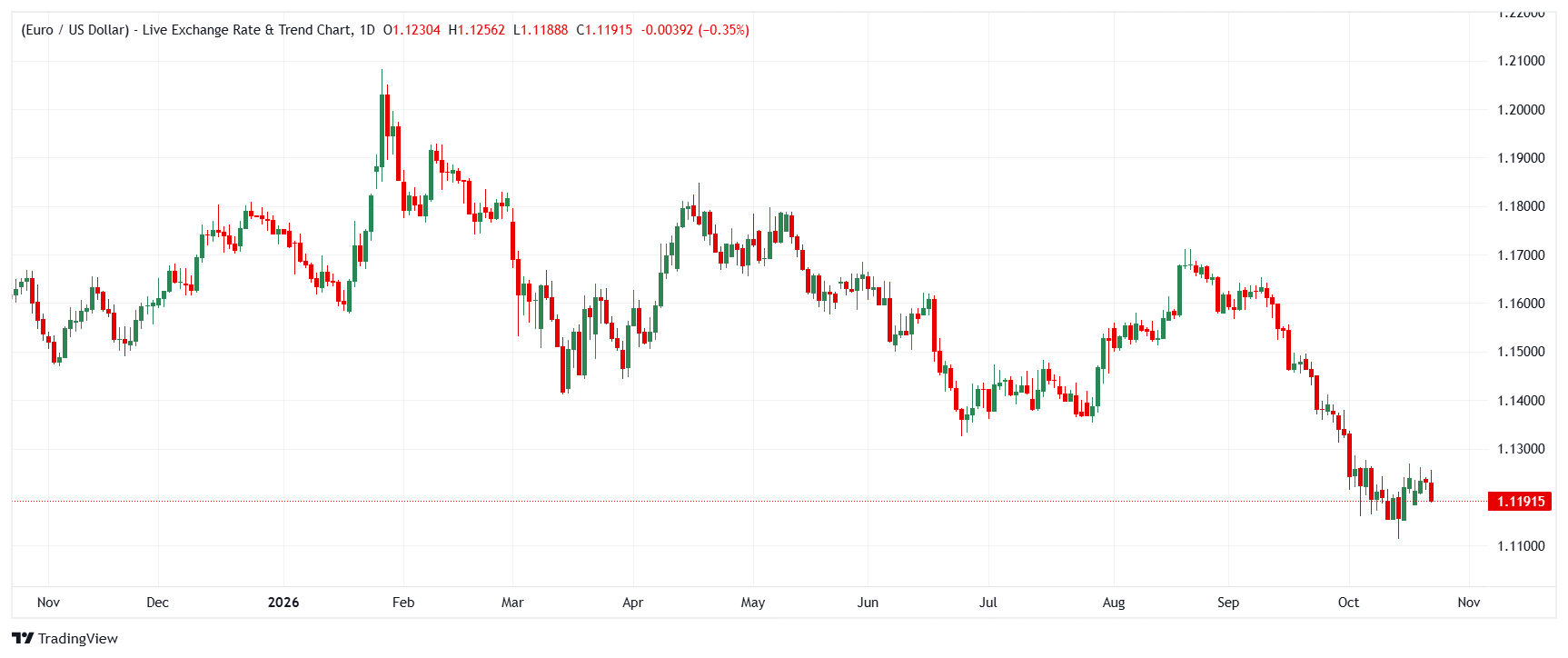
France's weakening public finances represent the principal threat to the Euro, according to Elias Haddad at BBH . At 175 bps, the premium on French 10-year government bond yields over their German counterparts is approaching the 2011 record of around 190 bps. Using Italy's 2018 experience as a guide, Haddad warns of a possible widening to about 250 bps, taking EUR/USD down to 1.1000. Several qualifications temper that comparison. The widening in France to date amounts to just over half Italy's 2018 peak, while concerns about a Euro exit remain subdued: the Sentix Euro breakup index was 2.4% in September, compared with around 13% during Italy's crisis. Spillover risks are also reduced by the ECB's Transmission Protection Instrument, which permits sovereign bond purchases subject to fiscal checks. A turning point could come with France's 2027 presidential election, provided it produces credible deficit reduction.
"French 10-year bond yield premium over Germany is up over 100bps since late February to 175bps, closing in on its 2011 record high of around 190bps. The spread can widen to about 250bps if Italy’s 2018 budget crisis is any guide and drag EUR/USD down to 1.1000."
With the ECB and Fed due to meet next week, Commerzbank analyst Thu Lan Nguyen examines the case made by ECB Chief Economist Philip Lane for wider international use of the single currency. Lane argues that this could support the ECB's price stability mandate: monetary policy would have a growing influence on overseas demand, strengthening its overall effect. More widespread Euro invoicing could also limit exchange rate pass-through, leaving the Euro area less exposed to external shocks. Nguyen nevertheless stresses the limits of that argument. Economic structure, fiscal policy and external shocks all help determine inflation, meaning that stronger monetary policy transmission cannot, by itself, protect credibility.
"A stronger role for the euro in the global financial system may improve monetary policy transmission, but it is certainly no panacea for price stability or monetary policy credibility."
Rather than French politics, the dominant market influence is the gradual unwinding of large, concentrated positions in US technology shares and the US Dollar, argues Chris Turner at ING . That adjustment helps explain EUR/USD's relatively firm performance despite more expensive energy and the continuing French budget impasse. ING maintains that expectations of further Fed tightening have held steady at around +75 bps in recent weeks. Those expectations could persist over the coming months, supporting the US Dollar and restricting the Euro's scope to rise. A setback in technology shares could, however, prompt a dovish repricing at the short end and a wider US Dollar correction. A move through 1.1270/75 could then clear the way to 1.1340/50, though Turner cautions that "we would not chase the rally." ING puts its one-month EUR/USD forecast at 1.13.
"Expect FX traders to keep a very close watch on the short end of the US curve now. Expectations for further Fed tightening have stayed rock-solid at around +75bp over recent weeks. We think that could remain the case for the coming months and that the dollar could stay strong."
Although all three banks place the main near-term influences on the Euro outside the currency market, their emphasis differs. For BBH, the most pronounced risk is to the downside. French spreads approaching the scale of Italy's 2018 episode (250 bps) would hasten EUR/USD's decline towards 1.1000, while France's 2027 election offers the only credible medium-term remedy. ING also sees restricted upside, but focuses on positioning. With expectations of Fed tightening firmly anchored around +75bps, it forecasts EUR/USD at 1.13 in one month. Its tail-risk scenario is a technology-led US Dollar correction that could bring 1.1340/50 into reach. Commerzbank instead concentrates on structural considerations: a more international Euro could improve monetary policy transmission, offering a modest longer-term benefit. Nguyen nevertheless rejects the idea that this would guarantee price stability or interest rate credibility.
Whether French yield spreads widen faster than US markets reprice will shape the Euro's near-term path. A rise in France's premium from 175 bps towards the ~250bps benchmark from Italy's 2018 episode would bring BBH's 1.1000 EUR/USD target into play as the risk scenario. Under ING's base case, firmly priced Fed tightening keeps the euro constrained at 1.13. A technology-led US Dollar correction could instead create scope for 1.1340/50, although ING does not regard that as a rally to chase. The French-German spread, next week's ECB and Fed meetings, and the Sentix Euro breakup index are the indicators to watch for confirmation of either direction. Commerzbank's broader caution also remains relevant: a greater global role for the euro is no replacement for the structural and fiscal influences that ultimately determine the ECB's battle with inflation.
(This article was created with the help of an Artificial Intelligence tool and reviewed by an editor. Learn more.)







Phone: +61 2 8036 8388
Fax: +61 2 8036 8388
Email: support@tmgm.com



The information provided on this website is of a general nature only and does not constitute personal financial advice. Before acting on any information on this website, you should consider the suitability of the information in relation to your objectives, financial situation and needs. Investing in CFDs and FX Margin Contracts carries significant risks and is not suitable for all investors. You may lose more than your initial deposit. You do not own, or have, any interest in the underlying asset. We recommend that you seek independent advice and ensure you fully understand the risks involved before trading. It is important that you read and consider the disclosure document before you acquire any product listed on the website. The information and advertisements offered on this website are not intended for use by any person in any country or jurisdiction where such use would be contrary to local laws and regulations. The Products and Services offered on this website are not intended for residents of the United States, Malaysia and Thailand.
TMGM is authorized and regulated in various jurisdictions.
Trademax Australia Limited, trading as TMGM, is regulated by the Australian Securities and Investments Commission (ASIC), AFSL no. 436416 and is located at Level 28, One International Tower, 100 Barangaroo Avenue, 2000 Sydney, NSW Australia.
Email: support@tmgm.com.au
Trademax Global Limited, trading as TMGM, is authorized and regulated by the Vanuatu Financial Services Commission (VFSC), registration number 40356 and registered at 1276, Kumul Highway, Port Vila, Vanuatu, Republic of Vanuatu.
Email: support@tmgm.com
Trademax Global Markets (SE) Limited, trading as TMGM, is authorized and regulated by the Financial Services Authority (FSA) of Seychelles, with license number SD224. The company is registered at Office No 13, Providence Estate ABIS Centre, Mahe, Seychelles.
Email: support@tmgm.com
Trademax Global Markets (International) Pty Ltd, trading as TMGM, is authorized and regulated by the Financial Services Commission, Mauritius (FSC) with license no. GB22201012, and registered at 33, Edith Cavell Street C/o IQ EQ Fund Services (Mauritius) Ltd Port Louis, 11324 Mauritius.
Email: support@tmgm.com
Copyright © TMGM. All rights reserved

