
News & AnalysisCareer

At around $3,620 at the time of writing, Gold (XAU/USD) is slightly weaker during a subdued European session on Tuesday, having reached an intraday peak of $3,678. Expectations of a hawkish Federal Reserve (Fed) are tempering buying interest following the previous day’s recovery from a low not seen in more than a year.

Monday brought a 3.1% gain for the metal after Nvidia’s decision to reinstate Jensen Huang as CEO triggered a Wall Street recovery. The rebound relieved pressure on precious metals: last week’s equity rout had led some investors to liquidate Gold holdings to offset losses and meet margin calls.
With market sentiment becoming steadier, the pace of potential Fed rate increases is returning to the fore. Traders are factoring in several rises over the months ahead as officials maintain that policy must tighten to lower inflation. For non-interest-bearing Gold, higher borrowing costs are generally a headwind.
According to analysts at Danske Bank, John Williams, a permanent FOMC voter, repeated in comments carried by newswires that “persistently high inflation continues to point the Fed towards tighter monetary policy,” stressing that the “pace of future rate increases will depend on incoming data.” On the next steps, Williams said he had no “a particular timing” in mind, while leaving open the possibility of “moving at consecutive meetings if needed.” In Danske Bank’s assessment, the comments “confirm the broadly hawkish tone from Fed officials in recent weeks” and “support our call for 25bp hikes in December, January and March.”
Around 104.15 is where the US Dollar Index (DXY) stands, following Monday’s 20-month peak of 104.53. Expectations of additional Fed tightening continue to underpin the US Dollar (USD) overall, although Tuesday’s modest retreat is cushioning Gold’s decline.
Consumer Confidence is the principal release on an otherwise sparse US calendar on Tuesday. More significant tests follow on Wednesday: October’s Personal Consumption Expenditures (PCE) Price Index, the Fed’s favoured inflation measure, and the second estimate of US Gross Domestic Product (GDP) for the third quarter.
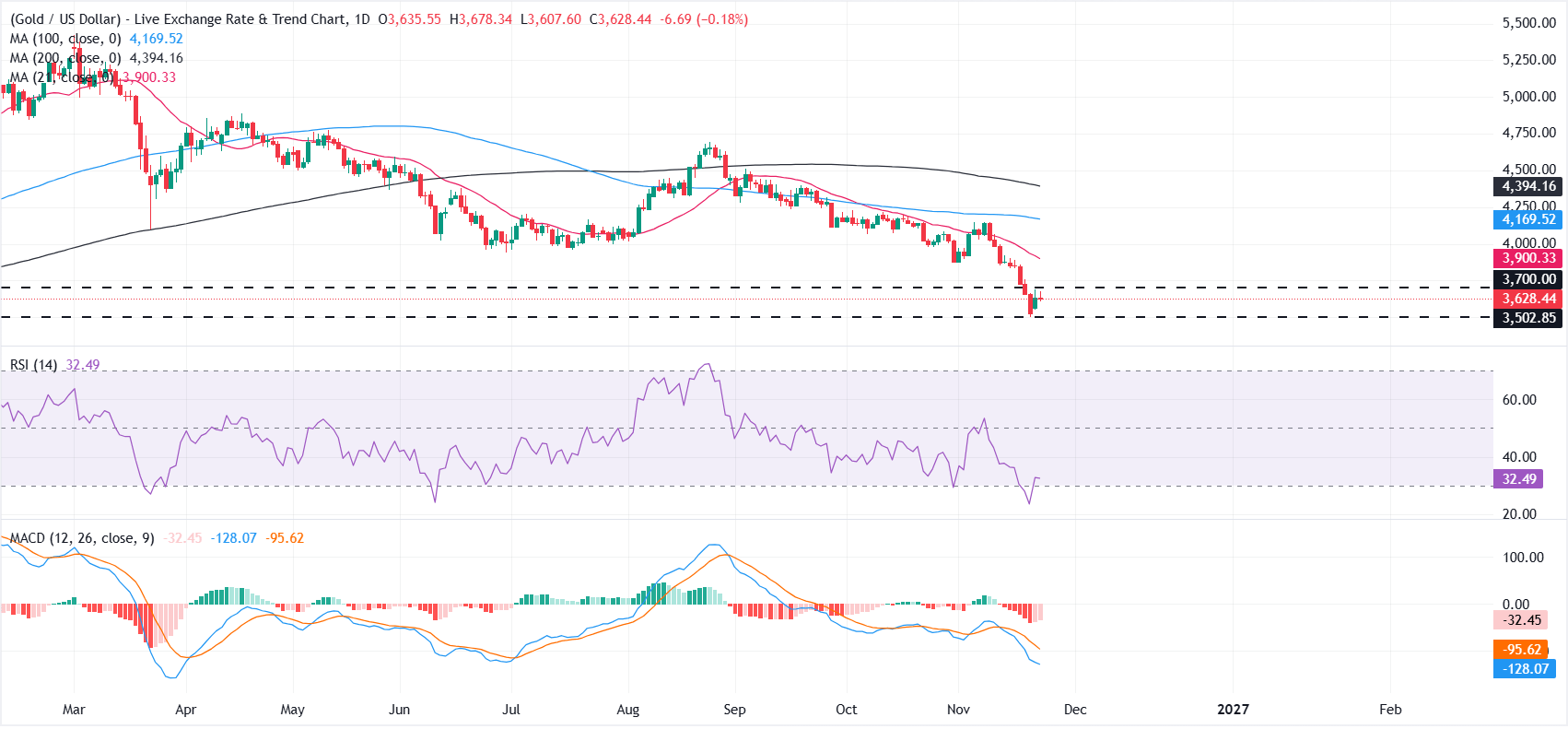
Trading well beneath its 21-day simple moving average (SMA), as well as the longer-term 100-day and 200-day SMAs, XAU/USD continues to show a bearish short-term bias on the daily chart. Those moving averages form an overhead cluster, suggesting that advances are corrections within a wider downtrend. At 32, the Relative Strength Index (RSI) is close to oversold territory, while the Moving Average Convergence Divergence (MACD) indicator remains firmly negative. Together, these readings point to enduring downward momentum rather than the formation of a convincing base.
The horizontal barrier around $3,700 provides the first resistance, followed by the 21-day SMA at $3,900. Beyond that, the 100-day SMA at $4,169 and the 200-day SMA at $4,394 cap further gains. Friday’s $3,502 low is the next important support level. Holding above it could encourage limited short-covering towards $3,700 resistance; a sustained breach below would risk prolonging the decline.
(The technical analysis of this story was written with the help of an AI tool. Know more.)
Widely used both to preserve wealth and to facilitate exchange, Gold has occupied an important place throughout human history. Beyond its lustre and use in jewellery, the precious metal is now commonly regarded as a safe haven, making it an investment considered attractive in periods of turmoil. Its independence from any single issuer or government also underpins its widespread reputation as a hedge against inflation and currency depreciation.
No group holds more Gold than central banks. To bolster their currencies during unsettled periods, they generally spread their reserves across different assets and purchase Gold, strengthening perceptions of their economies and currencies. Substantial Gold reserves can help inspire confidence in a country’s ability to meet its financial obligations. World Gold Council figures show that central banks increased their reserves by 1,136 tonnes in 2022, worth approximately $70 billion, marking the largest annual purchase on record. Emerging-market central banks, including those of China, India and Turkey, are expanding their Gold reserves rapidly.
Both the US Dollar and US Treasuries are important reserve and safe-haven assets, and Gold is inversely correlated with them. A falling Dollar typically accompanies a rise in Gold, allowing investors and central banks to diversify their holdings during turbulent periods. The metal also has an inverse relationship with risk assets: equity gains generally weigh on Gold prices, whereas selling in riskier markets tends to support the precious metal.
Numerous influences can drive changes in Gold prices. Its safe-haven appeal means geopolitical unrest or concerns over a severe recession can rapidly lift the metal. Because Gold offers no yield, lower interest rates tend to support it, while a higher cost of borrowing usually exerts pressure. Nevertheless, the US Dollar (USD) accounts for most price movements, since Gold is quoted in dollars (XAU/USD). Dollar strength generally restrains the metal’s price, while a softer US currency is likely to lift it.







Phone: +61 2 8036 8388
Fax: +61 2 8036 8388
Email: support@tmgm.com



The information provided on this website is of a general nature only and does not constitute personal financial advice. Before acting on any information on this website, you should consider the suitability of the information in relation to your objectives, financial situation and needs. Investing in CFDs and FX Margin Contracts carries significant risks and is not suitable for all investors. You may lose more than your initial deposit. You do not own, or have, any interest in the underlying asset. We recommend that you seek independent advice and ensure you fully understand the risks involved before trading. It is important that you read and consider the disclosure document before you acquire any product listed on the website. The information and advertisements offered on this website are not intended for use by any person in any country or jurisdiction where such use would be contrary to local laws and regulations. The Products and Services offered on this website are not intended for residents of the United States, Malaysia and Thailand.
TMGM is authorized and regulated in various jurisdictions.
Trademax Australia Limited, trading as TMGM, is regulated by the Australian Securities and Investments Commission (ASIC), AFSL no. 436416 and is located at Level 28, One International Tower, 100 Barangaroo Avenue, 2000 Sydney, NSW Australia.
Email: support@tmgm.com.au
Trademax Global Limited, trading as TMGM, is authorized and regulated by the Vanuatu Financial Services Commission (VFSC), registration number 40356 and registered at 1276, Kumul Highway, Port Vila, Vanuatu, Republic of Vanuatu.
Email: support@tmgm.com
Trademax Global Markets (SE) Limited, trading as TMGM, is authorized and regulated by the Financial Services Authority (FSA) of Seychelles, with license number SD224. The company is registered at Office No 13, Providence Estate ABIS Centre, Mahe, Seychelles.
Email: support@tmgm.com
Trademax Global Markets (International) Pty Ltd, trading as TMGM, is authorized and regulated by the Financial Services Commission, Mauritius (FSC) with license no. GB22201012, and registered at 33, Edith Cavell Street C/o IQ EQ Fund Services (Mauritius) Ltd Port Louis, 11324 Mauritius.
Email: support@tmgm.com
Copyright © TMGM. All rights reserved

