
News & AnalysisCareer

Having retested its seven-month low of 92.44, USD/INR recovers towards 92.95 on Monday. The rebound leaves the Indian Rupee (INR) struggling to build on the previous week’s advance against the US Dollar (USD).
Continued purchases of Indian equities by Foreign Institutional Investors (FIIs), despite the ongoing global Artificial Intelligence (AI) rout, keep the Indian Rupee’s prospects positive even as its rally pauses.

On every trading day in November so far, FIIs have been net buyers, adding holdings worth Rs. 1,11,949.39 crore.
Alongside India’s growing appeal during the global AI sell-off, stronger expectations of a near-term interest rate increase by the Reserve Bank of India (RBI) are helping to support the INR against its other peers.
A more difficult inflation environment in India is highlighted by Commerzbank analysts, who note that “inflation has breached the Reserve Bank of India’s (RBI) 6% upper threshold due to elevated cost pressures and higher food prices.” Against that backdrop, they argue that “RBI is expected to place greater attention on containing inflation risks in the coming year,” and forecast policymakers “to hike by 25 bps in December and by another 25-50 bps in H1 2027, taking the terminal repo rate to 6-6.25%.” In Commerzbank’s view, “higher interest rates should help anchor inflation expectations and support INR.”
At 56.3 in November, India’s HSBC Composite Purchasing Managers’ Index (PMI) exceeded October’s final reading of 56.2. Strong manufacturing activity drove the overall business expansion, with the Manufacturing PMI climbing from the previous reading of 54.7 to 56.0.
Services activity, by contrast, expanded more slowly: the Services PMI eased from 55.8 in October to 55.3.
Pranjul Bhandari, Chief India Economist at HSBC, said: "Manufacturing activity gathered momentum, with output and new orders accelerating. The increase in new orders was driven by stronger domestic demand, while new export orders moderated a bit. Services, by contrast, saw a softer performance despite a sharp rise in new export business. Input-cost inflation stayed subdued, while output-price inflation increased modestly supporting margins,"
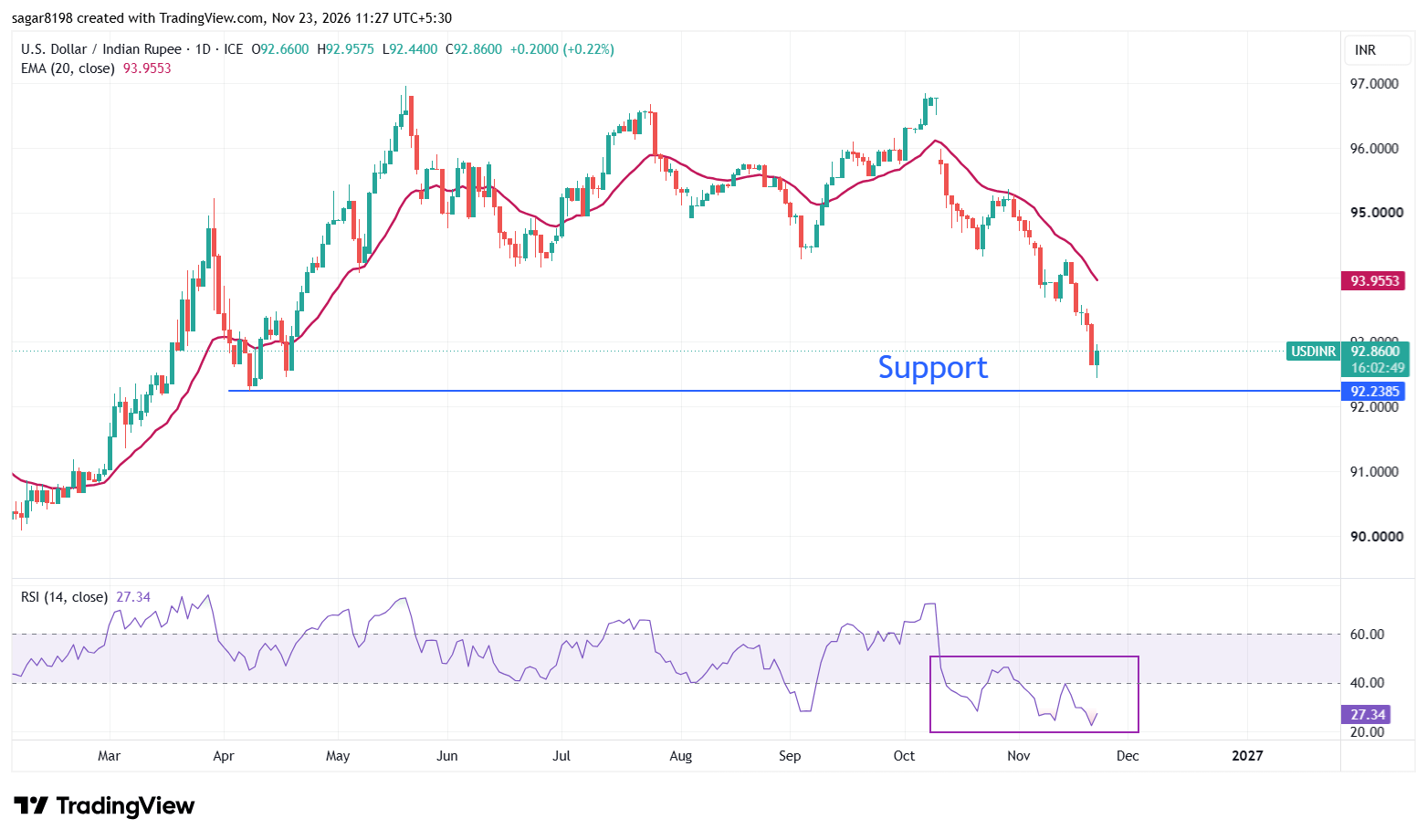
Trading at 92.95 on the daily chart, USD/INR continues to decline, with a distinctly bearish near-term outlook while spot remains well beneath the 20-day exponential moving average (EMA) of 93.95. That distance below the 20-day EMA underlines the downside bias. Meanwhile, a Relative Strength Index (14) reading of 27 points to deeply oversold conditions, which could curb immediate downward momentum but have not yet prompted a substantial recovery.
A daily close above the 20-day EMA, the first resistance level near 93.95, would be required to relieve the prevailing bearish pressure. On the downside, the April 8 low of 92.22 marks the major support level.
(The technical analysis of this story was written with the help of an AI tool. Know more.)
Published monthly by S&P Global and HSBC Bank, the Manufacturing Purchasing Managers’ Index (PMI) provides a leading gauge of activity in India’s manufacturing industry. Surveys of senior executives at private-sector businesses form the basis of the data. To compile the PMI, S&P Global uses questionnaire responses from survey panels comprising around 400 manufacturers and 400 service providers. Each panel is stratified by detailed sector and workforce size according to contributions to GDP. Ranging from 0 to 100, the index signals no change from the preceding month at 50.0. Readings above 50 suggest that manufacturing activity is generally expanding, a positive signal for the Indian Rupee (INR). Conversely, readings below 50 indicate a broad contraction in activity among goods producers and are regarded as negative for INR.
Find out more.Latest release: Mon 23 Nov 2026 05:00 (Prel)
Release frequency: Monthly
Reported figure: 56
Market consensus: -
Previous reading: 54.7
Data source: S&P Global







Phone: +61 2 8036 8388
Fax: +61 2 8036 8388
Email: support@tmgm.com



The information provided on this website is of a general nature only and does not constitute personal financial advice. Before acting on any information on this website, you should consider the suitability of the information in relation to your objectives, financial situation and needs. Investing in CFDs and FX Margin Contracts carries significant risks and is not suitable for all investors. You may lose more than your initial deposit. You do not own, or have, any interest in the underlying asset. We recommend that you seek independent advice and ensure you fully understand the risks involved before trading. It is important that you read and consider the disclosure document before you acquire any product listed on the website. The information and advertisements offered on this website are not intended for use by any person in any country or jurisdiction where such use would be contrary to local laws and regulations. The Products and Services offered on this website are not intended for residents of the United States, Malaysia and Thailand.
TMGM is authorized and regulated in various jurisdictions.
Trademax Australia Limited, trading as TMGM, is regulated by the Australian Securities and Investments Commission (ASIC), AFSL no. 436416 and is located at Level 28, One International Tower, 100 Barangaroo Avenue, 2000 Sydney, NSW Australia.
Email: support@tmgm.com.au
Trademax Global Limited, trading as TMGM, is authorized and regulated by the Vanuatu Financial Services Commission (VFSC), registration number 40356 and registered at 1276, Kumul Highway, Port Vila, Vanuatu, Republic of Vanuatu.
Email: support@tmgm.com
Trademax Global Markets (SE) Limited, trading as TMGM, is authorized and regulated by the Financial Services Authority (FSA) of Seychelles, with license number SD224. The company is registered at Office No 13, Providence Estate ABIS Centre, Mahe, Seychelles.
Email: support@tmgm.com
Trademax Global Markets (International) Pty Ltd, trading as TMGM, is authorized and regulated by the Financial Services Commission, Mauritius (FSC) with license no. GB22201012, and registered at 33, Edith Cavell Street C/o IQ EQ Fund Services (Mauritius) Ltd Port Louis, 11324 Mauritius.
Email: support@tmgm.com
Copyright © TMGM. All rights reserved


