
News & AnalysisCareer

A fresh seven-month low of 92.50 in USD/INR marks the Indian Rupee’s (INR) renewed advance against the US Dollar (USD) on Wednesday, following a brief pause. Steady foreign capital inflows into Indian equities continue to bolster India’s foreign exchange reserves.

Foreign Institutional Investors (FIIs) have added holdings worth Rs. 1,17,622.38 crore so far in November, remaining net buyers on every full trading day.
Following the victory of United States (US) Democrats in the midterm elections, concerns about the viability of hyperscalers’ AI infrastructure spending plans prompted financial markets to look beyond the global Artificial Intelligence (AI) trade. Against that backdrop, overseas investor interest has grown considerably in recent weeks.
The resignation of Nvidia CEO Jensen Huang added to the unwinding of the global AI trade last week. His unexpected reinstatement, however, has renewed appetite for AI-related shares.
Highlighting the remarkable developments at Nvidia, Danske Bank analysts note that the company "reinstated Jensen Huang as CEO, less than a week after the board had ruled out his return." According to the analysts, the board "said it had received input from 'senior levels' of the US government and saw no national security risk," and "President Trump said he had personally convinced the board."
Describing Monday’s market response, Danske Bank says "the stunning reversal sent Nvidia shares 31.5% higher on Monday and lifted the broader market, with S&P 500 up 4.7% and the Nasdaq up 6.9%."
Asian markets also shared in the AI-led gains. Danske Bank notes that "the AI trade is carrying through to Asia on Tuesday, with Taiwan up 9% and South Korea up 7%."
Despite the rebound, Danske Bank warns that Nvidia "still faces SEC and Justice Department investigations over issues ranging from potential accounting irregularities to alleged chip smuggling," adding that "senior Democrats have also pledged to investigate the matter once they take control of Congress in January."
Doubts about whether the reversal in the AI trade can endure also prompted a correction in the NASDAQ on Tuesday, particularly in Nvidia shares.
The INR’s prospects therefore appear to depend heavily on the durability of the global AI trade reversal, which could draw foreign capital back into AI-related investments.
October’s US Personal Consumption Expenditure (PCE) Price Index, due at 13:30 GMT on Wednesday, will be a key focus for investors.
Persistent price pressures are likely to be evident in the figures, according to Commerzbank, which says “the inflation rate… expected to rise to 3.8% in October, and even without food and energy prices, the inflation rate is expected to be too high at 3.2%.”
The Federal Reserve’s (Fed) monetary policy outlook is expected to be significantly influenced by the US PCE inflation figures.
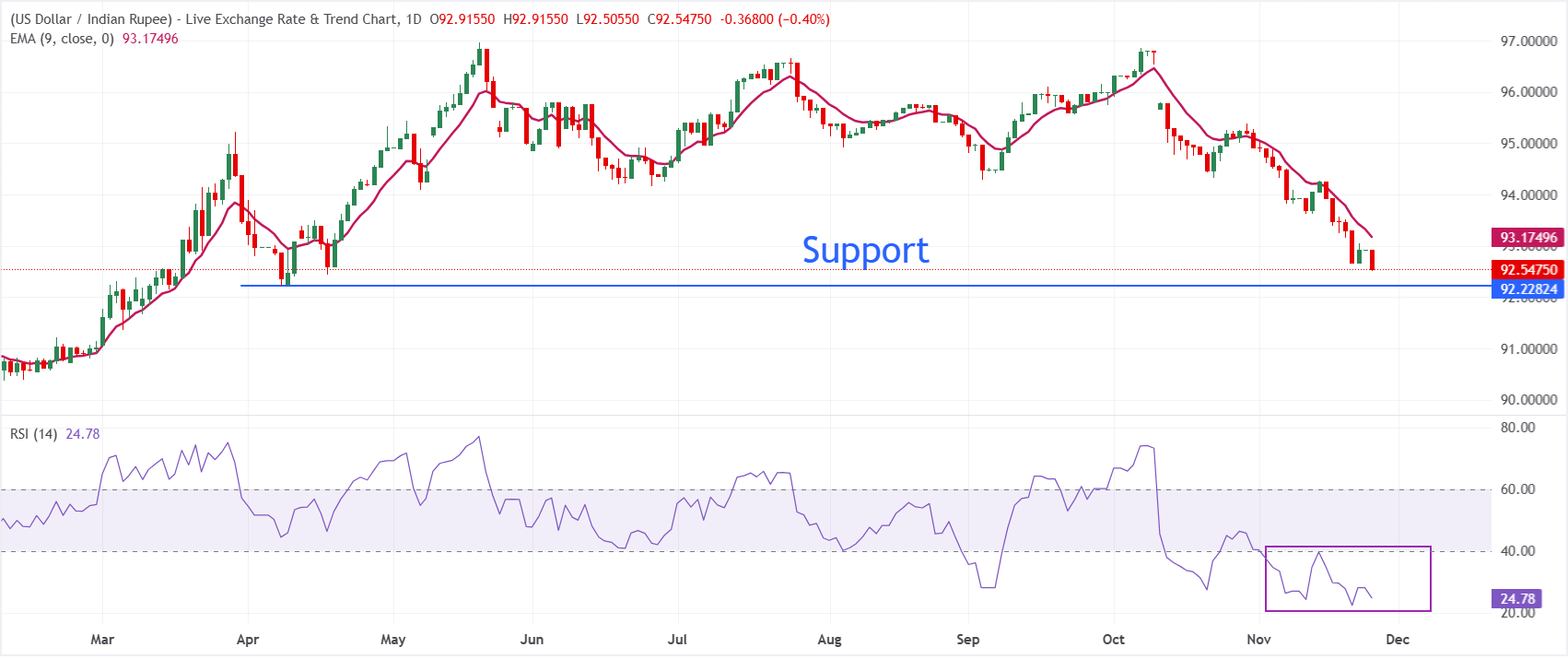
At 92.54 on the daily chart, USD/INR remains below the 9-period exponential moving average (EMA) of 93.18, maintaining a bearish near-term outlook. A continued gradual decline beneath this short-term trend gauge keeps the pair under pressure. Meanwhile, the Relative Strength Index (RSI) stands at 24.78 in oversold territory, suggesting that downward momentum is stretched despite the persistently weak broader tone.
For immediate selling pressure to ease, the pair would need to regain the 9-day EMA at 93.18, which provides initial resistance and restrains recovery attempts. On the downside, key support lies at the April 8 low of 92.22.
(The technical analysis of this story was written with the help of an AI tool. Know more.)
External developments have a particularly strong influence on the Indian Rupee (INR). Important drivers include Crude Oil prices, given India’s heavy reliance on imported Oil, and the US Dollar’s value, as most trade is settled in USD. The scale of foreign investment also matters. Domestically, both the interest rates set by the Reserve Bank of India (RBI) and its direct intervention in foreign exchange markets to stabilise the exchange rate play a major role.
To facilitate trade, the Reserve Bank of India (RBI) intervenes actively in foreign exchange markets to support exchange rate stability. It also adjusts interest rates in pursuit of its 4% inflation target. Rate increases tend to support the Rupee through the ‘carry trade’: investors borrow in countries where rates are lower and invest the proceeds in countries offering relatively higher rates, seeking to profit from the difference.
Inflation, interest rates, economic growth (GDP), the trade balance and foreign investment inflows all help determine the Rupee’s value. Faster growth can attract additional overseas investment and thereby increase demand for the currency, while a narrowing trade deficit will eventually strengthen it. Higher interest rates are another supportive factor, particularly when measured in real terms, after subtracting inflation. When investors are willing to take on more risk, larger inflows of Foreign Direct and Indirect Investment (FDI and FII) can also benefit the Rupee.
As a reflection of devaluation caused by oversupply, higher inflation generally weighs on the Rupee, especially when it exceeds inflation in India’s peer economies. By making exports more expensive, inflation also leads to more Rupees being sold to buy foreign imports, adding pressure on the currency. However, rising inflation typically prompts the Reserve Bank of India (RBI) to increase interest rates. That response can support the Rupee by attracting greater demand from international investors. Lower inflation has the reverse effect.







Phone: +61 2 8036 8388
Fax: +61 2 8036 8388
Email: support@tmgm.com



The information provided on this website is of a general nature only and does not constitute personal financial advice. Before acting on any information on this website, you should consider the suitability of the information in relation to your objectives, financial situation and needs. Investing in CFDs and FX Margin Contracts carries significant risks and is not suitable for all investors. You may lose more than your initial deposit. You do not own, or have, any interest in the underlying asset. We recommend that you seek independent advice and ensure you fully understand the risks involved before trading. It is important that you read and consider the disclosure document before you acquire any product listed on the website. The information and advertisements offered on this website are not intended for use by any person in any country or jurisdiction where such use would be contrary to local laws and regulations. The Products and Services offered on this website are not intended for residents of the United States, Malaysia and Thailand.
TMGM is authorized and regulated in various jurisdictions.
Trademax Australia Limited, trading as TMGM, is regulated by the Australian Securities and Investments Commission (ASIC), AFSL no. 436416 and is located at Level 28, One International Tower, 100 Barangaroo Avenue, 2000 Sydney, NSW Australia.
Email: support@tmgm.com.au
Trademax Global Limited, trading as TMGM, is authorized and regulated by the Vanuatu Financial Services Commission (VFSC), registration number 40356 and registered at 1276, Kumul Highway, Port Vila, Vanuatu, Republic of Vanuatu.
Email: support@tmgm.com
Trademax Global Markets (SE) Limited, trading as TMGM, is authorized and regulated by the Financial Services Authority (FSA) of Seychelles, with license number SD224. The company is registered at Office No 13, Providence Estate ABIS Centre, Mahe, Seychelles.
Email: support@tmgm.com
Trademax Global Markets (International) Pty Ltd, trading as TMGM, is authorized and regulated by the Financial Services Commission, Mauritius (FSC) with license no. GB22201012, and registered at 33, Edith Cavell Street C/o IQ EQ Fund Services (Mauritius) Ltd Port Louis, 11324 Mauritius.
Email: support@tmgm.com
Copyright © TMGM. All rights reserved


