
News & AnalysisCareer

A fresh six-week low near 96.30 marks Wednesday’s trading in USD/INR as the US Dollar (USD) continues to underperform. Following the previous day’s holiday, the Indian Rupee (INR) opens sharply stronger against the Dollar.
At around 101.77 at the time of writing, the US Dollar Index (DXY) is little changed. The index, which measures the Greenback against six major currencies, nevertheless remains near the almost three-week low of 101.50 recorded the day before.

Weakness in United States (US) Artificial Intelligence (AI)-related shares, alongside a correction in US bond yields as Federal Reserve (Fed) expectations are repriced, has weighed on the US Dollar. Market participants expect these headwinds to drive further losses in the currency.
Citing last week’s “heavy net losses for the DXY”, Scotiabank strategists argue that “broad USD weakness looks poised to extend in the short run as markets reassess near-term Fed tightening risks,” and that the “Sep/Oct rally in the index is poised to correct or reverse, potentially towards the 100.80/101.30 area at least.” The strategists also warn that “a deeper shake out in tech stocks could become a further headwind for the USD, given the dominance of the AI build out in the US growth/inflation narrative,” indicating that fresh weakness in the sector may add to the Dollar’s existing downtrend.
An unchanged interest rate decision at the Fed’s policy meeting later this month is now almost certain, according to the CME FedWatch tool. By contrast, a month earlier the tool indicated a meaningful probability of a rate increase at the October meeting too. After several officials signalled that another rate rise was not urgent, traders scaled back their hawkish Fed expectations.
A “multi-layered defence strategy to support the rupee this year” has been adopted by the Reserve Bank of India (RBI), according to economists at DBS Group Research. They describe a combination of “outright intervention in spot/forwards, regulatory action, liquidity steps, administrative measures and moves to curb import-related dollar demand.” DBS believes the authorities are “likely not done yet and remain ready to take further action, as required,” a resolve reinforced by RBI Governor Malhotra in a recent interview: “The RBI is determined to do whatever is necessary to ensure orderly movement in the foreign exchange market.”
Despite those measures, several headwinds leave DBS sceptical about a sustained rise in the INR. Assessing recent policy efforts to support the Rupee, DBS states that “we see limited room for sustained INR appreciation on grounds of manufacturing/trade competitiveness.” The economists also flag the currency’s “high sensitivity to oil price movements and risk sentiments.” In their view, “a challenging portfolio flows outlook leaves the door open to further gradual rupee depreciation subject to global developments,”
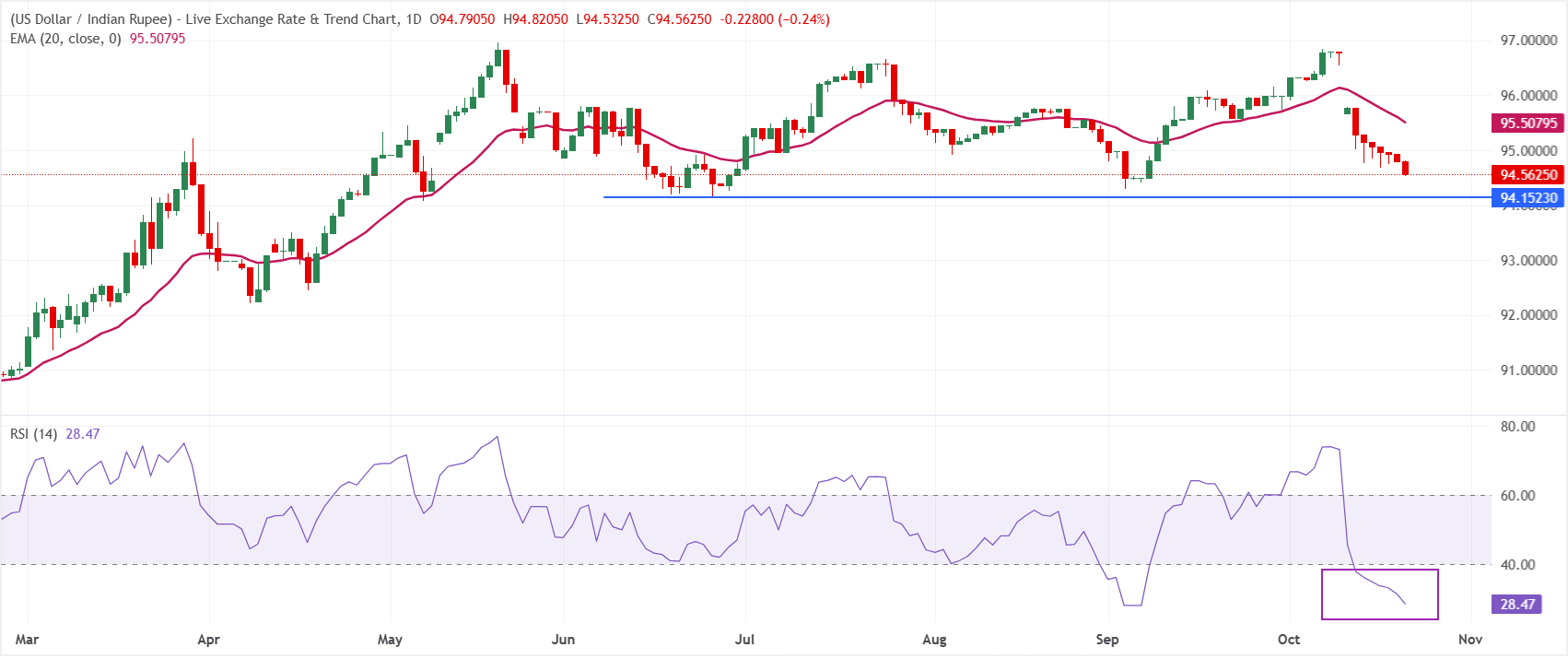
With USD/INR trading at 94.5625 on the daily chart, the near-term outlook remains bearish: spot is well beneath the 20-period Exponential Moving Average (EMA) of 95.5079. A sharp retreat from recent highs has taken the Relative Strength Index (RSI) to an oversold reading of 28.47. Rather than signalling a clear recovery, however, the indicator merely suggests that the decline is stretched, with overhead trend resistance still limiting price action.
Any rebound is likely to encounter fresh selling at the first resistance area, the 20-period EMA near 95.51. Although no distinct price-based support has emerged near current levels, an oversold RSI around 28 indicates that sellers could begin to lose conviction if the pair falls further. Stabilisation above 94.56 would be needed to lessen the risk of a prolonged decline.
(The technical analysis of this story was written with the help of an AI tool. Know more.)
External developments have a particularly strong influence on the Indian Rupee (INR), making it one of the currencies most sensitive to such factors. Key drivers include Crude Oil prices, given India’s heavy reliance on imported Oil; the US Dollar’s value, as most trade is denominated in USD; and foreign investment levels. The Rupee is also strongly influenced by the interest rates set by the Reserve Bank of India (RBI) and its direct intervention in FX markets to stabilise the exchange rate.
To facilitate trade, the Reserve Bank of India (RBI) intervenes actively in foreign exchange markets with the aim of keeping the exchange rate stable. Interest rate adjustments are another policy tool, used to keep inflation at its 4% target. The Rupee typically benefits from higher interest rates because of the ‘carry trade’: investors borrow in countries where rates are lower and invest in those offering relatively higher rates, earning the difference.
Inflation, interest rates, economic growth (GDP), the trade balance and foreign investment inflows all help determine the Rupee’s value. Faster growth can attract additional overseas investment and thereby increase demand for the currency, while a narrowing trade deficit will ultimately strengthen it. Higher interest rates are supportive too, particularly real rates, which are interest rates adjusted for inflation. Greater appetite for risk can encourage inflows of Foreign Direct and Indirect Investment (FDI and FII), providing further support for the Rupee.
When inflation is high, especially relative to India’s peers, the currency generally suffers because this reflects a loss of value through oversupply. Rising inflation also makes exports more expensive and results in more Rupees being sold to pay for foreign imports, another negative for the currency. However, it usually prompts the Reserve Bank of India (RBI) to raise interest rates, which can support the Rupee by attracting greater demand from international investors. Lower inflation has the reverse effect.







Phone: +61 2 8036 8388
Fax: +61 2 8036 8388
Email: support@tmgm.com



The information provided on this website is of a general nature only and does not constitute personal financial advice. Before acting on any information on this website, you should consider the suitability of the information in relation to your objectives, financial situation and needs. Investing in CFDs and FX Margin Contracts carries significant risks and is not suitable for all investors. You may lose more than your initial deposit. You do not own, or have, any interest in the underlying asset. We recommend that you seek independent advice and ensure you fully understand the risks involved before trading. It is important that you read and consider the disclosure document before you acquire any product listed on the website. The information and advertisements offered on this website are not intended for use by any person in any country or jurisdiction where such use would be contrary to local laws and regulations. The Products and Services offered on this website are not intended for residents of the United States, Malaysia and Thailand.
TMGM is authorized and regulated in various jurisdictions.
Trademax Australia Limited, trading as TMGM, is regulated by the Australian Securities and Investments Commission (ASIC), AFSL no. 436416 and is located at Level 28, One International Tower, 100 Barangaroo Avenue, 2000 Sydney, NSW Australia.
Email: support@tmgm.com.au
Trademax Global Limited, trading as TMGM, is authorized and regulated by the Vanuatu Financial Services Commission (VFSC), registration number 40356 and registered at 1276, Kumul Highway, Port Vila, Vanuatu, Republic of Vanuatu.
Email: support@tmgm.com
Trademax Global Markets (SE) Limited, trading as TMGM, is authorized and regulated by the Financial Services Authority (FSA) of Seychelles, with license number SD224. The company is registered at Office No 13, Providence Estate ABIS Centre, Mahe, Seychelles.
Email: support@tmgm.com
Trademax Global Markets (International) Pty Ltd, trading as TMGM, is authorized and regulated by the Financial Services Commission, Mauritius (FSC) with license no. GB22201012, and registered at 33, Edith Cavell Street C/o IQ EQ Fund Services (Mauritius) Ltd Port Louis, 11324 Mauritius.
Email: support@tmgm.com
Copyright © TMGM. All rights reserved


