
News & AnalysisCareer

At nearly 95.22, USD/INR edges higher in Tuesday’s opening trading. The Indian Rupee (INR) is once again losing ground against the US Dollar (USD), with elevated oil prices sustaining substantial demand for US Dollars.
A decline of 1.24% leaves the MCX Crude Oil contract expiring on 19 November trading near Rs. 9,600 at the time of writing. Nevertheless, it remains close to its recent highs of Rs. 9,828.

When oil prices are high, currencies of economies heavily dependent on imported oil for their energy needs, such as India, typically underperform.
Reports that Iran, Saudi Arabia, Pakistan, and Turkey have agreed to pursue further security talks and strengthen regional cooperation have eased concerns about Middle East conflicts spreading. Oil prices have consequently pulled back from their recent highs.
High-level talks in Tehran involving Saudi Arabia, Pakistan, and Turkey were aimed at representing the Mecca Joint Defence Agreement, the Islamic Republic of Iran Broadcasting (IRIB) reported on Monday. Under the agreement, the four countries committed to continuing dialogue and consultations, particularly on regional peace, security and stability.
The outlook for oil prices nonetheless retains a bullish bias, supported by concerns that the United States (US) and Israel could restart attacks on Iran following their respective elections.
Washington’s political rhetoric is increasing the region’s vulnerability to higher energy costs, analysts at MUFG/BTMU warn. With US President Trump "hinting at renewed military action against Iran after the US midterm elections," they caution that any "renewed escalation that pushes crude materially higher would amplify the adverse terms-of-trade and inflation shock for the region’s net energy importers and those with current account deficits." Asian economies are therefore particularly vulnerable to another surge in oil prices arising from Middle East risk.
Following several days of uninterrupted depreciation in the Indian currency against the US Dollar, financial markets anticipate that the Reserve Bank of India (RBI) will step in soon.
Traders identify 95.30 as a crucial level, citing the RBI’s more aggressive intervention around that point, according to a Reuters report. They said a sustained break could leave the rupee vulnerable to a steeper fall towards 96 per dollar.
Wednesday’s monetary policy announcement from the Federal Reserve (Fed) is set to be the main catalyst for global markets this week.
Little change to the formal communiqué is expected at the forthcoming Fed decision, according to economists at Deutsche Bank. They note that “the statement itself [is] to contain only limited changes, although dissents to a hold are possible.” Instead, they argue, “the interest will therefore be in Chair Warsh’s press conference and how the Fed balances still-elevated inflation and solid growth against the recent tightening in financial conditions,” as markets are likely to examine his comments closely for any change in the policy narrative.
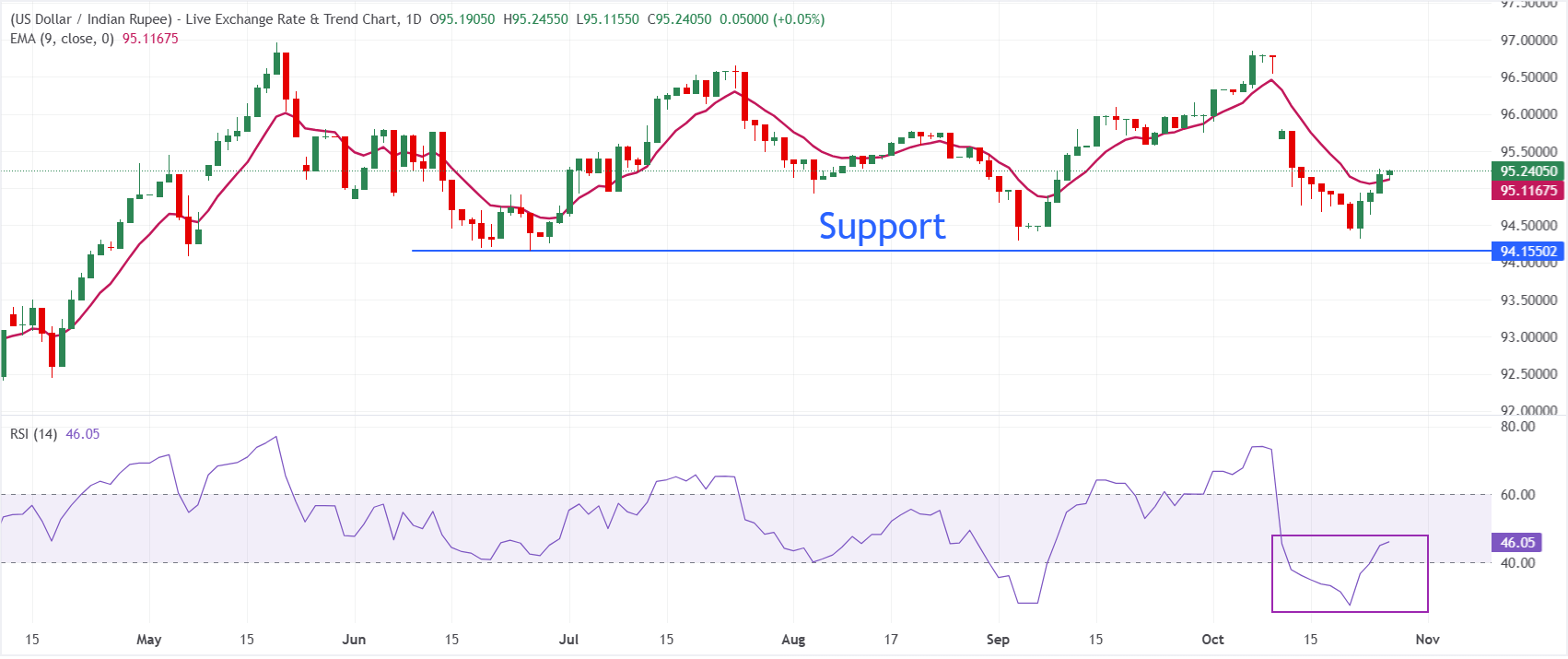
At 95.2405 on the daily chart, USD/INR remains marginally above its 9-period exponential moving average (EMA) of 95.1168, the immediate source of short-term support. Having pulled back from the mid-96s reached earlier in the month, the pair shows signs of fading bullish momentum. The Relative Strength Index (RSI), at 46.05 and below the 50 threshold, points to consolidation or a mild corrective bias rather than a pronounced directional move.
Traders will initially look to the 9-period EMA at 95.12 for downside support. A sustained breach would leave scope for further losses towards the 25 June low of 94.16. Resistance, meanwhile, is centred on the 12 October high at 95.80, which represents a key hurdle.
(The technical analysis of this story was written with the help of an AI tool. Know more.)
External developments have a particularly strong influence on the Indian Rupee (INR). Important drivers include Crude Oil prices, given India’s heavy reliance on imported Oil, foreign investment levels and the value of the US Dollar, as most trade is denominated in USD. The Rupee is also significantly affected by the interest rates set by the Reserve Bank of India (RBI) and its direct intervention in FX markets to stabilise the exchange rate.
To support trade, the Reserve Bank of India (RBI) intervenes actively in foreign exchange markets to keep the exchange rate stable. It also adjusts interest rates in an effort to maintain inflation at its 4% target. An increase in interest rates generally supports the Rupee through the ‘carry trade’: investors borrow in countries where rates are lower and invest the proceeds in countries offering relatively higher rates, profiting from the difference.
Inflation, interest rates, economic growth (GDP), the trade balance and foreign investment inflows all help determine the Rupee’s value. Faster growth can attract additional overseas investment and increase demand for the currency, while a narrowing trade deficit will eventually strengthen it. Higher interest rates are also supportive, particularly real rates, which are interest rates less inflation. Greater appetite for risk can encourage inflows of Foreign Direct and Indirect Investment (FDI and FII), providing further support for the Rupee.
Inflation generally weighs on the Rupee, especially when it exceeds that of India’s peers, because it reflects devaluation caused by oversupply. By raising export costs, inflation also results in more Rupees being sold to pay for foreign imports, putting further pressure on the currency. However, higher inflation usually prompts the Reserve Bank of India (RBI) to increase interest rates. This can support the Rupee by attracting greater demand from international investors. Lower inflation has the opposite effect.







Phone: +61 2 8036 8388
Fax: +61 2 8036 8388
Email: support@tmgm.com



The information provided on this website is of a general nature only and does not constitute personal financial advice. Before acting on any information on this website, you should consider the suitability of the information in relation to your objectives, financial situation and needs. Investing in CFDs and FX Margin Contracts carries significant risks and is not suitable for all investors. You may lose more than your initial deposit. You do not own, or have, any interest in the underlying asset. We recommend that you seek independent advice and ensure you fully understand the risks involved before trading. It is important that you read and consider the disclosure document before you acquire any product listed on the website. The information and advertisements offered on this website are not intended for use by any person in any country or jurisdiction where such use would be contrary to local laws and regulations. The Products and Services offered on this website are not intended for residents of the United States, Malaysia and Thailand.
TMGM is authorized and regulated in various jurisdictions.
Trademax Australia Limited, trading as TMGM, is regulated by the Australian Securities and Investments Commission (ASIC), AFSL no. 436416 and is located at Level 28, One International Tower, 100 Barangaroo Avenue, 2000 Sydney, NSW Australia.
Email: support@tmgm.com.au
Trademax Global Limited, trading as TMGM, is authorized and regulated by the Vanuatu Financial Services Commission (VFSC), registration number 40356 and registered at 1276, Kumul Highway, Port Vila, Vanuatu, Republic of Vanuatu.
Email: support@tmgm.com
Trademax Global Markets (SE) Limited, trading as TMGM, is authorized and regulated by the Financial Services Authority (FSA) of Seychelles, with license number SD224. The company is registered at Office No 13, Providence Estate ABIS Centre, Mahe, Seychelles.
Email: support@tmgm.com
Trademax Global Markets (International) Pty Ltd, trading as TMGM, is authorized and regulated by the Financial Services Commission, Mauritius (FSC) with license no. GB22201012, and registered at 33, Edith Cavell Street C/o IQ EQ Fund Services (Mauritius) Ltd Port Louis, 11324 Mauritius.
Email: support@tmgm.com
Copyright © TMGM. All rights reserved


