
News & AnalysisCareer

USD/INR climbs to around 94.92 on Friday as the surge in oil prices linked to Middle East tensions puts heavy pressure on the Indian currency. Extending Thursday’s decline against the US Dollar (USD), the Indian Rupee has surrendered almost all of its gains from earlier this week.

A 0.65% rise in early trading takes the MCX Crude Oil contract expiring on 19 November to around Rs. 9,550. That leaves the oil price near the recent high of Rs. 9,661 reached earlier this week.
For economies such as India, where energy needs are met largely through oil imports, rising crude prices are unfavourable for the currency.
Although the eventual effect on crude prices was limited, Commerzbank analysts say Middle East tensions “intensified after a drone attack on Saudi Arabia's Shaybah oil field killed two people and injured two others,”. According to the analysts, “oil prices briefly jumped on reports suggesting a wider withdrawal of US diplomatic personnel from the Gulf,” but those gains subsequently faded as “Washington clarified that the order was limited to Saudi Arabia,” leading the market to give back its earlier advance.
Fears of a further escalation in military aggression in Iran have grown following the withdrawal of non-emergency US personnel from the Gulf.
India’s Composite Purchasing Managers’ Index (PMI) rose to 56.7 in the preliminary HSBC Global release for October, compared with September’s final reading of 55.9. Overall business activity remained strong, with robust services activity driving the substantial improvement in the Composite PMI.
Pranjul Bhandari, Chief India Economist at HSBC, said: “Private-sector manufacturing activity continued to expand, with growth of output and new orders broadly unchanged at last month’s levels. However, the steady pace of new order growth masks the fastest increase in new export orders since June 2025. Manufacturers responded by increasing their stocks of purchases and finished goods. Input cost inflation eased, while the rise in selling prices softened to its weakest in almost four years,”
Markets turn to forthcoming US PMI release
October’s preliminary US S&P Global PMI figures are due at 13:45 GMT, with investors awaiting the release. Expectations are for another expansion in both manufacturing and services activity, albeit at a moderate pace.
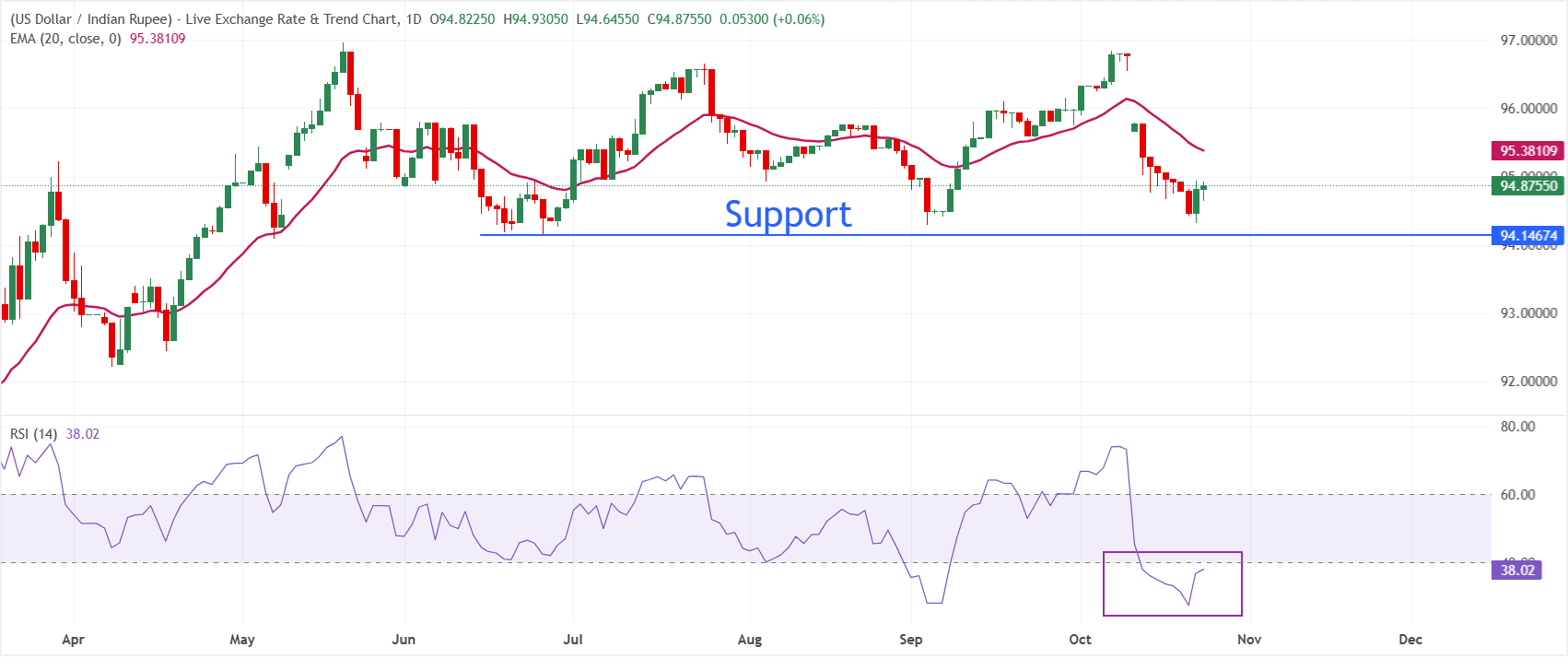
Below its 20-day exponential moving average (EMA) of 95.38, USD/INR retains a bearish near-term bias, trading at 94.92 on the daily chart.
Following a steep retreat from recent highs, the pair’s Relative Strength Index (14) stands at 37.94, only just above oversold territory. This suggests that downward momentum persists, although selling pressure may be easing.
Recovery attempts face immediate resistance at the 20-day EMA near 95.38. The pair would need to regain that level to relieve the prevailing downside bias. Below the market, key support lies at the 25 June low of 94.15.
(The technical analysis of this story was written with the help of an AI tool. Know more.)
External developments have a particularly strong influence on the Indian Rupee (INR). Key considerations include crude oil prices, given India’s heavy reliance on imported oil; the US Dollar’s value, as most trade is denominated in USD; and the scale of foreign investment. The Reserve Bank of India (RBI) also plays a major role through both its interest rate decisions and direct intervention in foreign exchange markets to stabilise the exchange rate.
To support trade, the Reserve Bank of India (RBI) intervenes actively in foreign exchange markets to keep the exchange rate stable. It also adjusts interest rates in pursuit of its 4% inflation target. Higher rates typically support the Rupee through the ‘carry trade’: investors borrow in lower-interest-rate countries and invest in countries offering relatively higher rates, seeking to profit from the difference.
Inflation, interest rates, economic growth (GDP), the trade balance and foreign investment inflows all help determine the Rupee’s value. Faster growth can attract additional overseas investment and increase demand for the currency, while a smaller trade deficit will eventually strengthen it. Higher interest rates are also supportive, particularly higher real rates, which are interest rates minus inflation. When investors are more willing to take risks, inflows of Foreign Direct and Indirect Investment (FDI and FII) can increase, providing further support for the Rupee.
When inflation exceeds that of India’s peers in particular, it generally weighs on the Rupee because it reflects a loss of value through oversupply. By making exports more expensive, inflation also results in more Rupees being sold to pay for foreign imports, further weakening the currency. However, higher inflation usually prompts the Reserve Bank of India (RBI) to raise interest rates. The resulting increase in demand from international investors can support the Rupee. Lower inflation has the reverse effect.







Phone: +61 2 8036 8388
Fax: +61 2 8036 8388
Email: support@tmgm.com



The information provided on this website is of a general nature only and does not constitute personal financial advice. Before acting on any information on this website, you should consider the suitability of the information in relation to your objectives, financial situation and needs. Investing in CFDs and FX Margin Contracts carries significant risks and is not suitable for all investors. You may lose more than your initial deposit. You do not own, or have, any interest in the underlying asset. We recommend that you seek independent advice and ensure you fully understand the risks involved before trading. It is important that you read and consider the disclosure document before you acquire any product listed on the website. The information and advertisements offered on this website are not intended for use by any person in any country or jurisdiction where such use would be contrary to local laws and regulations. The Products and Services offered on this website are not intended for residents of the United States, Malaysia and Thailand.
TMGM is authorized and regulated in various jurisdictions.
Trademax Australia Limited, trading as TMGM, is regulated by the Australian Securities and Investments Commission (ASIC), AFSL no. 436416 and is located at Level 28, One International Tower, 100 Barangaroo Avenue, 2000 Sydney, NSW Australia.
Email: support@tmgm.com.au
Trademax Global Limited, trading as TMGM, is authorized and regulated by the Vanuatu Financial Services Commission (VFSC), registration number 40356 and registered at 1276, Kumul Highway, Port Vila, Vanuatu, Republic of Vanuatu.
Email: support@tmgm.com
Trademax Global Markets (SE) Limited, trading as TMGM, is authorized and regulated by the Financial Services Authority (FSA) of Seychelles, with license number SD224. The company is registered at Office No 13, Providence Estate ABIS Centre, Mahe, Seychelles.
Email: support@tmgm.com
Trademax Global Markets (International) Pty Ltd, trading as TMGM, is authorized and regulated by the Financial Services Commission, Mauritius (FSC) with license no. GB22201012, and registered at 33, Edith Cavell Street C/o IQ EQ Fund Services (Mauritius) Ltd Port Louis, 11324 Mauritius.
Email: support@tmgm.com
Copyright © TMGM. All rights reserved


