
News & AnalysisCareer

Last week’s below-forecast Japanese inflation figures have prompted investors to reassess how far the Bank of Japan (BoJ) will take its tightening cycle, with the Japanese Yen (JPY) surrendering Friday’s gains against the US Dollar (USD) on Monday. In early European trading, USD/JPY moved back above 159.00 after touching lows of 158.40 last Friday, bringing the key 160.00 threshold closer.
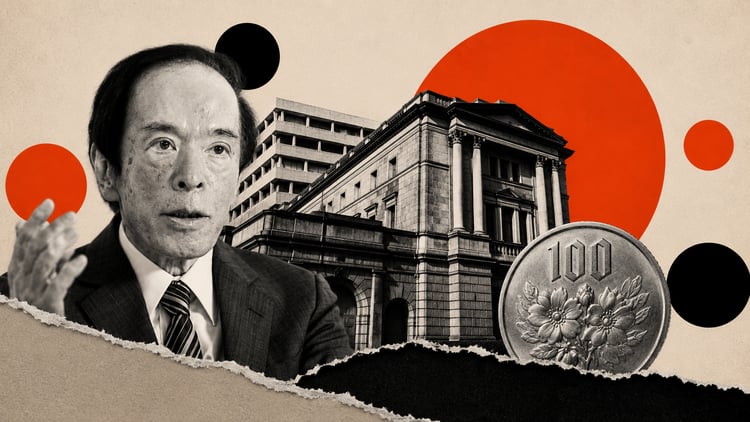
Although Japanese data published last week showed consumer inflation accelerating above the BoJ’s 2% target for the second consecutive time in October, core CPI undershot market forecasts. The release followed Q3 Gross Domestic Product (GDP) figures published one week earlier, which showed an unexpected contraction. That backdrop may have weighed on the BoJ’s monetary policy committee.
According to Elias Haddad of Brown Brothers Harriman, markets have responded to the “downside CPI surprise” by lowering the implied probability of a December BoJ “25bps rate increase to 77% from 87%.” BBH nevertheless emphasises that “inflation above the 2% target keeps a December hike on track,” adding that “contained underlying price pressure continues to argue for a gradual tightening cycle.”
Further Yen weakness is being limited, however, by a struggling US Dollar on Monday, as expectations of an aggressive Federal Reserve rate increase in December recede.
Citing the recent sell-off in equity markets, US Treasury Secretary Scott Bessent cautioned on Sunday that excessive Federal Reserve tightening could put the economy at risk. His remarks have left markets favouring a more measured pace of monetary tightening over the coming months.
On the economic calendar, US Flash PMIs are forecast to indicate that activity continued to expand at a solid pace in November. Attention will also centre on Wednesday’s Personal Consumption Expenditures (PCE) Price Index release. The figures are expected to point to persistently high inflation, increasing pressure on the central bank to raise borrowing costs.
Maintaining stable prices across a country or region is a central bank’s core mandate. As the prices of individual goods and services fluctuate, economies continually face inflationary or deflationary pressures. Persistent increases in the price of the same goods constitute inflation, while sustained declines constitute deflation. By adjusting its policy rate, a central bank seeks to keep demand in check. For major central banks, including the US Federal Reserve (Fed), the European Central Bank (ECB) and the Bank of England (BoE), the objective is to hold inflation close to 2%.
To push inflation higher or lower, a central bank can adjust a key instrument: its benchmark policy rate, commonly referred to as the interest rate. At scheduled times, it announces that rate in a statement explaining the decision to leave it unchanged, cut it or raise it. Domestic banks then alter their savings and lending rates accordingly. Those changes affect how easily savers can earn a return and how readily companies can borrow to invest in their businesses. Substantial interest rate increases by a central bank are known as monetary tightening; reductions in its benchmark rate are known as monetary easing.
Political independence is common among central banks. Before joining a central bank’s policy board, prospective members undergo a series of panels and hearings. Once appointed, they typically bring distinct views on controlling inflation and the monetary policy needed to do so. Those who favour very accommodative policy, using low rates and inexpensive credit to give the economy a substantial boost while accepting inflation slightly above 2%, are known as ‘doves’. By contrast, ‘hawks’ favour higher rates to reward savers and seek to keep inflation firmly in check, persisting until it reaches or falls just below 2%.
Meetings are generally led by a chair or president, whose role includes building agreement between hawks and doves. If members are evenly divided over a policy change, the chair has the deciding say to prevent a 50-50 tie. Speeches by the chair, often available to follow live, set out the current policy stance and outlook. Central banks aim to implement monetary policy without provoking sharp fluctuations in interest rates, equities or their currencies. Ahead of a policy meeting, all members communicate their views to markets. Public comments are then prohibited from a few days before the meeting until the new policy has been announced, a stretch known as the blackout period.







Phone: +61 2 8036 8388
Fax: +61 2 8036 8388
Email: support@tmgm.com



The information provided on this website is of a general nature only and does not constitute personal financial advice. Before acting on any information on this website, you should consider the suitability of the information in relation to your objectives, financial situation and needs. Investing in CFDs and FX Margin Contracts carries significant risks and is not suitable for all investors. You may lose more than your initial deposit. You do not own, or have, any interest in the underlying asset. We recommend that you seek independent advice and ensure you fully understand the risks involved before trading. It is important that you read and consider the disclosure document before you acquire any product listed on the website. The information and advertisements offered on this website are not intended for use by any person in any country or jurisdiction where such use would be contrary to local laws and regulations. The Products and Services offered on this website are not intended for residents of the United States, Malaysia and Thailand.
TMGM is authorized and regulated in various jurisdictions.
Trademax Australia Limited, trading as TMGM, is regulated by the Australian Securities and Investments Commission (ASIC), AFSL no. 436416 and is located at Level 28, One International Tower, 100 Barangaroo Avenue, 2000 Sydney, NSW Australia.
Email: support@tmgm.com.au
Trademax Global Limited, trading as TMGM, is authorized and regulated by the Vanuatu Financial Services Commission (VFSC), registration number 40356 and registered at 1276, Kumul Highway, Port Vila, Vanuatu, Republic of Vanuatu.
Email: support@tmgm.com
Trademax Global Markets (SE) Limited, trading as TMGM, is authorized and regulated by the Financial Services Authority (FSA) of Seychelles, with license number SD224. The company is registered at Office No 13, Providence Estate ABIS Centre, Mahe, Seychelles.
Email: support@tmgm.com
Trademax Global Markets (International) Pty Ltd, trading as TMGM, is authorized and regulated by the Financial Services Commission, Mauritius (FSC) with license no. GB22201012, and registered at 33, Edith Cavell Street C/o IQ EQ Fund Services (Mauritius) Ltd Port Louis, 11324 Mauritius.
Email: support@tmgm.com
Copyright © TMGM. All rights reserved


