
News & AnalysisCareer

With 0.5434 in focus, the New Zealand Dollar (NZD) risks further losses below that level against the US Dollar (USD) in Tuesday’s European session. Renewed strength in the global Artificial Intelligence (AI) trade has bolstered demand for the US Dollar, putting the Kiwi pair under pressure.

Near its 20-month high of 104.57, the US Dollar Index (DXY) is retaining its gains at the time of writing. The index measures the Greenback against a basket of six major currencies.
Equities rally and Dollar gains as Nvidia leadership changes
Jensen Huang’s reinstatement as Nvidia CEO has provided a significant catalyst for markets, according to analysts at Danske Bank. They say “Jensen Huang's return as the CEO of Nvidia” has helped to “rally equity markets and lift front end US Treasury yields in a flattener,” while a “broad USD continued to rally.” In the bank’s assessment, the impetus from AI has eclipsed conventional macroeconomic drivers. As investors shift towards US assets and Dollar exposure, the Euro has been left among the weakest G10 currencies, while Scandinavian currencies have also underperformed.
Hawkish expectations for the Federal Reserve (Fed) are providing another source of support for the US Dollar alongside the revival in the global AI trade. Policymakers’ continued backing for additional Fed tightening has compelled traders to factor in consecutive interest rate rises.
At 6.2/10, the FXS Speechtracker score for Fed official Williams’s speech matches its historical average, indicating a consistently hawkish message rather than a shift towards greater hawkishness. His remarks are broadly in line with the established baseline. The US central bank “still has work to do” to return inflation to its 2% target, he emphasises. Projections showing inflation at 3.5% at end-2026 and a return to 2% only by 2028 point to an extended period of restrictive policy, even as growth and a stable labour market suggest the economy remains resilient. Williams observes that inflationary pressures are not broadening significantly. Nevertheless, his view that inflation remains too high, with risks tilted to the upside, leaves the policy bias pointing towards further action if required.
A rise of 0.35 points took the FXS Fed Sentiment Index to 152.49, keeping it comfortably above the neutral threshold of 100 and underscoring the firmly hawkish nature of Fed communications. Together with the unchanged FXS Speechtracker score of 6.2/10, this modest increase points to a steady but decidedly hawkish backdrop. Expectations of prolonged policy restraint should therefore continue to support the Dollar.
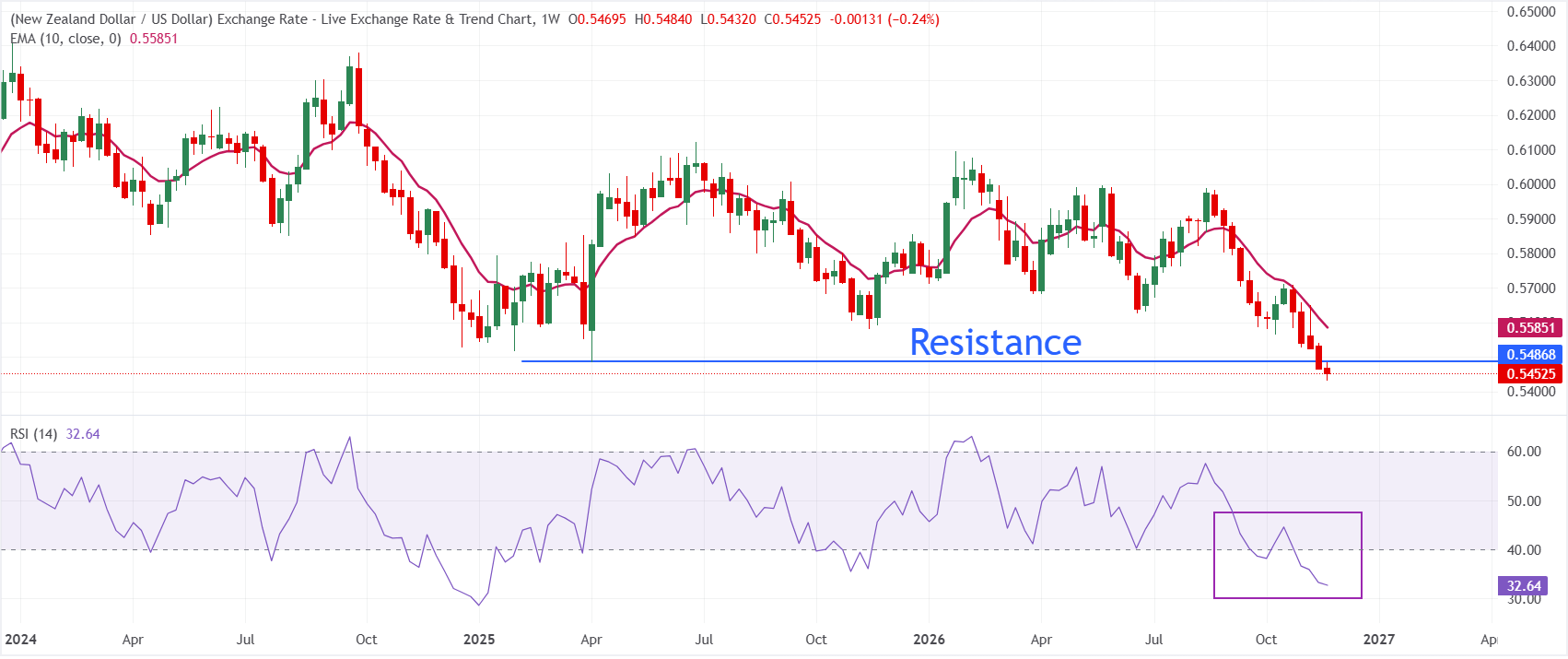
At 0.5453 on the weekly chart, NZD/USD remains below its 10-week exponential moving average (EMA) of 0.5585, preserving a bearish near-term outlook. Recent rebounds have failed to hold, and the pair is still edging lower. Its position beneath the short-term EMA indicates that sellers remain in control, notwithstanding occasional corrective recoveries.
The 10-week EMA at 0.5585 provides the first upside resistance, limiting recovery attempts for as long as the pair trades beneath it. Momentum indicators also favour the downside: the 14-week Relative Strength Index (RSI) is close to 33 and moving towards oversold territory. Although the trend remains under pressure, this suggests the pair could be susceptible to short-covering should sellers lose conviction at lower levels.
(The technical analysis of this story was written with the help of an AI tool. Find out more.)
As an academic discipline, artificial intelligence aims to reproduce human cognitive functions, logical understanding, perception and pattern recognition in machines. Usually shortened to AI, the field encompasses artificial neural networks, machine learning or predictive analytics, symbolic reasoning, deep learning, natural language processing, speech recognition, image recognition and expert systems. Its ultimate objective is artificial general intelligence, or AGI: a machine capable of solving arbitrary problems for which it has received no specific training.
Artificial intelligence has a wide range of applications. Among the best known are generative AI platforms, including ChatGPT and Google’s Bard platform, which draw on training using large language models (LLMs) to respond to text-based queries. Original images can also be produced from user-written text through programs such as Midjourney. Elsewhere, probabilistic techniques allow AI to assess an entity’s characteristics or how it is perceived. Upstart’s lending platform, for example, employs an AI-enhanced credit rating system to assess applicants’ creditworthiness, searching the internet for information about their careers, wealth profiles and relationships. In pharmaceutical research, other AI systems analyse large databases of scientific studies to propose potential new medicines for laboratory testing. By gathering and organising information on viewing habits, YouTube, Spotify, Facebook and other content aggregators use AI applications to recommend personalised content.
Semiconductor company Nvidia (NVDA) produces AI-focused computer chips as well as some of the platforms engineers use to develop AI applications. Because it supplies the tools needed for further applications of artificial intelligence, many advocates regard Nvidia as a picks-and-shovels investment in the AI revolution. Another company in the field is Palantir Technologies (PLTR), which specialises in “big data” analytics and holds substantial contracts with the US intelligence community. Its Gotham platform helps that community examine data, identify intelligence leads and support pattern recognition. Major corporations use Palantir’s Foundry product to monitor employee and customer data for predictive analytics and anomaly detection. Meanwhile, Microsoft (MSFT) owns a sizeable stake in OpenAI, the privately held creator of ChatGPT, and has incorporated OpenAI’s technology into its Bing search engine.
The public launch of ChatGPT in late 2022 prompted a rally in many AI-related shares. Over the six months after its release, Nvidia, for example, gained well over 200%. Wall Street commentators quickly began questioning whether another technology bubble was taking hold. Stanley Druckenmiller, the prominent investor who has held substantial positions in both Palantir and Nvidia, argued that bubbles never last just six months. Should enthusiasm for AI develop into a bubble, he said, extreme valuations would persist for at least two and a half years or longer, as they did during the DotCom bubble of the late 1990s. By the middle of 2023, the best assessment was that the market was not in a bubble, at least for the time being. Although Nvidia was then valued at 27 times forward sales, analysts expected exceptionally strong revenue growth over the coming years. For comparison, the NASDAQ 100 traded at 60 times earnings at the peak of the DotCom bubble, against 25 times earnings in mid-2023.







Phone: +61 2 8036 8388
Fax: +61 2 8036 8388
Email: support@tmgm.com



The information provided on this website is of a general nature only and does not constitute personal financial advice. Before acting on any information on this website, you should consider the suitability of the information in relation to your objectives, financial situation and needs. Investing in CFDs and FX Margin Contracts carries significant risks and is not suitable for all investors. You may lose more than your initial deposit. You do not own, or have, any interest in the underlying asset. We recommend that you seek independent advice and ensure you fully understand the risks involved before trading. It is important that you read and consider the disclosure document before you acquire any product listed on the website. The information and advertisements offered on this website are not intended for use by any person in any country or jurisdiction where such use would be contrary to local laws and regulations. The Products and Services offered on this website are not intended for residents of the United States, Malaysia and Thailand.
TMGM is authorized and regulated in various jurisdictions.
Trademax Australia Limited, trading as TMGM, is regulated by the Australian Securities and Investments Commission (ASIC), AFSL no. 436416 and is located at Level 28, One International Tower, 100 Barangaroo Avenue, 2000 Sydney, NSW Australia.
Email: support@tmgm.com.au
Trademax Global Limited, trading as TMGM, is authorized and regulated by the Vanuatu Financial Services Commission (VFSC), registration number 40356 and registered at 1276, Kumul Highway, Port Vila, Vanuatu, Republic of Vanuatu.
Email: support@tmgm.com
Trademax Global Markets (SE) Limited, trading as TMGM, is authorized and regulated by the Financial Services Authority (FSA) of Seychelles, with license number SD224. The company is registered at Office No 13, Providence Estate ABIS Centre, Mahe, Seychelles.
Email: support@tmgm.com
Trademax Global Markets (International) Pty Ltd, trading as TMGM, is authorized and regulated by the Financial Services Commission, Mauritius (FSC) with license no. GB22201012, and registered at 33, Edith Cavell Street C/o IQ EQ Fund Services (Mauritius) Ltd Port Louis, 11324 Mauritius.
Email: support@tmgm.com
Copyright © TMGM. All rights reserved


