
News & AnalysisCareer

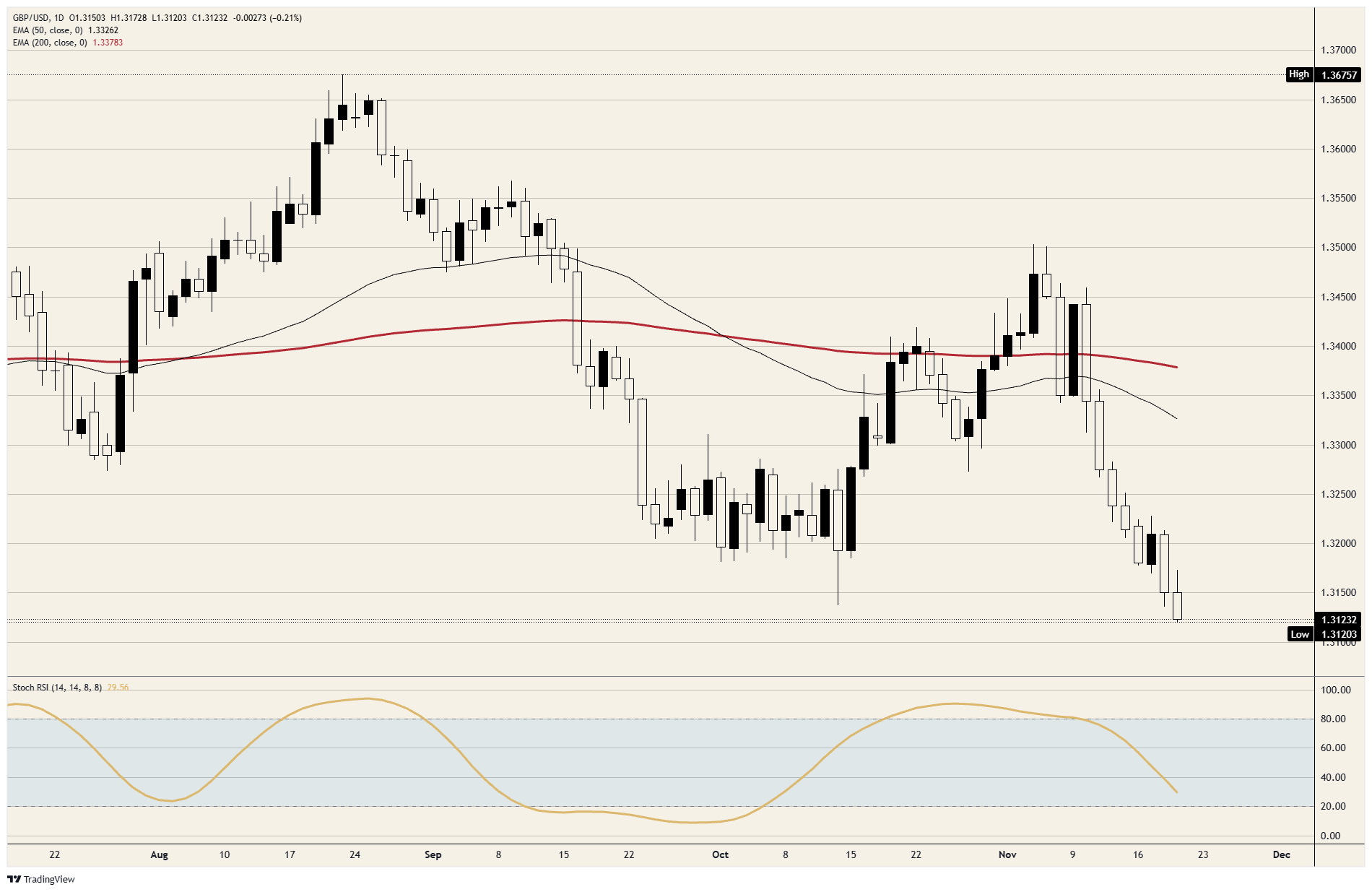
Weaker-than-forecast US jobless claims figures and the Philadelphia Fed survey on Thursday failed to prevent the Pound from breaking below October’s low. An initial advance in GBP/USD lasted ten five-minute bars after the releases, before the pair retreated to just above 1.3100, close to its session low once again. Since peaking on 4 November, it is heading for a ninth session of losses out of eleven.

October’s UK Consumer Price Index (CPI) inflation reading of 3.6%, below the BoE’s 3.7% forecast, has helped push the market-implied probability of a 17 December rate rise down from 92% to about 80%. Having lifted the UK’s Bank Rate to 4.00% on 5 November, the Bank of England (BoE) now looks less certain to deliver a second increase than the Fed does to raise rates at its next meeting. Markets put the probability of a Fed hike on 9 December at near 95%; the widening difference has accompanied the decline in GBP/USD.
At 203K, jobless claims exceeded forecasts, while the Philadelphia Fed index dropped from 20.9 to 6.3. Yet the survey’s prices paid index climbed from 43.2 to 58.2, pointing to a slowdown in factory activity alongside accelerating cost increases. With Fed Governor Waller already supporting a half-point rise, the figures offered no reason to scale back bets on Fed tightening. The Dollar’s initial decline following the releases consequently proved short-lived.
A reading of -22, up from -24, is forecast for UK GfK consumer confidence, due on Friday at 00:01 GMT. October retail sales, released at 07:00 GMT, are expected to show no monthly change at 0%, following -0.4%. Both releases will inform the BoE’s 17 December decision, shaping the UK side of the policy expectations gap.
Friday’s Fed speakers begin with Governor Waller at 13:25 GMT. Governor Cook, who dissented in October in support of a rate rise, speaks later at 17:15 GMT. Between those appearances, the University of Michigan releases its November survey at 15:00 GMT; one-year inflation expectations are forecast to remain at 4.3%. On the US side of the policy expectations gap, markets assign a probability of near one in ten to a half-point Fed increase in December.
The entire three-week rally that began on 14 October has been wiped out by the retreat from the 4 November high. That peak, just above 1.3500, fell short of August’s high just below 1.3700. GBP/USD trades beneath its 50-day Exponential Moving Average (EMA), which sits just below 1.3350 and has remained below the 200-day average since early October. Over the course of the decline, daily momentum has moved from overbought territory to just above oversold levels.
Dating back to 886 AD, the Pound Sterling (GBP) is the world’s oldest currency and serves as the United Kingdom’s official currency. Figures for 2022 rank it fourth among the most traded currencies in the global foreign exchange (FX) market, with a 12% share of all transactions and average daily turnover of $630 billion. Among its principal pairs, GBP/USD, known as ‘Cable’, represents 11% of FX trading. GBP/JPY, called the ‘Dragon’ by traders, accounts for 3%, while EUR/GBP accounts for 2%. Responsibility for issuing the Pound Sterling rests with the Bank of England (BoE).
Monetary policy set by the Bank of England is the most important single influence on Sterling’s value. Decisions hinge on whether the BoE has met its central objective of “price stability” – inflation holding steady at around 2%. Adjusting interest rates is its main means of pursuing that goal. To curb excessive inflation, the BoE seeks to raise borrowing costs for households and businesses through higher interest rates. Sterling generally benefits, as the higher returns make the UK a more appealing destination for international investors’ funds. By contrast, inflation that is too low signals slowing economic growth. The BoE will then consider cutting rates to make credit cheaper, encouraging businesses to borrow more and invest in projects that support growth.
Sterling can respond to economic releases because they provide a measure of the economy’s health. GDP, manufacturing and services PMIs, and employment figures are among the indicators that can steer GBP. Economic strength supports Sterling by drawing in more overseas investment and potentially prompting the BoE to raise interest rates, which would directly strengthen GBP. Weak economic figures, on the other hand, are likely to weigh on the Pound Sterling.
The trade balance is another important release for Sterling, showing the difference over a specified period between a country’s export earnings and its spending on imports. Strong overseas demand for a country’s exports creates additional demand for its currency as foreign buyers seek to purchase those goods. A positive net trade balance therefore supports the currency, while a negative balance has the opposite effect.







Phone: +61 2 8036 8388
Fax: +61 2 8036 8388
Email: support@tmgm.com



The information provided on this website is of a general nature only and does not constitute personal financial advice. Before acting on any information on this website, you should consider the suitability of the information in relation to your objectives, financial situation and needs. Investing in CFDs and FX Margin Contracts carries significant risks and is not suitable for all investors. You may lose more than your initial deposit. You do not own, or have, any interest in the underlying asset. We recommend that you seek independent advice and ensure you fully understand the risks involved before trading. It is important that you read and consider the disclosure document before you acquire any product listed on the website. The information and advertisements offered on this website are not intended for use by any person in any country or jurisdiction where such use would be contrary to local laws and regulations. The Products and Services offered on this website are not intended for residents of the United States, Malaysia and Thailand.
TMGM is authorized and regulated in various jurisdictions.
Trademax Australia Limited, trading as TMGM, is regulated by the Australian Securities and Investments Commission (ASIC), AFSL no. 436416 and is located at Level 28, One International Tower, 100 Barangaroo Avenue, 2000 Sydney, NSW Australia.
Email: support@tmgm.com.au
Trademax Global Limited, trading as TMGM, is authorized and regulated by the Vanuatu Financial Services Commission (VFSC), registration number 40356 and registered at 1276, Kumul Highway, Port Vila, Vanuatu, Republic of Vanuatu.
Email: support@tmgm.com
Trademax Global Markets (SE) Limited, trading as TMGM, is authorized and regulated by the Financial Services Authority (FSA) of Seychelles, with license number SD224. The company is registered at Office No 13, Providence Estate ABIS Centre, Mahe, Seychelles.
Email: support@tmgm.com
Trademax Global Markets (International) Pty Ltd, trading as TMGM, is authorized and regulated by the Financial Services Commission, Mauritius (FSC) with license no. GB22201012, and registered at 33, Edith Cavell Street C/o IQ EQ Fund Services (Mauritius) Ltd Port Louis, 11324 Mauritius.
Email: support@tmgm.com
Copyright © TMGM. All rights reserved


