
News & AnalysisCareer

With October’s United States (US) Personal Consumption Expenditure (PCE) Price Index due at 13:30 GMT, Silver (XAG/USD) remains under selling pressure. During Wednesday’s Asian session, the metal reaches a fresh 14-month low of $40.52.
Persistent price pressures are likely to be evident in the figures, according to Commerzbank, with “the inflation rate… expected to rise to 3.8% in October, and even without food and energy prices, the inflation rate is expected to be too high at 3.2%.”
Expectations for the Federal Reserve’s (Fed) monetary policy are likely to be significantly influenced by the inflation release.
Several Fed policymakers have recently expressed considerable concern that inflation is heading in the wrong direction, indicating that further interest rate increases are needed to bring it under control.
A 6.2 reading on the FXS Speechtracker puts Fed policymaker Williams’ speech broadly in line with its historical average, reflecting a consistently hawkish rather than extreme stance. Despite describing the economy as strong and resilient and the jobs market as stable, Williams emphasises that the US central bank “still has work to do” to return inflation to its 2% target. Together with a projection of 3.5% inflation in 2026 and risks tilted to the upside, those remarks underline the need for continued policy vigilance. Guidance pointing to inflation reaching 2% only by 2028, alongside solid growth of around 2.75%, implies that expectations of restrictive policy could persist for a prolonged period, which should, on balance, support the Dollar.
According to the FXS Speechtracker, the speech pushes the Fed’s overall rhetoric further into hawkish territory: the FXS Fed Sentiment Index advances 0.35 points to 152.49. Such a reading remains well above the neutral level of 100. Markets are therefore likely to view Williams’ remarks as reinforcing expectations that rates will stay higher for longer, an environment that usually benefits the Dollar against lower-yielding currencies.
An interest rate increase at the Fed’s December policy meeting is viewed as almost certain, according to the CME FedWatch tool.
In theory, assets that offer no yield, including Silver, are disadvantaged by higher Fed interest rates.
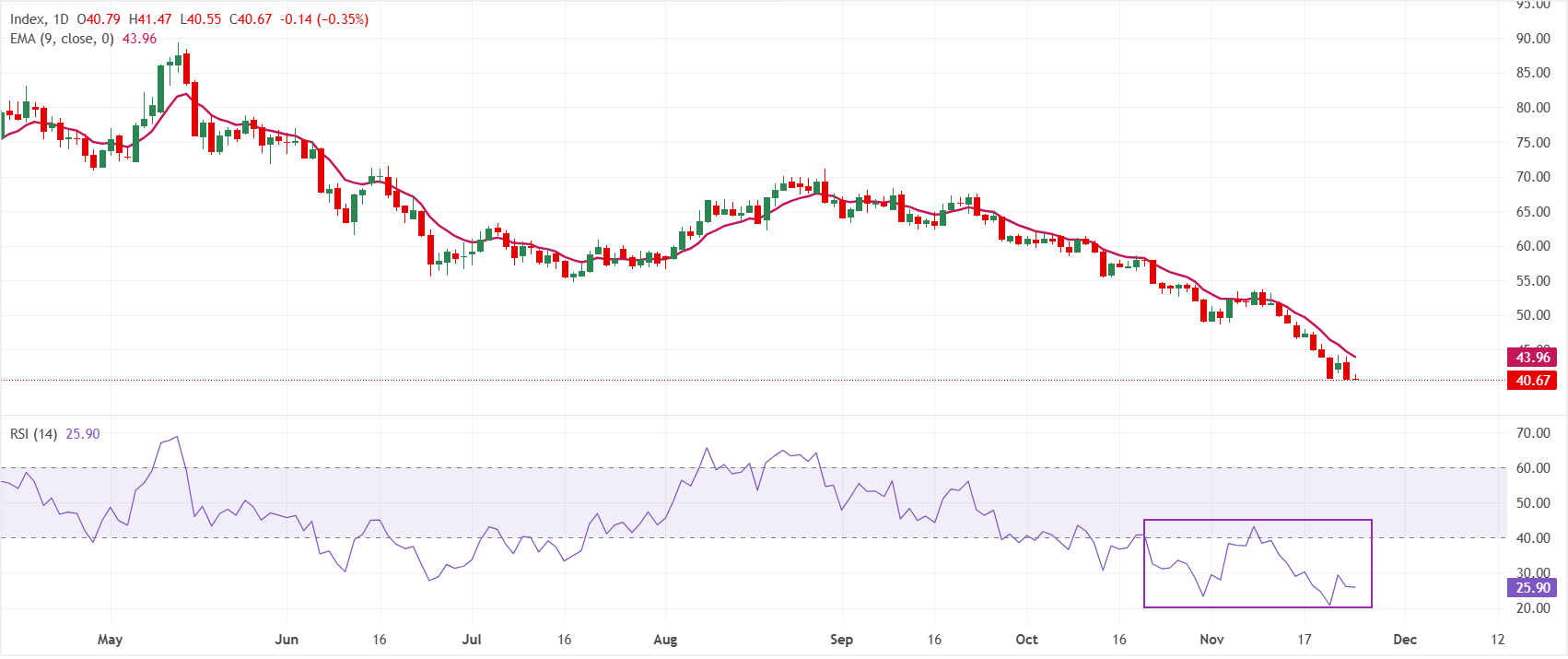
Below the 9-day exponential moving average (EMA) of $43.96, XAG/USD trades at $40.67 on the daily chart, leaving its short-term outlook bearish. Since reaching the mid-$50s earlier in the month, the metal has continued to retreat. With the 9-day EMA close overhead, this dynamic resistance is likely to limit rallies for as long as prices remain beneath it. Meanwhile, the Relative Strength Index (14) reads 25.90, placing it in oversold territory. Selling pressure remains dominant, but that reading suggests the recent decline could begin to lose momentum.
Any recovery would first face resistance at the 9-day EMA of $43.96; a move back above it would be needed to temper the prevailing bearish tone. This dataset offers no clear structural support close below the current price. Traders may therefore keep watching intraday movements and the RSI’s oversold readings for indications of possible stabilisation or a corrective rebound. Nevertheless, the broader downtrend remains in place while XAG/USD holds below its short-term EMA.
(The technical analysis of this story was written with the help of an AI tool. Know more.)
Long used both to preserve wealth and to facilitate exchange, Silver is a precious metal actively traded by investors. It attracts less attention than Gold, yet traders may choose it for its intrinsic value, to diversify a portfolio or as a possible hedge when inflation is high. Physical holdings can take the form of Silver coins or bars. Alternatively, investors can gain exposure through instruments such as exchange-traded funds, which follow its price in international markets.
A broad set of influences can shift Silver prices. Its safe-haven appeal can lift prices during geopolitical unrest or fears of a severe recession, although this effect is less pronounced than for Gold. Lower interest rates generally favour Silver because it pays no yield. Since the metal is quoted in dollars (XAG/USD), movements in the US Dollar (USD) also matter: a stronger Dollar usually restrains Silver, while a weaker one is likely to lift it. Investment demand, recycling rates and mine supply can affect prices too, with Silver far more plentiful than Gold.
Among metals, Silver has one of the highest levels of electrical conductivity, exceeding both Copper and Gold. This makes it widely used in industry, notably electronics and solar energy. Prices can rise when demand surges and tend to fall when it weakens. Economic developments in the US, China and India can also generate price fluctuations. Large industrial sectors in the US and, especially, China consume Silver in a range of processes, while Indian consumers’ demand for Silver jewellery is another important influence on prices.
Gold’s price movements are generally mirrored by Silver. Their shared safe-haven characteristics mean that a rise in Gold is usually accompanied by gains in Silver. Relative valuations can be assessed using the Gold/Silver ratio, which measures how many ounces of Silver equal the value of one ounce of Gold. A high reading may be interpreted by some investors as evidence that Silver is undervalued or Gold overvalued. Conversely, a low reading could indicate that Gold is undervalued compared with Silver.







Phone: +61 2 8036 8388
Fax: +61 2 8036 8388
Email: support@tmgm.com



The information provided on this website is of a general nature only and does not constitute personal financial advice. Before acting on any information on this website, you should consider the suitability of the information in relation to your objectives, financial situation and needs. Investing in CFDs and FX Margin Contracts carries significant risks and is not suitable for all investors. You may lose more than your initial deposit. You do not own, or have, any interest in the underlying asset. We recommend that you seek independent advice and ensure you fully understand the risks involved before trading. It is important that you read and consider the disclosure document before you acquire any product listed on the website. The information and advertisements offered on this website are not intended for use by any person in any country or jurisdiction where such use would be contrary to local laws and regulations. The Products and Services offered on this website are not intended for residents of the United States, Malaysia and Thailand.
TMGM is authorized and regulated in various jurisdictions.
Trademax Australia Limited, trading as TMGM, is regulated by the Australian Securities and Investments Commission (ASIC), AFSL no. 436416 and is located at Level 28, One International Tower, 100 Barangaroo Avenue, 2000 Sydney, NSW Australia.
Email: support@tmgm.com.au
Trademax Global Limited, trading as TMGM, is authorized and regulated by the Vanuatu Financial Services Commission (VFSC), registration number 40356 and registered at 1276, Kumul Highway, Port Vila, Vanuatu, Republic of Vanuatu.
Email: support@tmgm.com
Trademax Global Markets (SE) Limited, trading as TMGM, is authorized and regulated by the Financial Services Authority (FSA) of Seychelles, with license number SD224. The company is registered at Office No 13, Providence Estate ABIS Centre, Mahe, Seychelles.
Email: support@tmgm.com
Trademax Global Markets (International) Pty Ltd, trading as TMGM, is authorized and regulated by the Financial Services Commission, Mauritius (FSC) with license no. GB22201012, and registered at 33, Edith Cavell Street C/o IQ EQ Fund Services (Mauritius) Ltd Port Louis, 11324 Mauritius.
Email: support@tmgm.com
Copyright © TMGM. All rights reserved


