
News & AnalysisCareer

Now at its highest levels since April, the Indian Rupee (INR) has recovered roughly half of this year’s losses, with its strong rebound taking USD/INR below 94.15 and towards the 93.00–93.48 range. Lower oil prices, supportive Reserve Bank of India (RBI) measures and monthly foreign equity inflows of roughly $9.0–9.4 billion are supporting the recovery as global investors shift away from crowded Artificial Intelligence (AI) and semiconductor trades. Elevated forward premiums are also deterring speculative short positions. Against this backdrop, institutional strategists at Societe Generale and MUFG are assessing whether a sustained move below 93.25 will carry the Rupee towards 92.85 and 92.30, or whether continued capital inflows will be needed to maintain the advance.

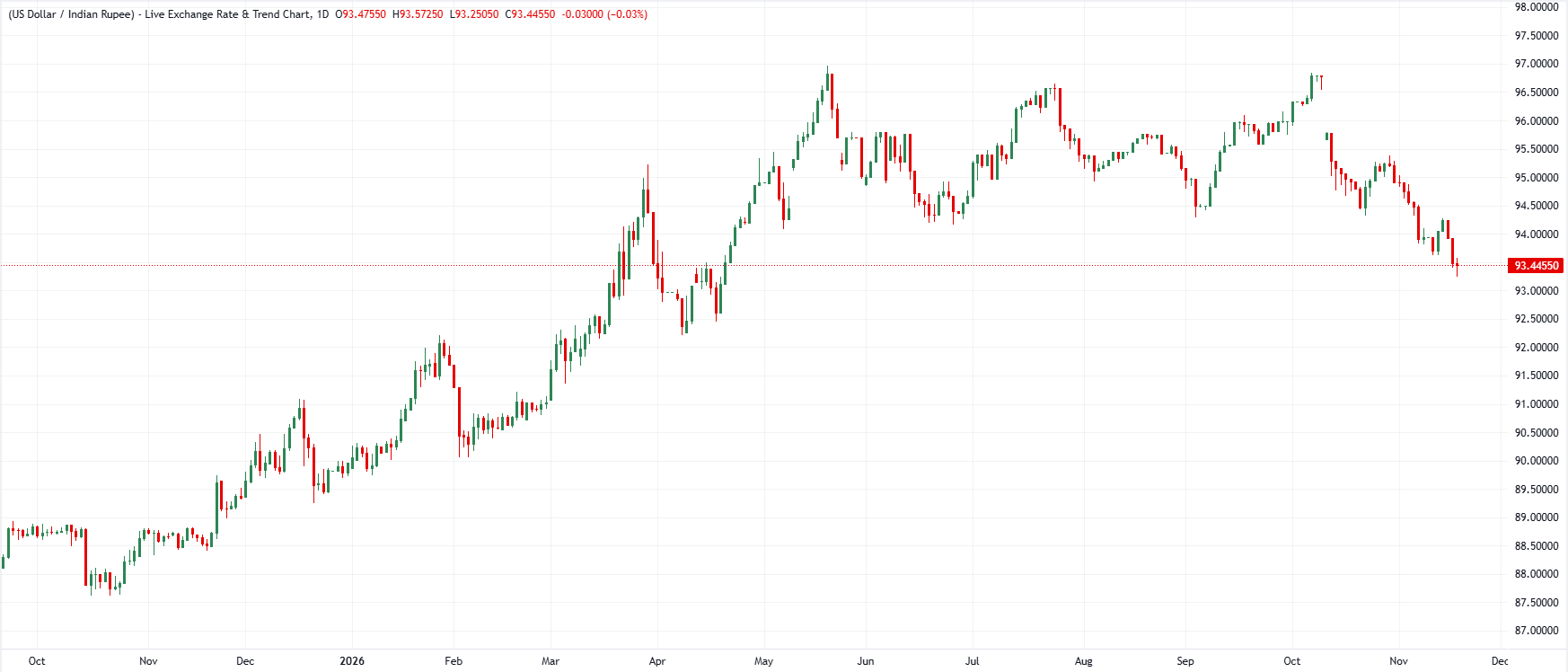
A seven-month high for the Indian Rupee against the US Dollar (USD) has brought USD/INR below 94.15 and close to 93.00, according to Santosh Ejantkar and Tanmay Purohit at Societe Generale. They attribute the mean reversion to lower oil prices, Reserve Bank of India measures including the FCNR(B) scheme, and monthly foreign portfolio inflows of $9.4 billion. As investors move from crowded Asian AI indices into Indian equities, a decisive fall through 93.25 would bring the next USD/INR support levels of 92.85 and 92.30 into view.
"In Asia, it’s worth contemplating if USD/INR is heading below 90. The rupee is trading at the strongest level in seven months. Having erased 94.15, the pair and is now within striking distance of 93.00, having retracing roughly half of this year's gains... The mean reversion is supported by three powerful tailwinds: lower oil prices, sustained foreign inflows and the growing appeal of India as a more attractive value market alternative to crowded AI-linked indices and regions... The combination of RBI measures, including the FCNR(B) scheme cannot be overlooked as a magnet for the rupee... FPIs have purchased a net $9.4bn local equities so far this month, a sharp turnaround from the record outflows earlier this year... A break below 93.25 would open next supports at 92.85 and 92.30."
Monthly foreign equity inflows of $9 billion and cheaper oil have helped push USD/INR towards 93.48, its lowest since April, with the Indian Rupee continuing to outperform, according to Lin Li at MUFG. India’s relatively limited exposure to semiconductor manufacturing offers support during the wider technology sell-off, while elevated forward premiums make outright INR short positions more costly. These factors provide a substantial cushion for the Rupee, although Li cautions that lasting appreciation depends on continued capital inflows, not simply a one-off rotation.
"INR continued to outperform, with USD/INR falling towards 93.48, the lowest since April, as foreign equity inflows reinforced the benefit of cheaper oil... Foreign investors have bought a net US$9bn of Indian equities this month as investors seek alternatives to the AI trade... Elevated forward premium also makes outright INR shorts more expensive, providing an additional cushion against depreciation pressure... India’s relatively limited exposure to semiconductor manufacturing helps explain its appeal amid the technology selloff, although sustained currency gains would require continued inflows rather than a temporary rotation alone."
Falling oil prices, supportive domestic policy measures and a substantial regional equity rotation out of AI-heavy markets have combined to lift the Indian Rupee to seven-month highs against the US Dollar, with USD/INR near 93.00–93.48. In the assessment of Societe Generale, RBI measures such as the FCNR(B) scheme, together with monthly foreign equity inflows of $9.4 billion, could push USD/INR below 93.25 and towards 92.85 and 92.30. For MUFG, however, elevated forward premiums and India’s insulation from the semiconductor sell-off can deliver lasting INR appreciation only if foreign capital continues to flow in rather than proving temporary.
(This article was created with the help of an Artificial Intelligence tool and reviewed by an editor. Know more.)







Phone: +61 2 8036 8388
Fax: +61 2 8036 8388
Email: support@tmgm.com



The information provided on this website is of a general nature only and does not constitute personal financial advice. Before acting on any information on this website, you should consider the suitability of the information in relation to your objectives, financial situation and needs. Investing in CFDs and FX Margin Contracts carries significant risks and is not suitable for all investors. You may lose more than your initial deposit. You do not own, or have, any interest in the underlying asset. We recommend that you seek independent advice and ensure you fully understand the risks involved before trading. It is important that you read and consider the disclosure document before you acquire any product listed on the website. The information and advertisements offered on this website are not intended for use by any person in any country or jurisdiction where such use would be contrary to local laws and regulations. The Products and Services offered on this website are not intended for residents of the United States, Malaysia and Thailand.
TMGM is authorized and regulated in various jurisdictions.
Trademax Australia Limited, trading as TMGM, is regulated by the Australian Securities and Investments Commission (ASIC), AFSL no. 436416 and is located at Level 28, One International Tower, 100 Barangaroo Avenue, 2000 Sydney, NSW Australia.
Email: support@tmgm.com.au
Trademax Global Limited, trading as TMGM, is authorized and regulated by the Vanuatu Financial Services Commission (VFSC), registration number 40356 and registered at 1276, Kumul Highway, Port Vila, Vanuatu, Republic of Vanuatu.
Email: support@tmgm.com
Trademax Global Markets (SE) Limited, trading as TMGM, is authorized and regulated by the Financial Services Authority (FSA) of Seychelles, with license number SD224. The company is registered at Office No 13, Providence Estate ABIS Centre, Mahe, Seychelles.
Email: support@tmgm.com
Trademax Global Markets (International) Pty Ltd, trading as TMGM, is authorized and regulated by the Financial Services Commission, Mauritius (FSC) with license no. GB22201012, and registered at 33, Edith Cavell Street C/o IQ EQ Fund Services (Mauritius) Ltd Port Louis, 11324 Mauritius.
Email: support@tmgm.com
Copyright © TMGM. All rights reserved

