
News & AnalysisCareer

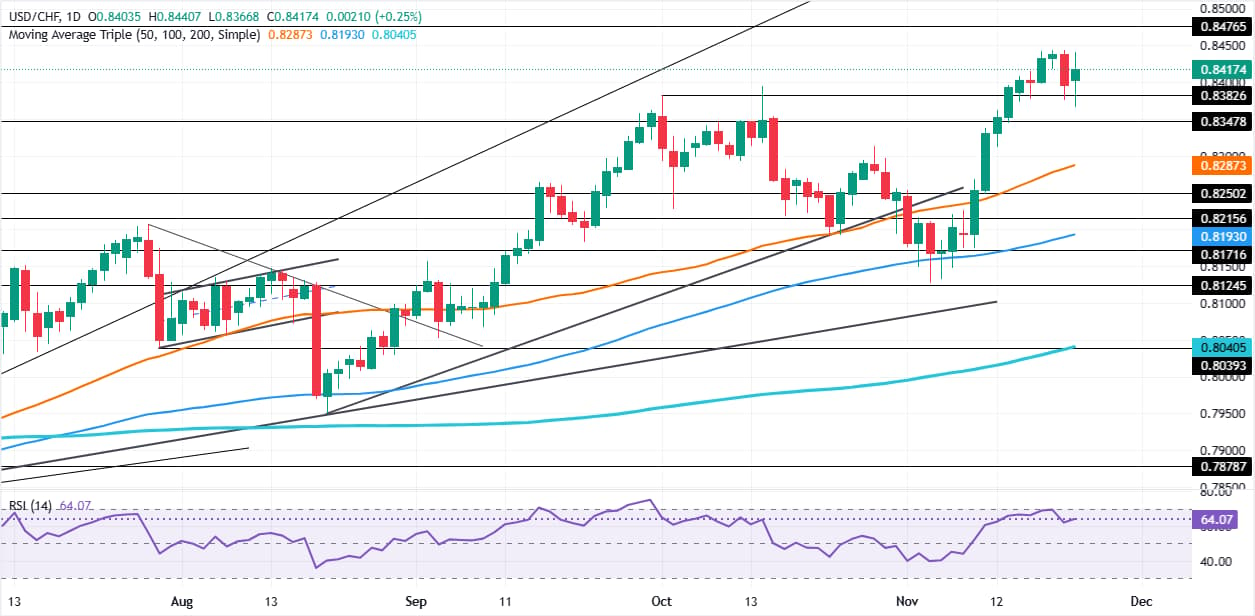
Gains of over 0.20% on Monday have lifted USD/CHF modestly, but a ‘spinning top’ emerging around 0.8400 suggests the uptrend is losing momentum. With neither buyers nor sellers in command, the pair may be set for consolidation while traders await crucial US inflation figures.

News concerning NVIDIA supported the US dollar, invalidating the ‘bearish engulfing’ chart pattern formed during last Friday’s trading. USD/CHF consequently recovered some of its earlier losses.
Although trading continues to point to an intact uptrend, a sustained advance requires buyers to take USD/CHF above its year-to-date (YTD) peak of 0.8444. A move beyond that level would bring the 12 May high of 0.8476 into focus, with 0.8500 next.
Conversely, a drop beneath last Friday’s low of 0.8376 would open the way for a test of 0.8300. A break below that threshold would put the 50-day Simple Moving Average (SMA) at 0.8282 in view, followed by 0.8200.
Among the world’s ten most actively traded currencies, the Swiss Franc (CHF) is Switzerland’s official currency, with trading volumes far exceeding the size of the domestic economy. Broad market sentiment, Switzerland’s economic performance and measures taken by the Swiss National Bank (SNB) are among the influences on its value. From 2011 to 2015, the Swiss Franc was pegged to the Euro (EUR). The sudden removal of that peg sent the Franc more than 20% higher, triggering market turmoil. Although the peg no longer applies, the Swiss economy’s heavy reliance on the neighbouring Eurozone means CHF movements tend to remain closely correlated with those of the Euro.
Investors tend to turn to the Swiss Franc (CHF) during periods of market stress, giving it the status of a safe-haven asset. That appeal reflects perceptions of Switzerland’s place in the world: its stable economy, robust export sector, substantial central bank reserves and longstanding policy of neutrality in global conflicts make its currency attractive to investors seeking to avoid risk. During turbulent periods, CHF is therefore likely to appreciate against currencies regarded as riskier investments.
Monetary policy is set at four meetings a year by the Swiss National Bank (SNB), one each quarter, a less frequent schedule than that of other major central banks. Its objective is annual inflation below 2%. If inflation exceeds that target, or is forecast to do so in the foreseeable future, the bank will seek to curb price rises by increasing its policy rate. By lifting yields and making Switzerland more attractive to investors, higher interest rates generally support the Swiss Franc (CHF). Lower rates, by contrast, tend to put pressure on CHF.
Assessments of Switzerland’s economic health rely heavily on macroeconomic releases, which can affect the valuation of the Swiss Franc (CHF). Despite the economy’s broad stability, abrupt shifts in growth, inflation, the current account or the central bank’s foreign currency reserves can prompt CHF movements. Strong economic growth, low unemployment and elevated confidence generally support the currency. Data signalling a loss of economic momentum, however, are likely to weigh on CHF.
Switzerland’s small, open economy relies heavily on the economic health of its Eurozone neighbours. As Switzerland’s largest economic partner and an important political ally, the wider European Union makes macroeconomic and monetary policy stability in the Eurozone essential to Switzerland and, in turn, the Swiss Franc (CHF). Reflecting that dependence, some models put the correlation between the fortunes of the Euro (EUR) and CHF at more than 90%, approaching a perfect relationship.







Phone: +61 2 8036 8388
Fax: +61 2 8036 8388
Email: support@tmgm.com



The information provided on this website is of a general nature only and does not constitute personal financial advice. Before acting on any information on this website, you should consider the suitability of the information in relation to your objectives, financial situation and needs. Investing in CFDs and FX Margin Contracts carries significant risks and is not suitable for all investors. You may lose more than your initial deposit. You do not own, or have, any interest in the underlying asset. We recommend that you seek independent advice and ensure you fully understand the risks involved before trading. It is important that you read and consider the disclosure document before you acquire any product listed on the website. The information and advertisements offered on this website are not intended for use by any person in any country or jurisdiction where such use would be contrary to local laws and regulations. The Products and Services offered on this website are not intended for residents of the United States, Malaysia and Thailand.
TMGM is authorized and regulated in various jurisdictions.
Trademax Australia Limited, trading as TMGM, is regulated by the Australian Securities and Investments Commission (ASIC), AFSL no. 436416 and is located at Level 28, One International Tower, 100 Barangaroo Avenue, 2000 Sydney, NSW Australia.
Email: support@tmgm.com.au
Trademax Global Limited, trading as TMGM, is authorized and regulated by the Vanuatu Financial Services Commission (VFSC), registration number 40356 and registered at 1276, Kumul Highway, Port Vila, Vanuatu, Republic of Vanuatu.
Email: support@tmgm.com
Trademax Global Markets (SE) Limited, trading as TMGM, is authorized and regulated by the Financial Services Authority (FSA) of Seychelles, with license number SD224. The company is registered at Office No 13, Providence Estate ABIS Centre, Mahe, Seychelles.
Email: support@tmgm.com
Trademax Global Markets (International) Pty Ltd, trading as TMGM, is authorized and regulated by the Financial Services Commission, Mauritius (FSC) with license no. GB22201012, and registered at 33, Edith Cavell Street C/o IQ EQ Fund Services (Mauritius) Ltd Port Louis, 11324 Mauritius.
Email: support@tmgm.com
Copyright © TMGM. All rights reserved

