
News & AnalysisCareer

A declining share of real-world asset (RWA) perpetual futures trading is leaving Hyperliquid (HYPE) facing stronger competition from centralised exchanges (CEXs), even as broader financial markets come under pressure.

Hyperliquid’s trade.xyz held roughly 80% of RWA perpetual trading volume in July, Artemis figures shared by Ark Invest Digital Asset Head of Research Lorenzo Valente show. That proportion has since declined to 26%, compared with a combined 64% now held by centralised exchanges. Weekly turnover has risen two- to threefold, from around $20 billion to between $40 billion and $60 billion.
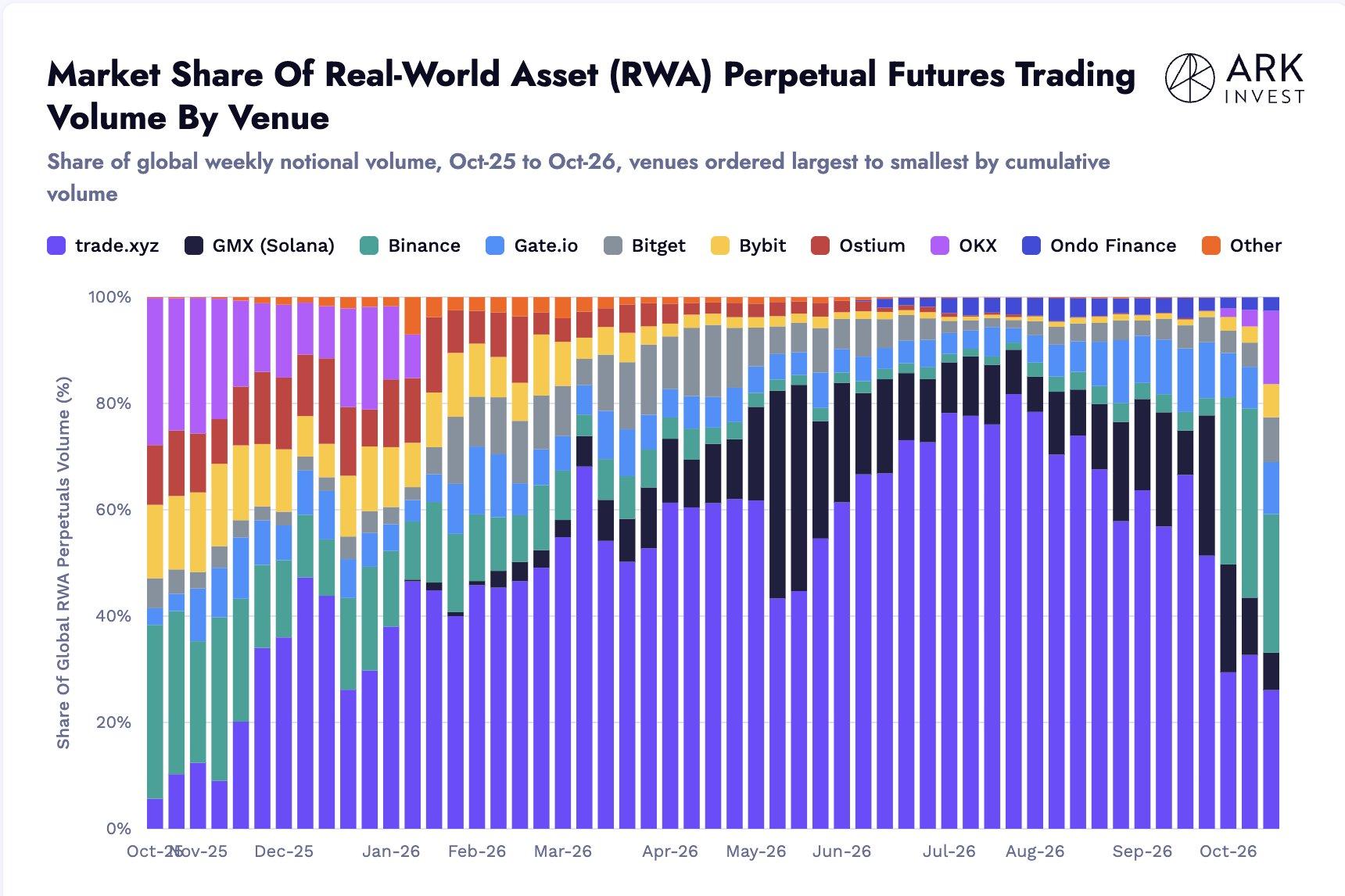
Rather than merely gaining from the redistribution of existing volume, centralised exchanges appear to be attracting most of the additional trading activity, the figures suggest.
Within two weeks, Binance reportedly lifted its share from 3% to 30%, with OKX reaching 14% during the same period. Gate and Bitget are gaining ground as well.
Behind this expansion is the ability of centralised exchanges to provide exposure to traditional assets alongside their established crypto trading products.
By providing continuous access to assets with restricted trading hours on traditional markets, Hyperliquid enjoyed an early advantage.
At the start of the year, geopolitical tensions made oil perpetual futures particularly appealing to traders looking to react to events outside normal market hours. As one of the few venues providing uninterrupted oil trading, Hyperliquid drew activity from traders beyond its customary crypto-native user base.
That initial edge is now diminishing as centralised exchanges introduce comparable access to traditional assets.
In March, Binance introduced TradFi perpetual contracts spanning commodities including gold and silver, selected shares such as Tesla and Intel, and exchange-traded funds (ETFs). Settled in USDT, these contracts can be traded around the clock.
More than 40 tokenised US stocks and ETFs were launched by OKX in July, enabling 24/7 trading against USDT in supported regions. Through its unified markets, users can access assets including Apple, Nvidia and Tesla using their existing exchange accounts.
Traditional financial institutions are also advancing towards tokenised securities as this competitive landscape changes. In January, the NYSE outlined plans for a platform enabling 24/7 trading and blockchain-based settlement of tokenised securities, subject to regulatory approval.
Subsequently, plans for an on-chain tokenised securities venue were announced by OKX and NYSE parent Intercontinental Exchange (ICE) through their joint venture, OKXICE.
In September, the US Securities and Exchange Commission (SEC) also introduced its Innovation Exemption. This provides conditional, temporary regulatory relief for qualifying venues that trade certain tokenised US-listed stocks.
With total perpetual futures volume of $208.07 billion over 30 days, Hyperliquid remains a major venue despite the decline in its RWA market share.
A 3.8% decline over the past 24 hours leaves HYPE trading at $77.8 on the daily chart at the time of writing. Although the token has rebounded from the 100-day EMA near $76, its near-term bias remains bearish. Price is still below the 20-day and 50-day Exponential Moving Averages (EMAs), which sit close together just above $82.00.
Weak momentum readings persist, with the 14-day Relative Strength Index (RSI) at 41 and the Stochastic Oscillator (Stoch) near 17. Both suggest continued downward pressure despite the modest recovery from recent lows.
The 100-day EMA offers the first support on the downside, sitting just above the horizontal level at $75.69. Below that, further support lies at $67.64, followed by $61.16.
The convergence of the short-term EMAs at $82.10 marks the first upside resistance, followed by a stronger hurdle at $85.04. If price breaks and holds above that area, the way would be clear towards the major resistance identified at $97.84.
(The technical analysis of this story was written with the help of an AI tool. Know more.)







Phone: +61 2 8036 8388
Fax: +61 2 8036 8388
Email: support@tmgm.com



The information provided on this website is of a general nature only and does not constitute personal financial advice. Before acting on any information on this website, you should consider the suitability of the information in relation to your objectives, financial situation and needs. Investing in CFDs and FX Margin Contracts carries significant risks and is not suitable for all investors. You may lose more than your initial deposit. You do not own, or have, any interest in the underlying asset. We recommend that you seek independent advice and ensure you fully understand the risks involved before trading. It is important that you read and consider the disclosure document before you acquire any product listed on the website. The information and advertisements offered on this website are not intended for use by any person in any country or jurisdiction where such use would be contrary to local laws and regulations. The Products and Services offered on this website are not intended for residents of the United States, Malaysia and Thailand.
TMGM is authorized and regulated in various jurisdictions.
Trademax Australia Limited, trading as TMGM, is regulated by the Australian Securities and Investments Commission (ASIC), AFSL no. 436416 and is located at Level 28, One International Tower, 100 Barangaroo Avenue, 2000 Sydney, NSW Australia.
Email: support@tmgm.com.au
Trademax Global Limited, trading as TMGM, is authorized and regulated by the Vanuatu Financial Services Commission (VFSC), registration number 40356 and registered at 1276, Kumul Highway, Port Vila, Vanuatu, Republic of Vanuatu.
Email: support@tmgm.com
Trademax Global Markets (SE) Limited, trading as TMGM, is authorized and regulated by the Financial Services Authority (FSA) of Seychelles, with license number SD224. The company is registered at Office No 13, Providence Estate ABIS Centre, Mahe, Seychelles.
Email: support@tmgm.com
Trademax Global Markets (International) Pty Ltd, trading as TMGM, is authorized and regulated by the Financial Services Commission, Mauritius (FSC) with license no. GB22201012, and registered at 33, Edith Cavell Street C/o IQ EQ Fund Services (Mauritius) Ltd Port Louis, 11324 Mauritius.
Email: support@tmgm.com
Copyright © TMGM. All rights reserved


