
News & AnalysisCareer

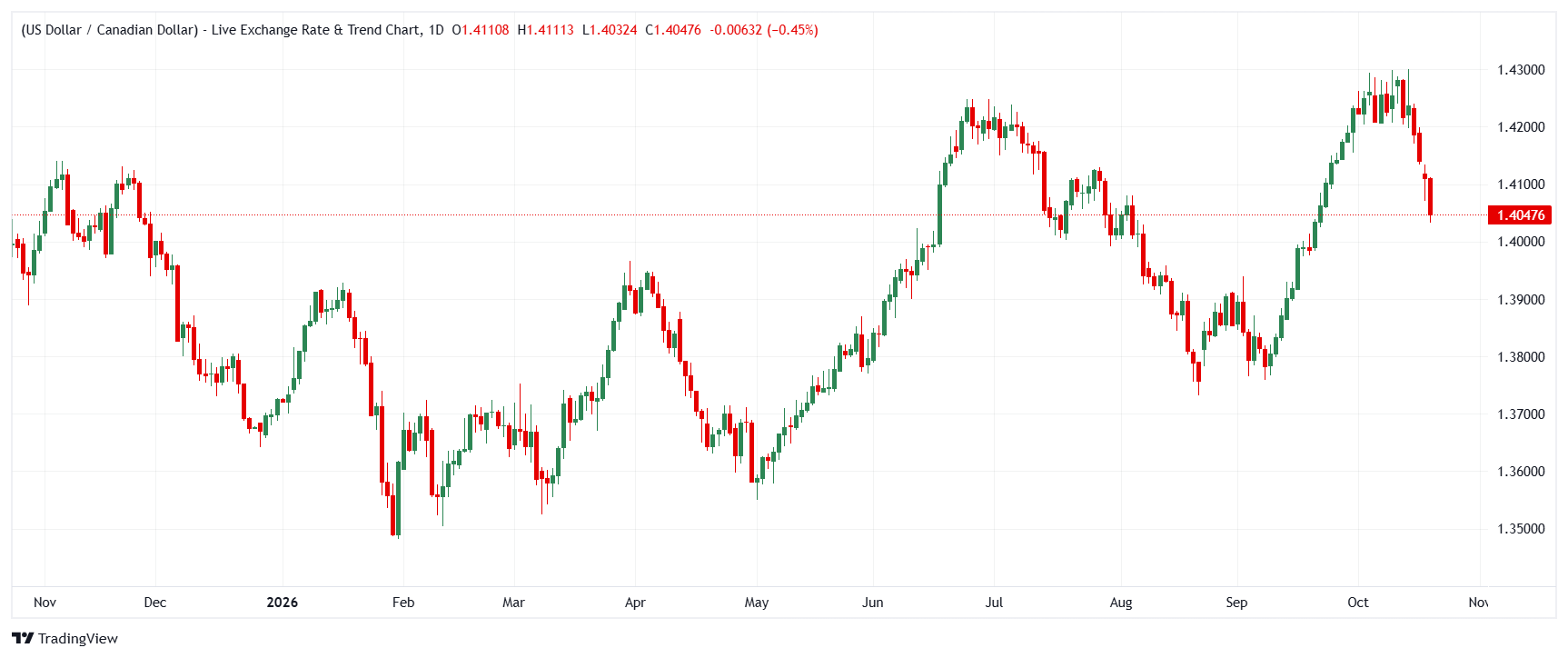
The Canadian Dollar (CAD) faces sharply rising Canadian inflation expectations and the collapse of trade talks with the US, fuelling debate about the Bank of Canada's (BoC) next policy decision. Expectations of a rate increase at the forthcoming meeting have been priced in rapidly, pushing USD/CAD to 1.4071, substantially below its 14 October high of 1.4300. MUFG expects the BoC is likely to raise rates, potentially followed by a second increase in December. Standard Chartered disagrees: it considers market expectations for tightening overdone and forecasts an unchanged rate of 2.25% through the end of 2026. RBC's survey findings help explain the hawkish shift, showing inflation expectations climbing sharply as US trade negotiations break down. Whether the BoC endorses the market's rate-rise expectations will determine the CAD's next move.

Standard Chartered economist Dan Pan forecasts that the BoC will leave its policy rate at 2.25% through the end of 2026 and throughout 2027, despite market pressure for increases starting as soon as this month. Weak domestic demand, muted core inflation and a soft labour market mean there is little risk of inflationary pressure spreading, in his assessment. Any October rate move would reflect "caution, not necessity," while the approximately 100bps of tightening embedded in market prices lacks a strong growth catalyst. His description of that pricing is "excessive."
"We now expect the Bank of Canada (BoC) to stay put at 2.25% until end-2026 and 2027 (versus a cut in 2026 and a hike in 2027 previously). High oil prices have lowered the likelihood of a near-term rate cut, but sustained economic slack and contained underlying inflation still make a case for the BoC to look through near-term energy price shocks."
According to MUFG analyst Lee Hardman, a further recovery in the Canadian Dollar against the US Dollar has taken USD/CAD down to 1.4071, extending its retreat from the 14 October peak of 1.4300. Behind the move is a shift towards tighter expected BoC policy. Interest rate markets now allow for around 21bps of increases, up from just 9bps at the end of last week, after three major Canadian banks changed their forecasts to predict a rise at next week's meeting. Findings from the BoC's business and consumer surveys add weight to that view, with households reporting higher longer-term inflation expectations. Nevertheless, Hardman acknowledges that a rise is "not a done deal" after September brought a second successive month of substantial job losses.
"The BoC has recently signalled that they are moving closer to hiking rates. If they place more weight on forward looking measures of inflation risks, and the Canadian rate market continues to price in a high probability of a hike heading into next week's meeting, we expect the BoC to pull the trigger and tighten policy."
An improvement in Canadian business sentiment through early August gave way to a marked deterioration following the collapse of Canada-US trade negotiations on 21 August, according to Claire Fan at Royal Bank of Canada (RBC). As sentiment, exports and investment weakened, inflation expectations also shifted higher. In September, firms' expectations for inflation one and two years ahead rebounded to 3.7% and 3.1% respectively, close to their spring highs. Half of the businesses surveyed intend to pass higher costs on to customers, a greater proportion than in the previous quarter. Among consumers, expectations over the longer five-year horizon increased substantially to reach the same level as shorter-term expectations, largely reflecting the continuing Middle East conflict.
"Conditions among firms generally improved through early August, but evidence collected after the breakdown of Canada-U.S. trade talks on August 21 pointed to renewed weakness in sentiment, exports and investment alongside rising inflation expectations."
Higher inflation expectations, uncertainty over trade and a vulnerable labour market form the common backdrop to all three banks' assessments. Their conclusions about the BoC's response, and the implications for CAD, differ considerably. A rate rise next week is MUFG's expectation, with another increase possible before December, providing further support for the Canadian Dollar. Conversely, Standard Chartered anticipates an unchanged rate of 2.25% throughout 2026 and 2027 and regards the tightening priced into markets as excessive. That assessment implies potential CAD weakness if expectations for increases are reversed. RBC occupies the middle ground: its findings capture the pressure from inflation expectations that supports hawkish market positioning, alongside fresh weakness in the real economy that makes the BoC's choice more difficult.
Rising inflation expectations among both businesses and consumers, with half of firms intending to pass on higher costs, suggest that inflation risks will remain a persistent concern, according to RBC's evidence. Against that backdrop, the forthcoming BoC meeting will determine the Canadian Dollar's immediate direction. The increase expected by MUFG would probably confirm the market's repricing, prolong the decline in USD/CAD and encourage speculation about a further rise in December. Alternatively, if the BoC disregards the near-term energy-price shock and maintains its rate at 2.25%, as Standard Chartered advocates, a reversal of hawkish positioning could weaken the CAD. Whichever outcome emerges, the inflation-risk narrative is unlikely to dissipate soon, leaving the BoC under pressure and the currency responsive to each indication of its next policy step.
(This article was created with the help of an Artificial Intelligence tool and reviewed by an editor. Know more.)







Phone: +61 2 8036 8388
Fax: +61 2 8036 8388
Email: support@tmgm.com



The information provided on this website is of a general nature only and does not constitute personal financial advice. Before acting on any information on this website, you should consider the suitability of the information in relation to your objectives, financial situation and needs. Investing in CFDs and FX Margin Contracts carries significant risks and is not suitable for all investors. You may lose more than your initial deposit. You do not own, or have, any interest in the underlying asset. We recommend that you seek independent advice and ensure you fully understand the risks involved before trading. It is important that you read and consider the disclosure document before you acquire any product listed on the website. The information and advertisements offered on this website are not intended for use by any person in any country or jurisdiction where such use would be contrary to local laws and regulations. The Products and Services offered on this website are not intended for residents of the United States, Malaysia and Thailand.
TMGM is authorized and regulated in various jurisdictions.
Trademax Australia Limited, trading as TMGM, is regulated by the Australian Securities and Investments Commission (ASIC), AFSL no. 436416 and is located at Level 28, One International Tower, 100 Barangaroo Avenue, 2000 Sydney, NSW Australia.
Email: support@tmgm.com.au
Trademax Global Limited, trading as TMGM, is authorized and regulated by the Vanuatu Financial Services Commission (VFSC), registration number 40356 and registered at 1276, Kumul Highway, Port Vila, Vanuatu, Republic of Vanuatu.
Email: support@tmgm.com
Trademax Global Markets (SE) Limited, trading as TMGM, is authorized and regulated by the Financial Services Authority (FSA) of Seychelles, with license number SD224. The company is registered at Office No 13, Providence Estate ABIS Centre, Mahe, Seychelles.
Email: support@tmgm.com
Trademax Global Markets (International) Pty Ltd, trading as TMGM, is authorized and regulated by the Financial Services Commission, Mauritius (FSC) with license no. GB22201012, and registered at 33, Edith Cavell Street C/o IQ EQ Fund Services (Mauritius) Ltd Port Louis, 11324 Mauritius.
Email: support@tmgm.com
Copyright © TMGM. All rights reserved

