
News & AnalysisCareer

Having reached a five-month high of $103.28, West Texas Intermediate (WTI) futures on NYMEX fall back towards $100 on Monday. Caution ahead of major monetary policy decisions from several global central banks weighs on oil as investors adopt a more guarded stance.

Upcoming monetary policy meetings will dominate market attention for the rest of the week, according to analysts at Danske Bank, who write that “focus turns to interest rate decisions from the Fed on Wednesday, the ECB on Thursday and the Bank of Japan on Friday.” Outlining its outlook, the bank says it will “expect all three to keep interest rates unchanged before resuming rate hikes later this year,” pointing to a temporary pause in tightening rather than an end to the prospect of further increases.
Concerns over renewed escalation between the United States (US) and Iran drove substantial gains in oil last week. A US State Department call for a broader withdrawal of US diplomatic personnel from the Gulf prompted financial markets to adopt a cautious stance.
A near-term upward bias remains in crude prices, according to TD Securities. Its analysts caution that “we expect crude oil will remain skewed to the upside in the near term as escalation risk ahead of Israeli elections and US midterm elections remains elevated.” Explaining the geopolitical premium in current prices, they observe that “recent Houthi strikes have seen risk premium pricing in the market increase, while persistent tanker attacks by Iran appear to have been successful in reducing some Hormuz flows,” lending further support to that premium.
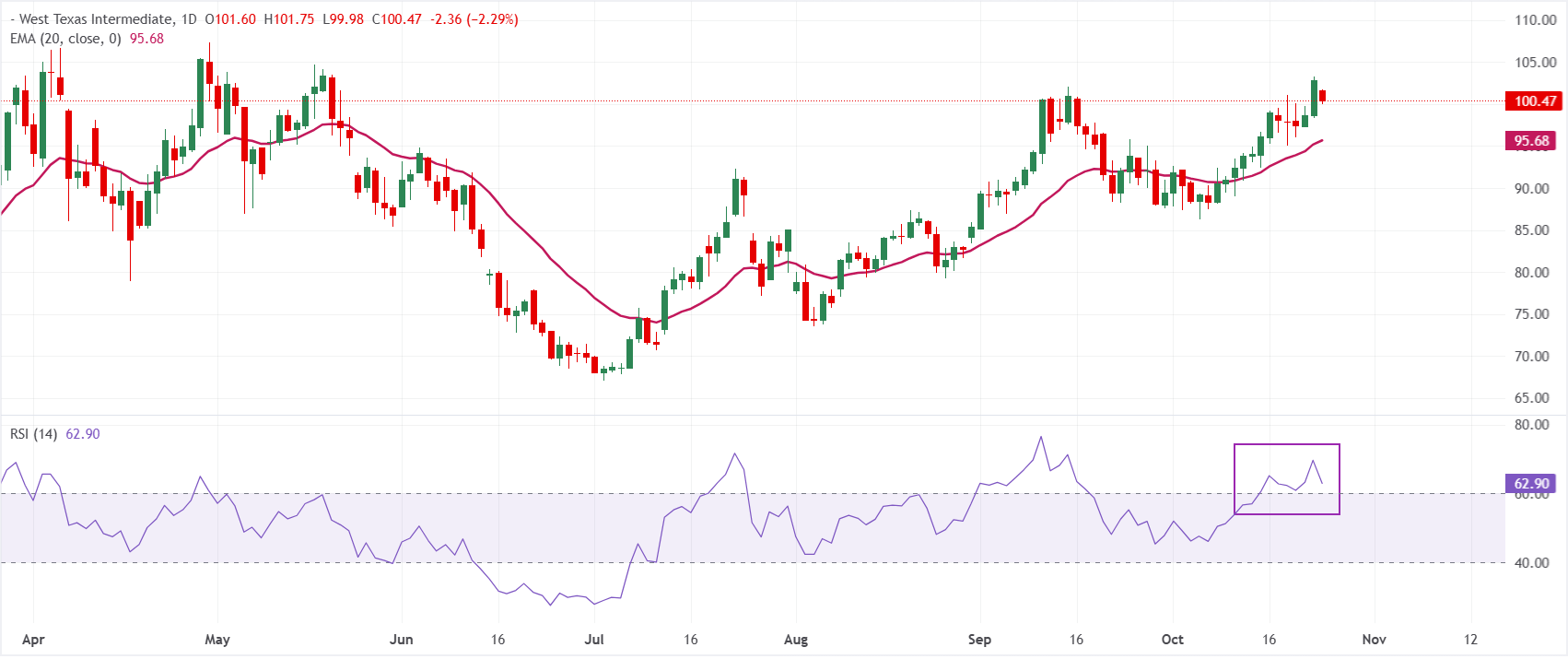
At $100.51 on the daily chart, WTI US Oil remains comfortably above its 20-day Exponential Moving Average (EMA) of $95.68. This positioning sustains a bullish near-term outlook and suggests that the uptrend retains support despite the latest consolidation. A Relative Strength Index (RSI) reading of 62.99 also points to positive, though not excessive, upward momentum, remaining in bullish territory without reaching overbought levels.
The $100.51 area provides the first downside support and an immediate pivot. A more pronounced retreat could encounter stronger demand around the 20-day EMA at $95.68. As the current dataset identifies no nearby technical resistance, traders may keep their attention on price action above these support levels, assessing whether the bullish structure can extend or give way to a correction.
(The technical analysis of this story was written with the help of an AI tool. Know more.)
Among the crude oils traded internationally, WTI, short for West Texas Intermediate, is one of three major types alongside Brent and Dubai Crude. Its relatively low gravity and sulphur content account for the descriptions “light” and “sweet”, respectively. Regarded as a high-quality oil that is straightforward to refine, WTI originates in the United States and reaches the market through the Cushing hub, known as “The Pipeline Crossroads of the World”. Its role as an oil-market benchmark means WTI prices are regularly cited in the media.
Supply and demand underpin WTI Oil prices, just as they do for other assets. Stronger global growth can lift demand, while weaker growth can have the reverse effect. Supply disruptions arising from political instability, wars or sanctions can also affect prices, as can decisions by OPEC, the group of major oil-producing countries. Because crude is traded predominantly in US Dollars, the currency's value is another influence on WTI prices: a weaker US Dollar can make oil more affordable, whereas a stronger one can have the opposite effect.
WTI Oil prices respond to weekly inventory releases from the American Petroleum Institute (API) and the Energy Information Agency (EIA), as stock changes reveal shifts in supply and demand. Falling inventories may signal stronger demand and push oil prices higher; rising stocks may indicate greater supply and weigh on prices. The API publishes its figures every Tuesday, followed by the EIA the next day. The two reports tend to produce similar results, with readings within 1% of one another 75% of the time. As the EIA is a government agency, its figures are regarded as more reliable.
At meetings held twice a year, the 12 oil-producing nations that make up OPEC (Organization of the Petroleum Exporting Countries) jointly set production quotas for their members. These decisions frequently influence WTI Oil prices. Lower quotas can restrict supply and lift prices, while an increase in OPEC production has the reverse effect. The broader OPEC+ grouping brings in ten additional non-OPEC members, with Russia the most notable.







Phone: +61 2 8036 8388
Fax: +61 2 8036 8388
Email: support@tmgm.com



The information provided on this website is of a general nature only and does not constitute personal financial advice. Before acting on any information on this website, you should consider the suitability of the information in relation to your objectives, financial situation and needs. Investing in CFDs and FX Margin Contracts carries significant risks and is not suitable for all investors. You may lose more than your initial deposit. You do not own, or have, any interest in the underlying asset. We recommend that you seek independent advice and ensure you fully understand the risks involved before trading. It is important that you read and consider the disclosure document before you acquire any product listed on the website. The information and advertisements offered on this website are not intended for use by any person in any country or jurisdiction where such use would be contrary to local laws and regulations. The Products and Services offered on this website are not intended for residents of the United States, Malaysia and Thailand.
TMGM is authorized and regulated in various jurisdictions.
Trademax Australia Limited, trading as TMGM, is regulated by the Australian Securities and Investments Commission (ASIC), AFSL no. 436416 and is located at Level 28, One International Tower, 100 Barangaroo Avenue, 2000 Sydney, NSW Australia.
Email: support@tmgm.com.au
Trademax Global Limited, trading as TMGM, is authorized and regulated by the Vanuatu Financial Services Commission (VFSC), registration number 40356 and registered at 1276, Kumul Highway, Port Vila, Vanuatu, Republic of Vanuatu.
Email: support@tmgm.com
Trademax Global Markets (SE) Limited, trading as TMGM, is authorized and regulated by the Financial Services Authority (FSA) of Seychelles, with license number SD224. The company is registered at Office No 13, Providence Estate ABIS Centre, Mahe, Seychelles.
Email: support@tmgm.com
Trademax Global Markets (International) Pty Ltd, trading as TMGM, is authorized and regulated by the Financial Services Commission, Mauritius (FSC) with license no. GB22201012, and registered at 33, Edith Cavell Street C/o IQ EQ Fund Services (Mauritius) Ltd Port Louis, 11324 Mauritius.
Email: support@tmgm.com
Copyright © TMGM. All rights reserved


