

Trading
Explore a wide range of markets with competitive pricing, deep liquidity, and advanced trading tools.
Learn More 
Platform
Trade seamlessly with TMGM's powerful platform, built for speed, precision, and a superior trading experience.
Learn More Trading Platform
Academy
Learn the fundamentals of trading with beginner-friendly resources, including guides, webinars, and market insights.
Learn More News & Analysis
Get real-time market updates and expert analysis to stay ahead of trading opportunities
Learn More News & Analysis
About
Learn what sets TMGM apart — our global presence, regulatory strength, and commitment to innovation in trading.
Learn More Why Choose TMGM
Sponsorship
Australian Dollar posts modest gains against US Dollar as markets await US flash PMI data
- Broad outperformance helps the Australian Dollar edge up against the US Dollar.
- Another RBA interest rate increase is anticipated by investors.
- An unchanged interest rate decision is expected from the Fed on Wednesday.
Broad strength in the Australian Dollar (AUD), supported by firm expectations of another Reserve Bank of Australia (RBA) interest rate increase this year, lifts the Aussie pair. During Friday’s European session, the AUD is marginally firmer against the US Dollar (USD), trading around 0.7018.
How Is The Australian Dollar Performing Today?
Among the major currencies listed below, the Australian Dollar recorded its strongest performance against the Swiss Franc today. The table sets out the Australian Dollar’s (AUD) percentage moves against each currency.
| USD | EUR | GBP | JPY | CAD | AUD | NZD | CHF | |
|---|---|---|---|---|---|---|---|---|
| USD | 0.17% | 0.19% | 0.09% | -0.04% | 0.02% | -0.02% | 0.43% | |
| EUR | -0.17% | 0.03% | -0.07% | -0.20% | -0.14% | -0.19% | 0.26% | |
| GBP | -0.19% | -0.03% | -0.10% | -0.21% | -0.17% | -0.20% | 0.23% | |
| JPY | -0.09% | 0.07% | 0.10% | -0.12% | -0.08% | -0.12% | 0.34% | |
| CAD | 0.04% | 0.20% | 0.21% | 0.12% | 0.06% | 0.00% | 0.46% | |
| AUD | -0.02% | 0.14% | 0.17% | 0.08% | -0.06% | -0.04% | 0.40% | |
| NZD | 0.02% | 0.19% | 0.20% | 0.12% | -0.01% | 0.04% | 0.45% | |
| CHF | -0.43% | -0.26% | -0.23% | -0.34% | -0.46% | -0.40% | -0.45% |
Percentage movements between major currencies are displayed in the heat map. To read a currency pair, select its base currency in the left-hand column and its quote currency in the top row. Selecting the Australian Dollar on the left and following that row across to the US Dollar, for instance, gives the percentage change for AUD (base)/USD (quote) in the corresponding cell.

Can the Aussie extend gains as RBA warning puts inflation data in focus?
Comments by RBA Deputy Governor Andrew Hauser helped drive AUD-USD to its highest level since late September, according to analysts at Commerzbank, who say the Aussie “received further support from a significant rise in interest rate expectations,”. Market scrutiny of the forthcoming price figures has intensified after Hauser characterised the inflation outlook as “materially worse” than the RBA’s earlier expectations and cautioned about a possible “de-anchoring of inflation expectations,”.
With the RBA’s long-term inflation target at 2-3%, Commerzbank views the survey findings cited by Hauser as a concern. According to the bank, he drew attention to evidence that “a growing share of businesses believe that inflation of 3-3.5% is ‘the new normal’.” Commerzbank describes this as “certainly be concerning,” especially since “trimmed-mean inflation most recently stood at 3.6%, further above the target range.”
Against this backdrop, Commerzbank says the situation “makes the inflation data due on 28 October all the more important.” The bank notes that the RBA’s August forecasts had already projected “headline inflation to fall to 3.6% and trimmed-mean inflation to 3.3% by December,” adding that the forthcoming figures “should at least provide indications that inflation is indeed moving in that direction.” It warns that if “price pressures remain similarly elevated or even intensify, however, this would validate the recent rise in rate-hike expectations and cement the risk of another rate move at the RBA’s meeting on 3 November.”
For the US Dollar, attention is on October’s preliminary United States (US) S&P Global PMI figures, scheduled for release at 13:45 GMT. Expectations point to another rise in both the manufacturing and services PMI, although the increases are likely to be moderate.
Having retested Thursday’s three-week low of 101.44, the DXY has recovered. At the time of writing, the USD Index is up 0.1%, trading close to 101.75.
Next week’s monetary policy announcement from the Federal Reserve (Fed) will be the key catalyst for the US Dollar. Expectations are for interest rates to remain in the 3.75%-4.00% range.
AUD/USD Technical Analysis: Can Buyers Defend The EMA?
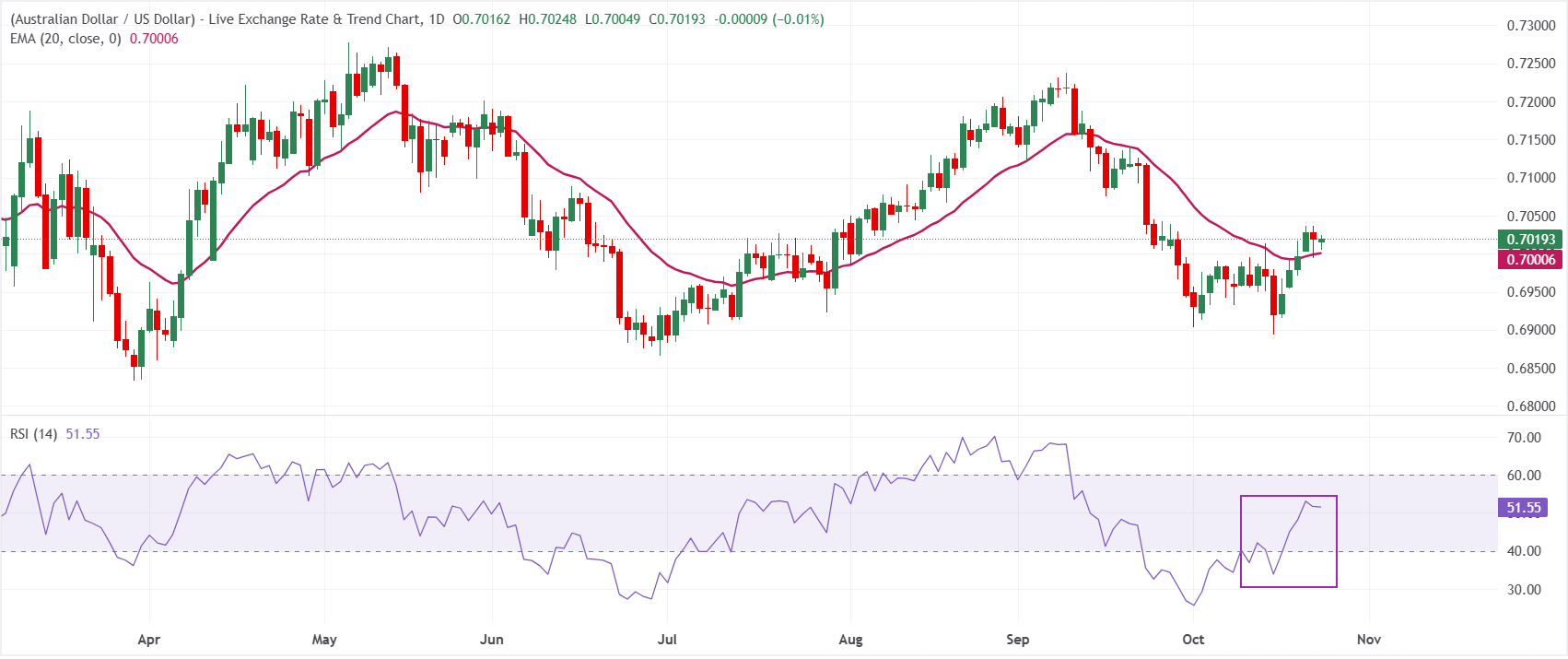
A mildly bullish near-term bias remains in place as AUD/USD, quoted at 0.7019 on the daily chart, stays just above its 20-day exponential moving average (EMA) of 0.7001. The pair is defending this dynamic support. Meanwhile, the Relative Strength Index (RSI) reading of 51.5 is only slightly above neutral, suggesting that momentum is stabilising following the recent recovery from oversold territory, rather than signalling a strong impulsive rally.
The 20-day EMA near 0.7001 offers immediate downside support. Today’s opening area of 0.7020/0.7020 serves as a nearby pivot; a break below it would undermine the positive bias and leave the pair vulnerable to deeper consolidation. As the current dataset provides no clear technical levels overhead, additional gains would likely hinge on buyers continuing to protect the EMA base and lifting the pair further from the 0.70 mark, thereby preserving the broader recovery structure.
(The technical analysis of this story was written with the help of an AI tool. Know more.)
Economic Release In Focus
What Does The Fed Interest Rate Decision Signal?
At eight scheduled meetings each year, the Federal Reserve (Fed) reviews monetary policy and determines interest rates. Maintaining full employment and keeping inflation at 2% form its dual mandate. To pursue these goals, it primarily sets interest rates, covering both lending to banks and lending between banks. Higher rates typically support the US Dollar (USD) by drawing in more foreign capital. A rate cut, by contrast, generally weakens the USD as funds move towards countries offering better returns. When rates remain on hold, the focus shifts to the language of the Federal Open Market Committee (FOMC) statement: a hawkish tone suggests expectations of higher future interest rates, while a dovish tone points to expectations of lower rates.
Read further.Upcoming release: Wed 28 Oct 2026 18:00
Release frequency: Irregular
Consensus estimate: 4%
Previous reading: 4%
Data source: Federal Reserve
POPULAR ARTICLES
1Mexican Peso: Banxico’s lag behind Fed keeps currency under pressure – ING2US Dollar: Holding Firm Ahead of FOMC Amid Election Risks – TD Securities3Silver Price Forecast: Is $50 in sight as bearish pressure intensifies?4Euro: Will Fed and ECB convergence support gradual gains? – Commerzbank5XRP holds support at $1.30 as Ripple teams up with Arf to bring RLUSD settlement liquidity to XRPL6Gold: A cautious view of near-term prospects – OCBC7Why did safe-haven demand weaken the US Dollar against the Japanese Yen despite its yield advantage?8British Pound: Are BoE tightening expectations justified? – BBH9USD/CHF Price Forecast: Dollar moves towards 0.8250 as momentum picks up
LIVE QUOTES


ALL ABOUT FOREX
What Is a Stop Loss, How Does It Work and How Do You Set One?
Margin Call Meaning: What It Is, What Triggers It, and How to Avoid One
What Is an Islamic Account in Forex?
Best Indicators for Forex Trading and How to Use Them
The Top 10 Most Traded Currency Pairs in the World
What are the Major Forex Pairs? 7 Major Currency Pairs in the World
5 Best Forex Trading Apps In India In 2026
Top 15 Weakest Currencies in the World
Best Time to Trade Forex
Get Started!
Sign up and access the Global Markets in less than 3 minutes

Connect With Us









Contacts
Phone: +61 2 8036 8388
Fax: +61 2 8036 8388
Email: support@tmgm.com



The information provided on this website is of a general nature only and does not constitute personal financial advice. Before acting on any information on this website, you should consider the suitability of the information in relation to your objectives, financial situation and needs. Investing in CFDs and FX Margin Contracts carries significant risks and is not suitable for all investors. You may lose more than your initial deposit. You do not own, or have, any interest in the underlying asset. We recommend that you seek independent advice and ensure you fully understand the risks involved before trading. It is important that you read and consider the disclosure document before you acquire any product listed on the website. The information and advertisements offered on this website are not intended for use by any person in any country or jurisdiction where such use would be contrary to local laws and regulations. The Products and Services offered on this website are not intended for residents of the United States, Malaysia and Thailand.
TMGM is authorized and regulated in various jurisdictions.
Trademax Australia Limited, trading as TMGM, is regulated by the Australian Securities and Investments Commission (ASIC), AFSL no. 436416 and is located at Level 28, One International Tower, 100 Barangaroo Avenue, 2000 Sydney, NSW Australia.
Email: support@tmgm.com.au
Trademax Global Limited, trading as TMGM, is authorized and regulated by the Vanuatu Financial Services Commission (VFSC), registration number 40356 and registered at 1276, Kumul Highway, Port Vila, Vanuatu, Republic of Vanuatu.
Email: support@tmgm.com
Trademax Global Markets (SE) Limited, trading as TMGM, is authorized and regulated by the Financial Services Authority (FSA) of Seychelles, with license number SD224. The company is registered at Office No 13, Providence Estate ABIS Centre, Mahe, Seychelles.
Email: support@tmgm.com
Trademax Global Markets (International) Pty Ltd, trading as TMGM, is authorized and regulated by the Financial Services Commission, Mauritius (FSC) with license no. GB22201012, and registered at 33, Edith Cavell Street C/o IQ EQ Fund Services (Mauritius) Ltd Port Louis, 11324 Mauritius.
Email: support@tmgm.com
Copyright © TMGM. All rights reserved