

Trading
Explore a wide range of markets with competitive pricing, deep liquidity, and advanced trading tools.
Learn More 
Platform
Trade seamlessly with TMGM's powerful platform, built for speed, precision, and a superior trading experience.
Learn More Trading Platform
Academy
Learn the fundamentals of trading with beginner-friendly resources, including guides, webinars, and market insights.
Learn More News & Analysis
Get real-time market updates and expert analysis to stay ahead of trading opportunities
Learn More News & Analysis
About
Learn what sets TMGM apart — our global presence, regulatory strength, and commitment to innovation in trading.
Learn More Why Choose TMGM
Sponsorship
Bitcoin derivatives strengthen, but can the $87,000 sell wall be breached?
- Renewed positioning accompanied Bitcoin’s price recovery, with futures open interest climbing 4.2% to 645,410 BTC.
- Selling pressure could challenge BTC around $86,500 to $87,500, a resistance zone where sell orders coincide with major leveraged liquidation clusters.
- Selling pressure may emerge for Strategy if new rules effective from November 11 lead MSCI to remove the company from its indices.
Rising selling risk in the $86,500 to $87,500 zone threatened to cap Bitcoin’s (BTC) recovery on Wednesday, even as derivatives positioning strengthened. Sell orders and leveraged liquidation clusters in that range could restrict further upside.

Is Bitcoin derivatives positioning strengthening again?
According to a Wednesday report from crypto exchange Bitfinex, buying on dips supported Bitcoin between $81,724 and $83,470, allowing it to hold the lower end of its range despite repeated attempts to push prices down.
By October 20, futures open interest on major exchanges had reached 645,410 BTC, up 4.2% from the October 12 low. The increase pointed to fresh positioning alongside the price recovery. During peak sessions, funding rates normalised to annualised levels of 7% to 9%, indicating a moderate preference for leveraged long positions.
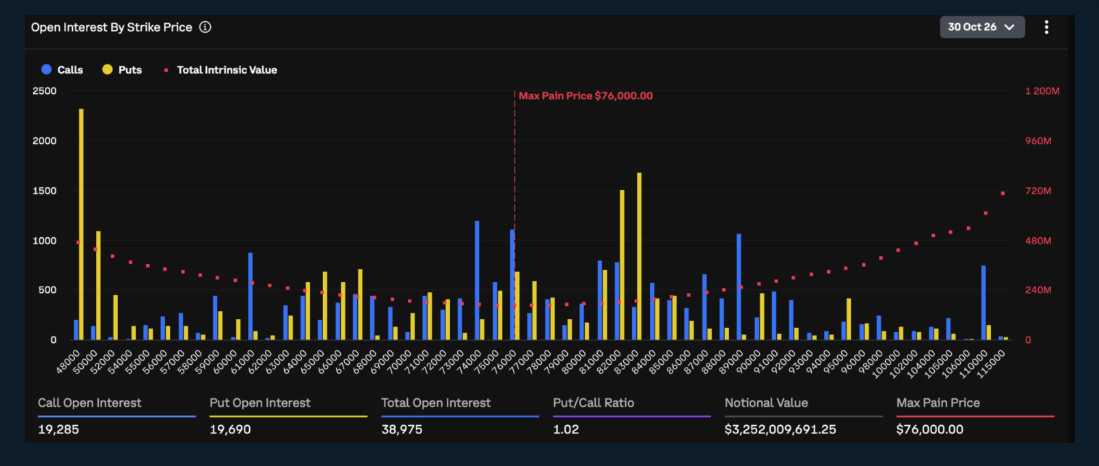
A limited near-term trading range is also suggested by options positioning. According to Bitfinex, notional open interest for Friday’s expiry stands at $1.23 billion, while the maximum pain price is close to $82,000.
For the October 30 monthly expiry, notional open interest totals $11.2 billion. Its implied one-standard-deviation range extends from $78,300 to $87,100.
Can Bitcoin clear the liquidity clusters at $87K resistance?
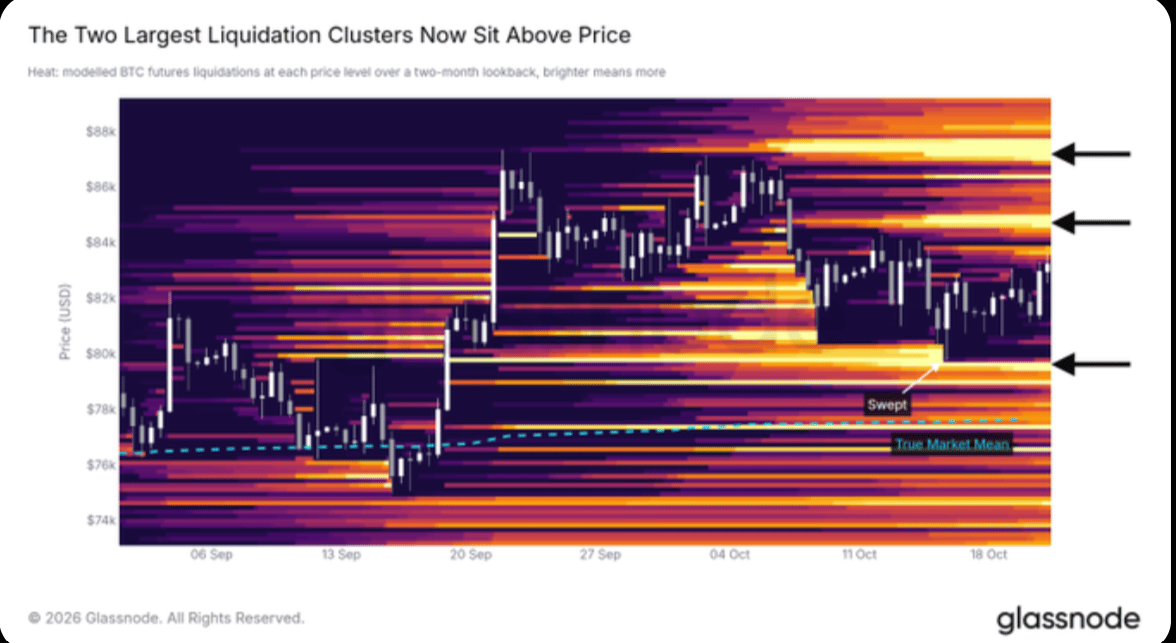
Against the improving backdrop in Bitcoin derivatives, onchain analytics firm Glassnode flagged sell orders in the $86,500 to $87,500 range. It also identified liquidation clusters close to $85,000 and $87,000.
“A move toward $87K could gain speed as short positions are forced shut, but it would meet the asks on the order book at the same price,” Glassnode said in a report published on Wednesday.
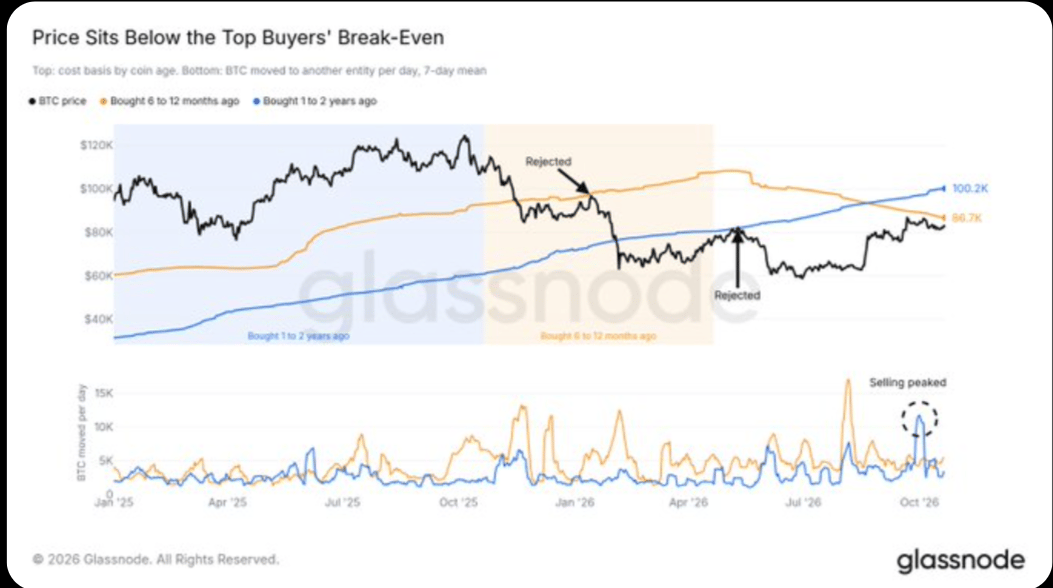
Profit realisation had slowed to roughly half the pace recorded in the week of September’s market high, Glassnode noted. This suggested that holders sitting on profits were exerting less selling pressure.
Among investors who bought Bitcoin one to two years ago, selling has fallen below a third of the daily level seen in early October.
“A daily close above $86.7K would put the 6 to 12 month buyers back in profit on average and clear the nearest band of supply overhead,” the firm said.
Meanwhile, Monday brought a return to inflows for US spot Bitcoin exchange-traded funds (ETFs), which attracted $526 million. This was their biggest daily intake since September 22 and pushed weekly flows back into positive territory, though ETF trading volumes stayed subdued.
Glassnode added: “Inflows that repeat on rising volume would show demand broadening beyond a single day,”
Could MSCI’s decision lead to Strategy’s removal?
Also flagged in the report was MSCI’s forthcoming final list of companies affected by its new index rules for non-operating businesses. The list is scheduled for release on November 11.
A preliminary assessment had identified Strategy as one of the affected companies. Should it be removed, funds tracking the indices could be compelled to sell its shares.
Strategy has faced the prospect of removal from MSCI indices before. A proposal put forward by MSCI in October 2025 sought to exclude companies with digital asset holdings representing at least 50% of total assets, placing Strategy at risk. In January, however, the index provider stepped back from immediate exclusion.
POPULAR ARTICLES
1USD/JPY Price Forecast: Bears target trading range support near 157.50 as pair falls to one-week low2Why is the Swiss Franc struggling as Fed rate pause expectations weigh on the US Dollar?3AUD/JPY Price Forecast: Does the dip towards 110.50 reinforce a modestly bearish outlook?4India Gold price today: FXStreet data shows a decline in Gold5Why has Gold fallen to a one-week low below $4,100 as Fed hike bets leave bulls unmoved by weak USD?6Cardano Price Forecast: Can ADA sustain its recovery amid weak momentum?7Ripple and Stellar outlook: Why are XRP and XLM recoveries stalling below EMAs?8EUR/JPY Price Forecast: Pair Trades Near Nine-Day EMA Around 177.509Zcash Price Forecast: What next as ZEC regains $1,300 and ETF inflow reaches 30-day high?
LIVE QUOTES


ALL ABOUT TECHNICAL
Average True Range (ATR) Indicator: What Is the Formula, and How Do You Read and Use It?
What Is a Judas Swing? ICT Trading Strategy Explained With Examples
The Real Interest Rate: Are Your Savings Actually Earning Anything?
Butterfly Pattern Trading: How to Identify and Trade the Butterfly Harmonic Pattern
What Is a Rising Wedge Pattern and How Do You Trade It?
What Is a Descending Triangle Pattern and How Do You Trade It?
Accumulation, Manipulation and Distribution (AMD): ICT Power of 3 Trading Guide
How to Read the CPI Report Before You Trade It: A Trader's Guide to Headline and Core
Slippage, Spread and Gaps: Why Your Fill Differs From the Price You Saw
Get Started!
Sign up and access the Global Markets in less than 3 minutes

Connect With Us









Contacts
Phone: +61 2 8036 8388
Fax: +61 2 8036 8388
Email: support@tmgm.com



The information provided on this website is of a general nature only and does not constitute personal financial advice. Before acting on any information on this website, you should consider the suitability of the information in relation to your objectives, financial situation and needs. Investing in CFDs and FX Margin Contracts carries significant risks and is not suitable for all investors. You may lose more than your initial deposit. You do not own, or have, any interest in the underlying asset. We recommend that you seek independent advice and ensure you fully understand the risks involved before trading. It is important that you read and consider the disclosure document before you acquire any product listed on the website. The information and advertisements offered on this website are not intended for use by any person in any country or jurisdiction where such use would be contrary to local laws and regulations. The Products and Services offered on this website are not intended for residents of the United States, Malaysia and Thailand.
TMGM is authorized and regulated in various jurisdictions.
Trademax Australia Limited, trading as TMGM, is regulated by the Australian Securities and Investments Commission (ASIC), AFSL no. 436416 and is located at Level 28, One International Tower, 100 Barangaroo Avenue, 2000 Sydney, NSW Australia.
Email: support@tmgm.com.au
Trademax Global Limited, trading as TMGM, is authorized and regulated by the Vanuatu Financial Services Commission (VFSC), registration number 40356 and registered at 1276, Kumul Highway, Port Vila, Vanuatu, Republic of Vanuatu.
Email: support@tmgm.com
Trademax Global Markets (SE) Limited, trading as TMGM, is authorized and regulated by the Financial Services Authority (FSA) of Seychelles, with license number SD224. The company is registered at Office No 13, Providence Estate ABIS Centre, Mahe, Seychelles.
Email: support@tmgm.com
Trademax Global Markets (International) Pty Ltd, trading as TMGM, is authorized and regulated by the Financial Services Commission, Mauritius (FSC) with license no. GB22201012, and registered at 33, Edith Cavell Street C/o IQ EQ Fund Services (Mauritius) Ltd Port Louis, 11324 Mauritius.
Email: support@tmgm.com
Copyright © TMGM. All rights reserved