

Trading
Explore a wide range of markets with competitive pricing, deep liquidity, and advanced trading tools.
Learn More 
Platform
Trade seamlessly with TMGM's powerful platform, built for speed, precision, and a superior trading experience.
Learn More Trading Platform
Academy
Learn the fundamentals of trading with beginner-friendly resources, including guides, webinars, and market insights.
Learn More News & Analysis
Get real-time market updates and expert analysis to stay ahead of trading opportunities
Learn More News & Analysis
About
Learn what sets TMGM apart — our global presence, regulatory strength, and commitment to innovation in trading.
Learn More Why Choose TMGM
Sponsorship
Bitcoin Price Forecast: Why has BTC slipped below $80,000 as Fed keeps rates unchanged with a hawkish tone?
- Bitcoin gives up most of its weekly advance and falls below $80,000 on Thursday following the Fed’s hawkish hold on interest rates.
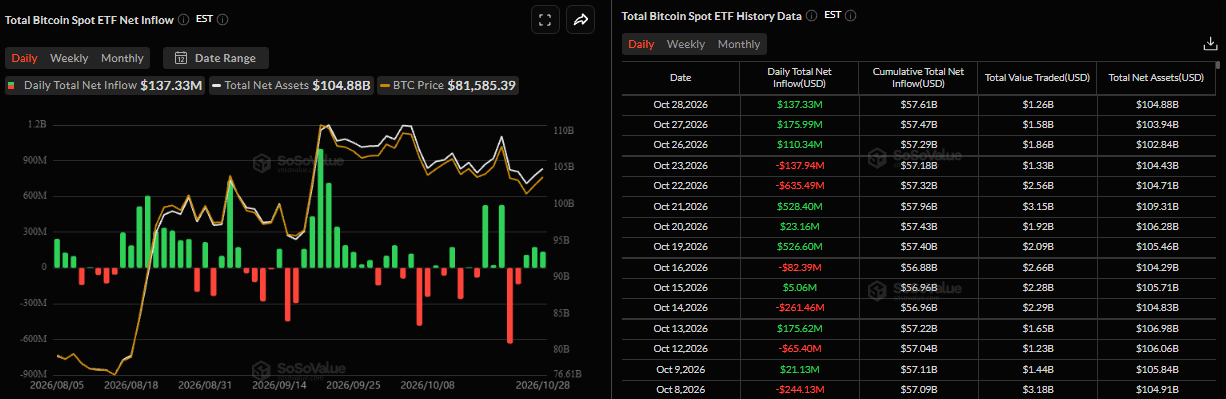
- A third successive day of positive flows saw US-listed spot ETFs attract $137.33 million on Wednesday.
- Fresh indications of economic health are in focus as market participants await Thursday’s US September PCE and Q3 GDP releases.
Most of Bitcoin’s (BTC) weekly advance has been wiped out as the cryptocurrency falls below $80,000 on Thursday, following a hawkish signal from the Federal Reserve (Fed) despite its decision to leave interest rates unchanged. Institutional demand has nevertheless remained modest so far this week, notwithstanding the price pullback. Spot Bitcoin Exchange Traded Funds (ETFs) attracted $137.33 million on Wednesday, extending their run of positive flows to three consecutive days.

Caution also prevails among traders awaiting fresh indications of economic health from the US September Personal Consumption Expenditures (PCE) inflation report and Q3 Gross Domestic Product (GDP) figures, both scheduled for release later on Thursday.
Does the Fed’s rate hold leave room for further action on inflation?
At the conclusion of its two-day October policy meeting on Wednesday, the Fed left its policy rate at 3.75%-4.00%, though the decision was not unanimous. Lisa Cook and Beth Hammack were the two officials seeking a 25-basis-point increase. Chair Kevin Warsh, meanwhile, said incoming information would guide the Fed’s assessment of whether additional action is necessary.
At his press conference, Warsh said officials have “made clear our readiness to act as circumstances require, and we have shown our willingness to act.”
Warsh said, “It’s our responsibility to get inflation down,” adding: “That’s the reason the FOMC’s discussion over the last couple of days focused mainly on the price stability side of our remit,”
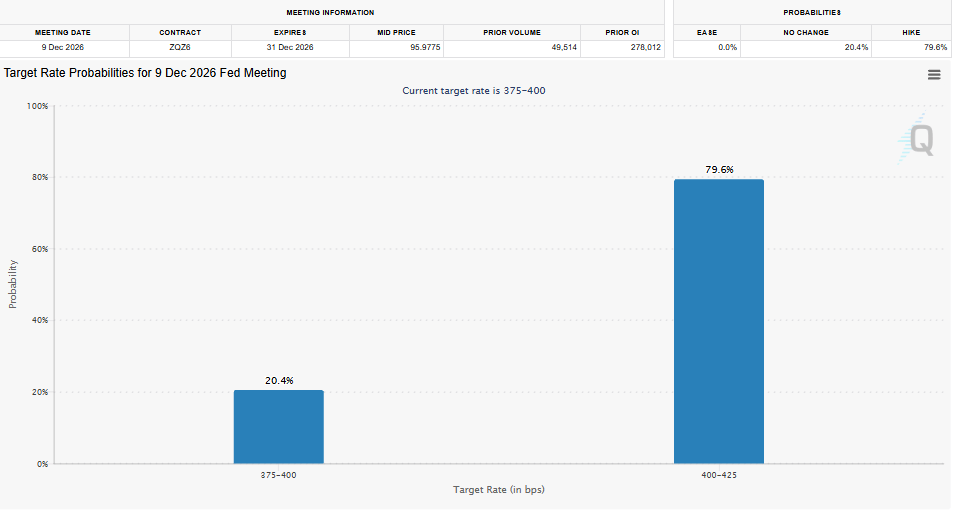
Although an unchanged rate decision was already priced in, inflation concerns and the hawkish tone of the Fed’s forward guidance have reinforced market caution, putting pressure on risk assets such as Bitcoin. The CME FedWatch Tool put the likelihood of tightening at the December 9 meeting at 79.6% on Thursday, a slight increase from 78.33% on Tuesday. This shift towards tighter monetary policy is lending modest support to safe-haven assets: the 10-year Treasury yield remains above 5%, while the US Dollar Index (DXY) holds above $102. Risk assets remain under pressure, with BTC falling below $80,000 on Thursday.
Even so, USD bulls appear reluctant to initiate fresh positions without further signals. Attention therefore remains on Thursday’s US releases: the Advance Q3 GDP report and the Personal Consumption Expenditures (PCE) Price Index. Alongside fresh indications of economic health and the monetary policy outlook, these key figures will have a major bearing on USD price movements and could help establish a directional bias for BTC.
Can modest institutional demand support Bitcoin?
A cautiously bullish tone continues to characterise institutional demand for Bitcoin. According to SoSoValue, spot Bitcoin ETFs drew $137.33 million on Wednesday, extending inflows to a third consecutive week. Daily inflows so far point to modest institutional buying, but their smaller scale compared with last week suggests investors remain cautious. A continuation and strengthening of these inflows this week could help BTC recover.
Bitcoin technical outlook: Can BTC find support below $80,000?
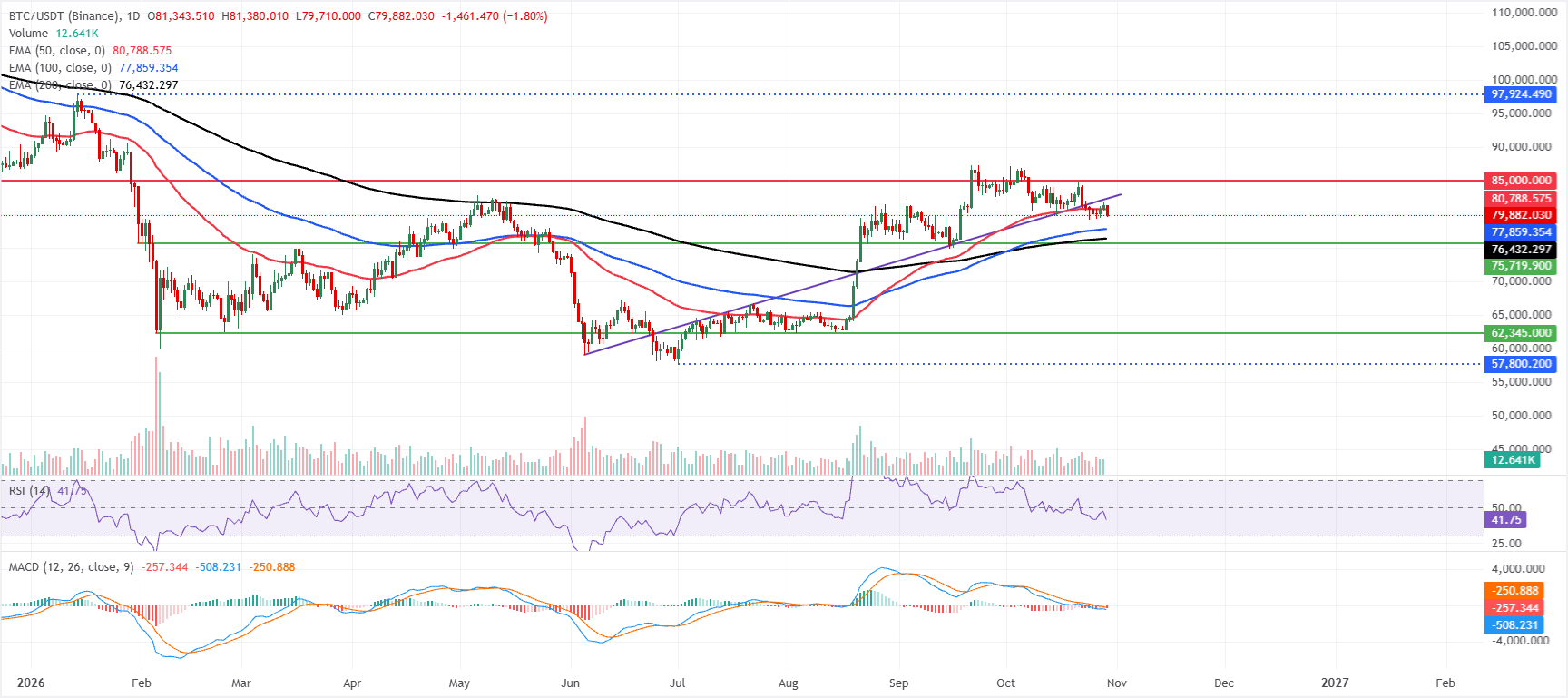
At $79,882 on Thursday, Bitcoin remains above its 100-day and 200-day Exponential Moving Averages (EMAs), positioned at $77,859 and $76,432 respectively. These levels support the broader uptrend, although the 50-day EMA at $80,788 is increasingly restricting the pair’s upside.
Momentum points to consolidation with a mildly bearish bias as buyers struggle to regain the short-term average. The Relative Strength Index (RSI) has eased towards the low-40s, while the Moving Average Convergence Divergence (MACD) stays below zero with muted momentum.
Any move higher would first encounter resistance at the 50-day EMA near $80,788. Beyond that, the horizontal level at $85,000 could attract fresh supply if the price continues to advance.
Initial support on a decline lies at the 100-day EMA around $77,859, ahead of a lower floor at the 200-day EMA near $76,432. A daily close beneath these averages would materially undermine the current structure, paving the way for a broader correction.
(The technical analysis of this story was written with the help of an AI tool. Know more.)
FAQs on Bitcoin, altcoins and stablecoins
The largest cryptocurrency by market capitalisation, Bitcoin is a virtual currency created to function as money. No single person, group or entity can control this payment method, removing the need for third-party involvement in financial transactions.
Any cryptocurrency other than Bitcoin is considered an altcoin. Some, however, exclude Ethereum as well, on the grounds that forking originates from these two cryptocurrencies. Under that interpretation, Litecoin is the first altcoin: it was forked from the Bitcoin protocol and is therefore an “improved” version of it.
Designed to maintain a stable price, stablecoins are cryptocurrencies backed by reserves of the assets they represent. Their value is pegged to a commodity or financial instrument, such as the US Dollar (USD), while an algorithm or demand regulates their supply. Stablecoins primarily provide an entry and exit route for investors seeking to trade and invest in cryptocurrencies. They also offer a way to store value, given the volatility generally associated with cryptocurrencies.
The ratio of Bitcoin’s market capitalisation to the combined market capitalisation of all cryptocurrencies is known as Bitcoin dominance. This measure offers a clear indication of investor interest in Bitcoin. BTC dominance is typically high before and during a bull run, when investors favour relatively stable cryptocurrencies with large market capitalisations, such as Bitcoin. A decline in BTC dominance generally signals that investors are shifting capital and/or profits into altcoins in pursuit of higher returns, usually setting off a surge in altcoin rallies.
POPULAR ARTICLES
1Euro: Is the ECB’s Cautious Outlook Weighing on the Currency? – Commerzbank2Euro eases within range: what will the ECB’s monetary policy decision bring?3Eurozone Business Climate registered at 0.09 above expectations (0) in October4British Pound: How are budget relief and BoE support helping Sterling? – Societe Generale5Bitcoin Price Forecast: Why has BTC slipped below $80,000 as Fed keeps rates unchanged with a hawkish tone?6US Dollar: Is Fed caution curbing gains? – MUFG7Why are AI capex plans, not hawkish Fed bets or Mideast risks, hurting Silver?8Euro: Are political risks limiting its recovery against US Dollar? – Rabobank9Silver price today: Prices decline, FXStreet data shows

Get Started!
Sign up and access the Global Markets in less than 3 minutes

Connect With Us









Contacts
Phone: +61 2 8036 8388
Fax: +61 2 8036 8388
Email: support@tmgm.com



The information provided on this website is of a general nature only and does not constitute personal financial advice. Before acting on any information on this website, you should consider the suitability of the information in relation to your objectives, financial situation and needs. Investing in CFDs and FX Margin Contracts carries significant risks and is not suitable for all investors. You may lose more than your initial deposit. You do not own, or have, any interest in the underlying asset. We recommend that you seek independent advice and ensure you fully understand the risks involved before trading. It is important that you read and consider the disclosure document before you acquire any product listed on the website. The information and advertisements offered on this website are not intended for use by any person in any country or jurisdiction where such use would be contrary to local laws and regulations. The Products and Services offered on this website are not intended for residents of the United States, Malaysia and Thailand.
TMGM is authorized and regulated in various jurisdictions.
Trademax Australia Limited, trading as TMGM, is regulated by the Australian Securities and Investments Commission (ASIC), AFSL no. 436416 and is located at Level 28, One International Tower, 100 Barangaroo Avenue, 2000 Sydney, NSW Australia.
Email: support@tmgm.com.au
Trademax Global Limited, trading as TMGM, is authorized and regulated by the Vanuatu Financial Services Commission (VFSC), registration number 40356 and registered at 1276, Kumul Highway, Port Vila, Vanuatu, Republic of Vanuatu.
Email: support@tmgm.com
Trademax Global Markets (SE) Limited, trading as TMGM, is authorized and regulated by the Financial Services Authority (FSA) of Seychelles, with license number SD224. The company is registered at Office No 13, Providence Estate ABIS Centre, Mahe, Seychelles.
Email: support@tmgm.com
Trademax Global Markets (International) Pty Ltd, trading as TMGM, is authorized and regulated by the Financial Services Commission, Mauritius (FSC) with license no. GB22201012, and registered at 33, Edith Cavell Street C/o IQ EQ Fund Services (Mauritius) Ltd Port Louis, 11324 Mauritius.
Email: support@tmgm.com
Copyright © TMGM. All rights reserved