

Trading
Explore a wide range of markets with competitive pricing, deep liquidity, and advanced trading tools.
Learn More 
Platform
Trade seamlessly with TMGM's powerful platform, built for speed, precision, and a superior trading experience.
Learn More Trading Platform
Academy
Learn the fundamentals of trading with beginner-friendly resources, including guides, webinars, and market insights.
Learn More News & Analysis
Get real-time market updates and expert analysis to stay ahead of trading opportunities
Learn More News & Analysis
About
Learn what sets TMGM apart — our global presence, regulatory strength, and commitment to innovation in trading.
Learn More Why Choose TMGM
Sponsorship
Will the BoC raise interest rates to 2.50% as expected?
- Expectations point to a 25-basis-point interest rate increase by the Bank of Canada on Wednesday, taking the rate to 2.50%.
- The case for monetary tightening has become more complicated following a steep fall in Canadian employment in September.
- For indications of additional rate hikes, investors will closely assess the central bank's policy guidance.
Expectations of further monetary tightening remain in focus despite mounting evidence of economic weakness in Canada. Persistent concerns over inflation are putting policymakers under pressure to act, with the Bank of Canada (BoC) expected to lift its benchmark interest rate by 25 basis points to 2.50% on Wednesday.

A rate increase would be the central bank's first since July 2023, and 19 of 34 economists surveyed by Reuters expect that outcome. Yet recent economic releases underscore the difficulties confronting Canada's economy, leaving the decision uncertain.
Higher energy prices were the main driver of September's increase in Canada's Consumer Price Index (CPI), which rose 3.1% year-on-year against 3% in August. Measures of underlying inflation softened, however, indicating that wider price pressures remain relatively contained. Governor Tiff Macklem of the BoC has cautioned that a sustained rise in oil prices could ultimately feed through to other goods and services.
In contrast, September brought a marked deterioration in Canada's labour market. Against expectations for a 7K increase, employment fell by 68.3K jobs, after a decline of 41.7K jobs in August. Adding to concerns over softer domestic demand, the unemployment rate climbed from 6.4% to 6.5%.
Economists remain split over these contrasting signals. While a quarter-point increase is expected by BBH and Scotiabank, TD Securities forecasts that the BoC will hold off until December. Citing weak economic conditions and muted underlying inflation, Standard Chartered also favours leaving rates unchanged.
Investors' attention will extend beyond Wednesday's rate announcement to the BoC's revised economic forecasts and Governor Macklem's remarks. These will be examined for signs of whether policymakers are considering further tightening or leaning towards greater caution.
How could USD/CAD react to the BoC decision, and when is the announcement due?
Wednesday's policy announcement from the BoC is scheduled for 13:45 GMT, when its updated Monetary Policy Report will also be released. Further clarity on the central bank's policy outlook will come from Governor Tiff Macklem's press conference, which follows at 14:30 GMT.
The Canadian Dollar (CAD) could gain support, putting pressure on USD/CAD, if a 25-basis-point increase is paired with hawkish guidance. By contrast, leaving rates on hold or issuing cautious guidance that emphasises labour market weakness could weaken the Canadian Dollar and lift USD/CAD.
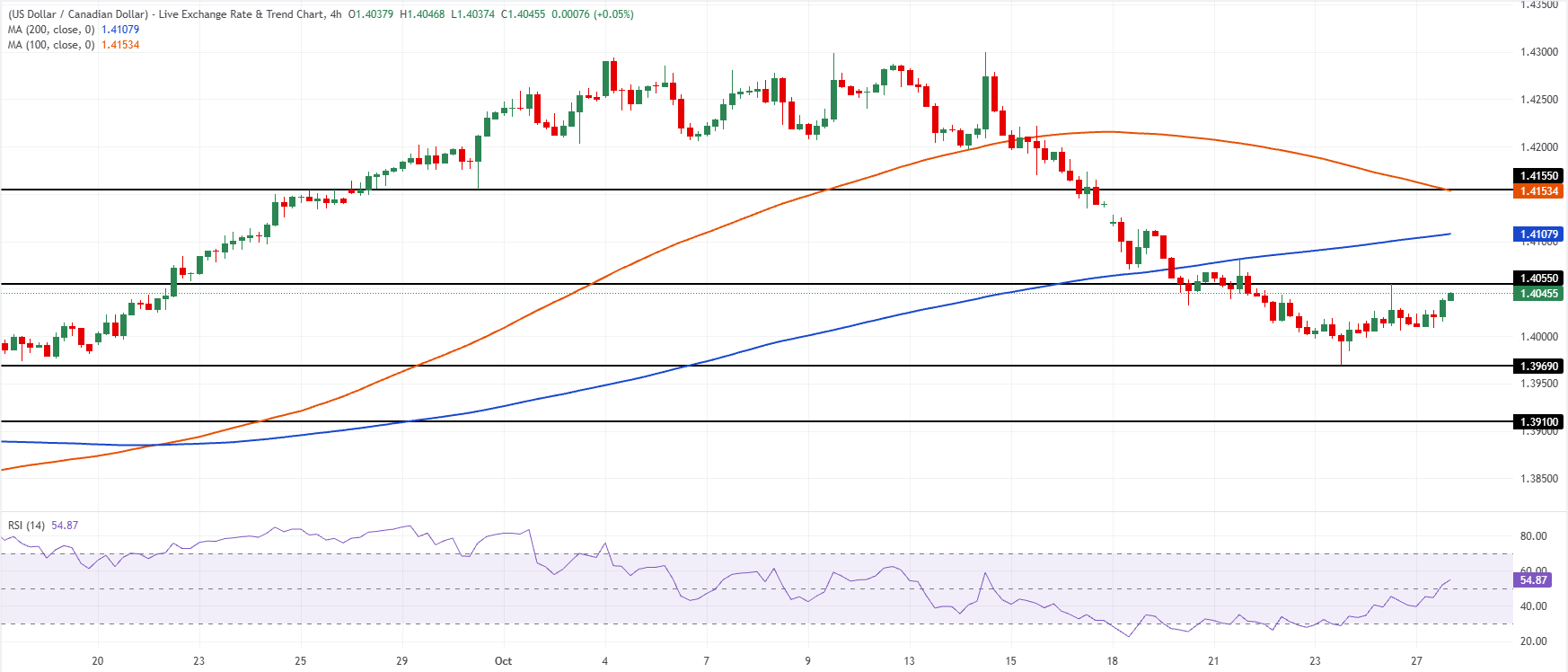
Near-term upside in USD/CAD remains limited on the four-hour chart. The pair trades just below horizontal resistance at 1.4055 and beneath both the 200-period simple moving average (SMA) at 1.4108 and the 100-period SMA at 1.4153. Having recovered to 54.9, the Relative Strength Index (14) is now mildly positive, pointing to improving momentum. Nevertheless, the moving averages above the price continue to restrict further gains for now.
A move higher would first encounter resistance at 1.4055, followed by the 200-period SMA at 1.4108. Further up, the 100-period SMA at 1.4153 combines with the adjacent horizontal level of 1.4155 to create a wider supply zone. Immediate downside support lies at 1.3969, ahead of a lower floor at 1.3910. A breach of 1.3910 would likely leave the pair vulnerable to additional bearish pressure in the near term.
(The technical analysis of this story was written with the help of an AI tool. Learn more.)
Economic Release
What Does the BoC Interest Rate Decision Signal?
At the conclusion of each of its eight scheduled meetings a year, the Bank of Canada (BoC) announces its interest rate decision. When the BoC expects inflation to exceed its target, it adopts a hawkish stance and raises rates to bring inflation down. Higher rates draw larger foreign capital inflows, making this bullish for the CAD. Conversely, when inflation is expected to slip below target, the BoC adopts a dovish stance and cuts rates to stimulate Canada's economy, hoping to bring inflation back up. As this reduces the flow of foreign capital into the country, it is bearish for the CAD.
Explore further.Next scheduled release: Wed 28 Oct 2026 13:45
Release frequency: Irregular
Consensus forecast: 2.5%
Previous reading: 2.25%
Data source: Bank of Canada
Bank of Canada: Key Questions Answered
The Canadian Dollar (CAD) typically strengthens when interest rates are relatively high and weakens when they are relatively low. Canada's interest rates and monetary policy are set by the Ottawa-based Bank of Canada (BoC), which holds eight scheduled meetings each year, alongside emergency meetings as needed. Maintaining price stability is the BoC's primary mandate, with inflation kept within a range of 1-3%. Raising or cutting interest rates is its principal means of meeting that objective, while quantitative easing and quantitative tightening are among its other policy tools.
The Canadian Dollar usually weakens under Quantitative Easing (QE), a policy tool the Bank of Canada can deploy in extreme circumstances. Under QE, the BoC prints Canadian Dollars to purchase assets, typically government or corporate bonds, from financial institutions. This measure is a last resort when interest rate cuts alone are unlikely to deliver price stability. During the Great Financial Crisis of 2009-11, the Bank of Canada deployed QE after banks lost confidence in one another's ability to repay debts, causing credit to freeze.
The Canadian Dollar generally benefits from quantitative tightening (QT), which is the reverse of QE. QT follows QE once an economic recovery is underway and inflation begins to rise. Under QE, the Bank of Canada supplies liquidity to financial institutions by purchasing government and corporate bonds from them. Under QT, by contrast, the BoC halts further asset purchases and no longer reinvests the principal repaid as bonds in its existing holdings mature. Its effect on the Canadian Dollar is usually positive, or bullish.
POPULAR ARTICLES
1Gold Price Forecast: XAU/USD rebound stalls beneath former support near $4,0702Iran: We maintain our policy of no flexibility on nuclear issue3Crypto Today: Bitcoin, Ethereum, XRP rebound as Fed decision approaches4Czech Koruna: Why political tensions are pushing up the risk premium – Commerzbank5Pi Network Price Forecast: Why Is PI Stalling as Core Team Expands Investment Fund to Axis Robotics?6New Zealand Dollar: Are risks of losses against the US Dollar mounting? – Societe Generale7Euro: Is slower lending putting key support against US Dollar at risk? - ING8UK budget in focus as British Pound pares losses but stays below 1.33009Will the BoC raise interest rates to 2.50% as expected?
LIVE QUOTES


ALL ABOUT FOREX
What Is a Stop Loss, How Does It Work and How Do You Set One?
Margin Call Meaning: What It Is, What Triggers It, and How to Avoid One
What Is an Islamic Account in Forex?
Best Indicators for Forex Trading and How to Use Them
The Top 10 Most Traded Currency Pairs in the World
What are the Major Forex Pairs? 7 Major Currency Pairs in the World
5 Best Forex Trading Apps In India In 2026
Top 15 Weakest Currencies in the World
Best Time to Trade Forex
Get Started!
Sign up and access the Global Markets in less than 3 minutes

Connect With Us









Contacts
Phone: +61 2 8036 8388
Fax: +61 2 8036 8388
Email: support@tmgm.com



The information provided on this website is of a general nature only and does not constitute personal financial advice. Before acting on any information on this website, you should consider the suitability of the information in relation to your objectives, financial situation and needs. Investing in CFDs and FX Margin Contracts carries significant risks and is not suitable for all investors. You may lose more than your initial deposit. You do not own, or have, any interest in the underlying asset. We recommend that you seek independent advice and ensure you fully understand the risks involved before trading. It is important that you read and consider the disclosure document before you acquire any product listed on the website. The information and advertisements offered on this website are not intended for use by any person in any country or jurisdiction where such use would be contrary to local laws and regulations. The Products and Services offered on this website are not intended for residents of the United States, Malaysia and Thailand.
TMGM is authorized and regulated in various jurisdictions.
Trademax Australia Limited, trading as TMGM, is regulated by the Australian Securities and Investments Commission (ASIC), AFSL no. 436416 and is located at Level 28, One International Tower, 100 Barangaroo Avenue, 2000 Sydney, NSW Australia.
Email: support@tmgm.com.au
Trademax Global Limited, trading as TMGM, is authorized and regulated by the Vanuatu Financial Services Commission (VFSC), registration number 40356 and registered at 1276, Kumul Highway, Port Vila, Vanuatu, Republic of Vanuatu.
Email: support@tmgm.com
Trademax Global Markets (SE) Limited, trading as TMGM, is authorized and regulated by the Financial Services Authority (FSA) of Seychelles, with license number SD224. The company is registered at Office No 13, Providence Estate ABIS Centre, Mahe, Seychelles.
Email: support@tmgm.com
Trademax Global Markets (International) Pty Ltd, trading as TMGM, is authorized and regulated by the Financial Services Commission, Mauritius (FSC) with license no. GB22201012, and registered at 33, Edith Cavell Street C/o IQ EQ Fund Services (Mauritius) Ltd Port Louis, 11324 Mauritius.
Email: support@tmgm.com
Copyright © TMGM. All rights reserved