

Trading
Explore a wide range of markets with competitive pricing, deep liquidity, and advanced trading tools.
Learn More 
Platform
Trade seamlessly with TMGM's powerful platform, built for speed, precision, and a superior trading experience.
Learn More Trading Platform
Academy
Learn the fundamentals of trading with beginner-friendly resources, including guides, webinars, and market insights.
Learn More News & Analysis
Get real-time market updates and expert analysis to stay ahead of trading opportunities
Learn More News & Analysis
About
Learn what sets TMGM apart — our global presence, regulatory strength, and commitment to innovation in trading.
Learn More Why Choose TMGM
Sponsorship
Loonie steadies at a 19-month low following Canadian retail sales
- USD/CAD retreats from a 19-month peak following gains in seven of eight sessions.
- A 1.5% decline in October retail sales is indicated by Statistics Canada's own preliminary estimate.
- Tuesday brings remarks from BoC Governor Macklem ahead of Wednesday's US core PCE and GDP releases.
USD/CAD's retreat on Friday has barely dented the advance that lifted it to a 19-month peak on Thursday after seven gains in eight sessions. Weighing on the pair are a weaker US Dollar and Canadian retail sales that exceeded forecasts by a tenth. Having eased from just above 1.4350, the pair remains above Thursday's low.
A widening US-Canadian two-year yield differential has accompanied USD/CAD's advance, with the gap expanding by about a fifth of a point in November. The Fed's policy rate stands at 3.75%-4.00%, while the Bank of Canada (BoC) raised its rate to 2.50% on October 28. Both central banks announce their decisions on December 9. Markets have fully priced in a quarter-point Fed increase, and Fed officials have raised the possibility of a half-point move.
September's Canadian retail sales increase of 0.8% exceeded the 0.7% forecast, while sales excluding autos advanced 1.0%. A 6.9% rise at gasoline stations led the gains, with sales volumes increasing 0.1%. However, Statistics Canada's preliminary estimate points to a 1.5% decline in October, tempering the stronger-than-expected reading. With Crude Oil on course for a third consecutive weekly decline, the other incentive to buy the Loonie is also absent.
Which calendar events are in focus?
About two weeks before the BoC decides whether to deliver a second increase after October's rate hike, Governor Macklem is scheduled to speak on Tuesday at 16:30 GMT. Canada's third-quarter current account figures are then due on Friday, November 27, at 13:30 GMT.
Remarks from Fed Governor Cook are scheduled for Friday at 17:15 GMT. At 13:30 GMT on Wednesday, November 25, October core Personal Consumption Expenditures Price Index (PCE) inflation and the preliminary third-quarter Gross Domestic Product (GDP) reading will be released. The GDP forecast is for annualised growth of 3.4%. Both releases will help determine the scale of the Fed's December rate increase and, in turn, the US side of the rate differential.
What do the charts indicate?
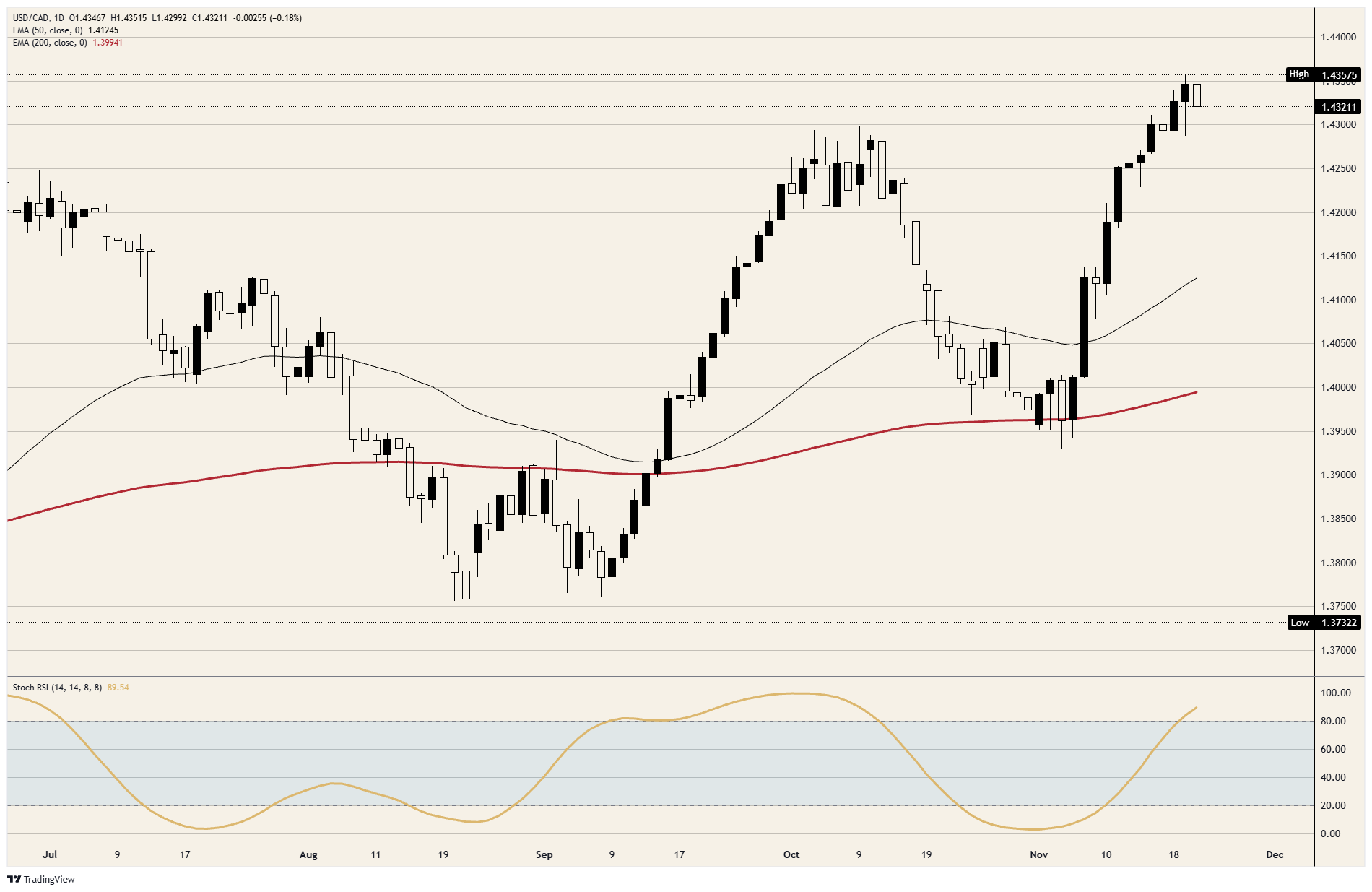
Friday's decline has retraced roughly a seventh of the rally that began just below 1.3950 on November 4. The session's low came just below 1.4300, the level at which the pair topped out three times in October. Beneath the current price, both the 50-day Exponential Moving Average (EMA), just above 1.4100, and the 200-day EMA, just below 1.4000, continue to rise. Daily momentum has entered overbought territory for the first time since early October.
Daily price chart for USD/CAD
Canadian Dollar: Frequently Asked Questions
Movements in the Canadian Dollar (CAD) are primarily influenced by the Bank of Canada's (BoC) interest rate settings, Oil prices, economic conditions, inflation and the trade balance. Oil is Canada's largest export, while the trade balance measures the difference between the value of its exports and imports. Investor sentiment matters as well: a willingness to buy riskier assets (risk-on) generally supports the CAD, whereas a preference for safe havens signals a risk-off environment. Conditions in the US economy are another important influence on the Canadian Dollar, given that the US is Canada's largest trading partner.
By determining the interest rate at which banks lend to each other, the Bank of Canada (BoC) exerts considerable influence over the Canadian Dollar. This rate, in turn, shapes borrowing rates across the economy. Keeping inflation within 1-3% is the BoC's principal objective, pursued by raising or lowering interest rates. Relatively high rates generally support the CAD. To influence credit conditions, the Bank of Canada can also employ quantitative easing, which is negative for the CAD, or quantitative tightening, which is positive for it.
As petroleum is Canada's largest export, changes in Oil prices tend to have an immediate effect on the Canadian Dollar's value, making Oil a major driver of the currency. Rising Oil prices generally lift overall demand for the CAD and strengthen it; falling prices typically have the reverse effect. Costlier Oil also increases the likelihood of a trade surplus, providing further support to the CAD.
Inflation was traditionally regarded as harmful to a currency because it erodes the value of money. With cross-border capital controls becoming more relaxed in modern times, however, the relationship has actually reversed. When inflation rises, central banks tend to increase interest rates, drawing capital from global investors seeking attractive returns. The resulting demand for the domestic currency supports its value; in Canada, that currency is the Canadian Dollar.
The Canadian Dollar can respond to macroeconomic releases because they provide a measure of the economy's health. GDP, Manufacturing and Services PMIs, employment figures and consumer sentiment surveys are among the indicators that can shape the CAD's direction. Economic strength supports the currency by attracting foreign investment and potentially encouraging the Bank of Canada to raise interest rates. Weak economic readings, by contrast, are likely to weigh on the CAD.
POPULAR ARTICLES
1Loonie steadies at a 19-month low following Canadian retail sales2UK retail sales beat leaves pound steady at three-month low3Hong Kong: Cautious re-engagement is spurred by policy support – BNY4Euro remains on course for third weekly decline despite modest gains as US Dollar softens5Breaking: Mounting selling pressure drives Bitcoin below $60,0006Bitcoin vs Gold Forecast: Why are BTC and XAU extending losses amid hawkish Fed expectations?7Gold: Bullish case holds despite a setback – TD Securities8Canada: RBC Expects Modest Q4 Growth Despite Weak Q39Silver Price Forecast: Will XAG/USD test the 200-week SMA as selling pressure persists?

Get Started!
Sign up and access the Global Markets in less than 3 minutes

Connect With Us









Contacts
Phone: +61 2 8036 8388
Fax: +61 2 8036 8388
Email: support@tmgm.com



The information provided on this website is of a general nature only and does not constitute personal financial advice. Before acting on any information on this website, you should consider the suitability of the information in relation to your objectives, financial situation and needs. Investing in CFDs and FX Margin Contracts carries significant risks and is not suitable for all investors. You may lose more than your initial deposit. You do not own, or have, any interest in the underlying asset. We recommend that you seek independent advice and ensure you fully understand the risks involved before trading. It is important that you read and consider the disclosure document before you acquire any product listed on the website. The information and advertisements offered on this website are not intended for use by any person in any country or jurisdiction where such use would be contrary to local laws and regulations. The Products and Services offered on this website are not intended for residents of the United States, Malaysia and Thailand.
TMGM is authorized and regulated in various jurisdictions.
Trademax Australia Limited, trading as TMGM, is regulated by the Australian Securities and Investments Commission (ASIC), AFSL no. 436416 and is located at Level 28, One International Tower, 100 Barangaroo Avenue, 2000 Sydney, NSW Australia.
Email: support@tmgm.com.au
Trademax Global Limited, trading as TMGM, is authorized and regulated by the Vanuatu Financial Services Commission (VFSC), registration number 40356 and registered at 1276, Kumul Highway, Port Vila, Vanuatu, Republic of Vanuatu.
Email: support@tmgm.com
Trademax Global Markets (SE) Limited, trading as TMGM, is authorized and regulated by the Financial Services Authority (FSA) of Seychelles, with license number SD224. The company is registered at Office No 13, Providence Estate ABIS Centre, Mahe, Seychelles.
Email: support@tmgm.com
Trademax Global Markets (International) Pty Ltd, trading as TMGM, is authorized and regulated by the Financial Services Commission, Mauritius (FSC) with license no. GB22201012, and registered at 33, Edith Cavell Street C/o IQ EQ Fund Services (Mauritius) Ltd Port Louis, 11324 Mauritius.
Email: support@tmgm.com
Copyright © TMGM. All rights reserved