

Trading
Explore a wide range of markets with competitive pricing, deep liquidity, and advanced trading tools.
Learn More 
Platform
Trade seamlessly with TMGM's powerful platform, built for speed, precision, and a superior trading experience.
Learn More Trading Platform
Academy
Learn the fundamentals of trading with beginner-friendly resources, including guides, webinars, and market insights.
Learn More News & Analysis
Get real-time market updates and expert analysis to stay ahead of trading opportunities
Learn More News & Analysis
About
Learn what sets TMGM apart — our global presence, regulatory strength, and commitment to innovation in trading.
Learn More Why Choose TMGM
Sponsorship
US Dollar rebound trims Euro’s early gains as markets await US NFP data
- Euro pares its initial advance as the US Dollar regains ground.
- Despite political uncertainty in the US and softer oil prices, the US Dollar reverses its earlier decline.
- The prospect of a rise in the Eurozone’s flash HICP has added weight to the case for further ECB rate increases.
Renewed US Dollar (USD) strength leaves the Euro (EUR) with almost none of its earlier gains during Thursday’s European session. Having pulled back from the day’s peak of 1.1268, EUR/USD trades broadly unchanged near 1.1228. Behind the pair’s retreat is a recovery in the US Dollar, with the US Dollar Index (DXY) reversing its losses to edge into positive territory around 101.54.

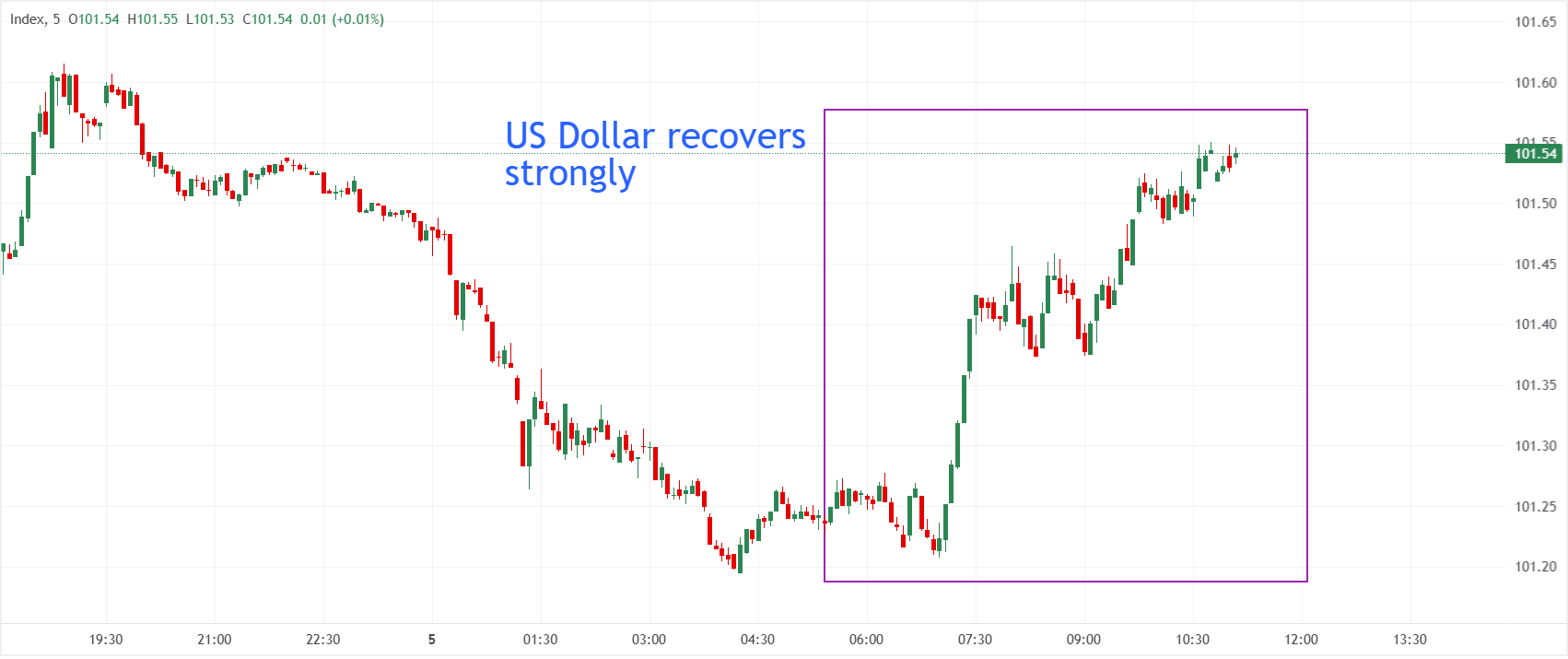
The durability of the US Dollar’s rebound remains in doubt among market experts, however, given political turmoil in the United States (US) and the steep fall in oil prices.
According to MUFG analysts, the “weaker US dollar and lower US yields have been encouraged by the sharp decline in the price of oil which is helping to ease market concerns over upside inflation risks.” Brent’s price, they observe, “has fallen by around USD10/barrel since the US mid-term elections results were announced,” moving back towards support at the “200-day moving average at around USD93.60/barrel.” On the timing of the decline, MUFG says oil “had already been falling sharply at the start of this week and the mid-term election results have reinforced the sell-off.”
A further concern identified by the bank is “another downside risk for the US dollar from the US mid-term election,” with the result potentially set “to further undermine investor confidence in US AI-related investments in response to increased Democratic opposition to the ongoing AI build-out.”
Friday’s release of October US Nonfarm Payrolls (NFP) is the next economic data point investors are awaiting. The figures are likely to shape expectations for Federal Reserve (Fed) interest rates.
Ahead of that release, traders remain confident of a 25 basis points (bps) rate increase at the Fed’s December policy meeting, taking rates to the 4.00%-4.25% range.
For the Euro, a further pick-up in Eurozone inflationary pressures has reinforced expectations that the European Central Bank (ECB) will raise interest rates again in the near term.
Can stubborn inflation and renewed ECB pressure keep the Euro supported?
Further monetary tightening remains the focus of the policy debate following the latest Eurozone figures, according to Commerzbank’s Antje Praefcke. She notes that “at the same time, euro area inflation rose to 4% year-on-year in October, while the core rate remained unchanged at 2.5%.” Assessing the policy implications, she says that “although these figures were in line with analysts’ expectations, with an inflation target of 2% and a deposit rate of 2.50%, they clearly make the case for further ECB rate hikes.” Praefcke also argues that “as a consequence of persistently high energy prices, an increasing number of companies is likely to pass on higher costs over time,” adding to the case for further ECB action and providing support to the Euro even as growth concerns persist.
EUR/USD Technical Analysis: Can Support Hold?
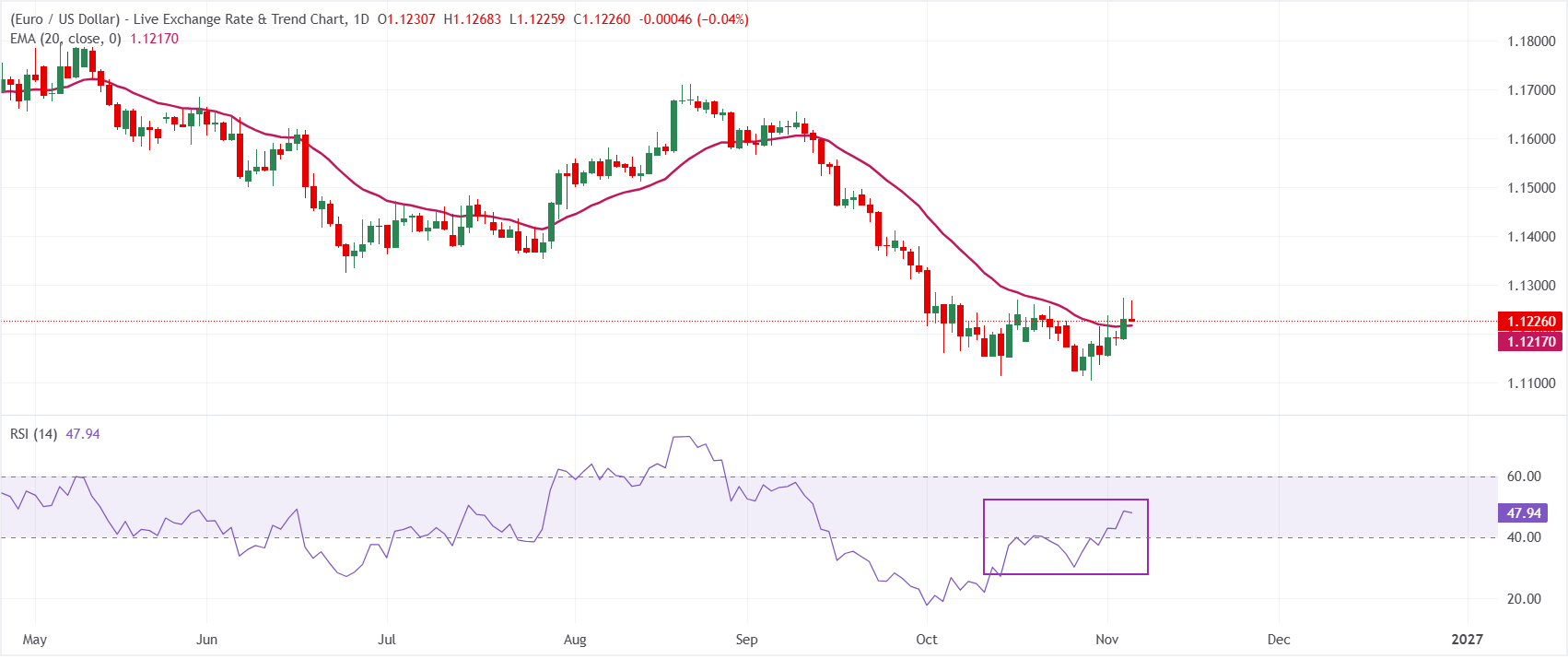
Tentative signs of stabilisation are emerging after EUR/USD’s recent decline, with the daily chart showing the pair at 1.1228, marginally above its 20-day exponential moving average (EMA) of 1.1217. Even so, the lack of nearby reference levels overhead leaves the broader outlook neutral rather than firmly bullish. At 48, the Relative Strength Index (RSI) is moving back towards its midline, indicating that downward momentum is easing without yet signalling a clear acceleration to the upside.
The 20-day EMA at 1.1217 provides the first downside support. A sustained move below it would revive the risk of a larger retreat towards earlier lows on the chart. Consolidation could continue if spot holds this moving average and the RSI stays close to the 50 region, as buyers try to establish a base while waiting for a clearer upside reference level to test.
(The technical analysis of this story was written with the help of an AI tool. Know more.)
Economic Data Indicator
Harmonized Index of Consumer Prices (YoY)
Price movements across a representative basket of goods and services in the European Monetary Union are tracked by the Harmonized Index of Consumer Prices (HICP). Eurostat publishes the index each month. Its harmonised approach applies a common methodology across all member states, with each state’s contribution weighted. The YoY figure measures prices in the reference month against those in the same month a year earlier. A higher reading is generally regarded as bullish for the Euro (EUR); a lower one is viewed as bearish.
Read further.Latest release: Wed 4 Nov 2026 10:00 (Prel)
Release frequency: Monthly
Reported figure: 4%
Market consensus: 4%
Prior reading: 3.8%
Data source: Eurostat
POPULAR ARTICLES
1New Zealand Dollar retreats from 0.5660 as US Dollar regains ground2XRP advances as Ripple CEO urges clear rules, says US crypto users will remain after midterms3Japanese Yen: Broad range against US Dollar holds despite volatility – UOB4US Dollar Index (DXY) trims losses as fallout from US midterm elections settles5ECB’s Zigman sees a fairly strong chance of a December rate hike6Brent: What do the election-driven sell-off and Iran risks mean? – Rabobank7US Dollar rebound trims Euro’s early gains as markets await US NFP data8British Pound: How are BoE hike expectations and a weaker Dollar lending support? – MUFG9Gold recovery continues amid post-election volatility as focus shifts to US jobs data


Get Started!
Sign up and access the Global Markets in less than 3 minutes

Connect With Us









Contacts
Phone: +61 2 8036 8388
Fax: +61 2 8036 8388
Email: support@tmgm.com



The information provided on this website is of a general nature only and does not constitute personal financial advice. Before acting on any information on this website, you should consider the suitability of the information in relation to your objectives, financial situation and needs. Investing in CFDs and FX Margin Contracts carries significant risks and is not suitable for all investors. You may lose more than your initial deposit. You do not own, or have, any interest in the underlying asset. We recommend that you seek independent advice and ensure you fully understand the risks involved before trading. It is important that you read and consider the disclosure document before you acquire any product listed on the website. The information and advertisements offered on this website are not intended for use by any person in any country or jurisdiction where such use would be contrary to local laws and regulations. The Products and Services offered on this website are not intended for residents of the United States, Malaysia and Thailand.
TMGM is authorized and regulated in various jurisdictions.
Trademax Australia Limited, trading as TMGM, is regulated by the Australian Securities and Investments Commission (ASIC), AFSL no. 436416 and is located at Level 28, One International Tower, 100 Barangaroo Avenue, 2000 Sydney, NSW Australia.
Email: support@tmgm.com.au
Trademax Global Limited, trading as TMGM, is authorized and regulated by the Vanuatu Financial Services Commission (VFSC), registration number 40356 and registered at 1276, Kumul Highway, Port Vila, Vanuatu, Republic of Vanuatu.
Email: support@tmgm.com
Trademax Global Markets (SE) Limited, trading as TMGM, is authorized and regulated by the Financial Services Authority (FSA) of Seychelles, with license number SD224. The company is registered at Office No 13, Providence Estate ABIS Centre, Mahe, Seychelles.
Email: support@tmgm.com
Trademax Global Markets (International) Pty Ltd, trading as TMGM, is authorized and regulated by the Financial Services Commission, Mauritius (FSC) with license no. GB22201012, and registered at 33, Edith Cavell Street C/o IQ EQ Fund Services (Mauritius) Ltd Port Louis, 11324 Mauritius.
Email: support@tmgm.com
Copyright © TMGM. All rights reserved