

Trading
Explore a wide range of markets with competitive pricing, deep liquidity, and advanced trading tools.
Learn More 
Platform
Trade seamlessly with TMGM's powerful platform, built for speed, precision, and a superior trading experience.
Learn More Trading Platform
Academy
Learn the fundamentals of trading with beginner-friendly resources, including guides, webinars, and market insights.
Learn More News & Analysis
Get real-time market updates and expert analysis to stay ahead of trading opportunities
Learn More News & Analysis
About
Learn what sets TMGM apart — our global presence, regulatory strength, and commitment to innovation in trading.
Learn More Why Choose TMGM
Sponsorship
Will Fed Minutes shed further light on the central bank’s pace of rate hikes?
- Market scrutiny will centre on the Fed Minutes for signals on how quickly, and how far, the bank may take its tightening cycle.
- October’s FOMC decision kept rates unchanged after what Fed Chair Kevin Warsh called a “heck of a family fight,”
- Expectations of an outsized rate increase at the December meeting drove last week’s US Dollar rally.
Markets are preparing to scrutinise the Minutes of October’s Federal Open Market Committee (FOMC) meeting, which the United States (US) Federal Reserve (Fed) will publish on Wednesday. Recent evidence of persistently high consumer inflation and a robust labour market has fuelled anticipation of a half-point increase in rates in December.
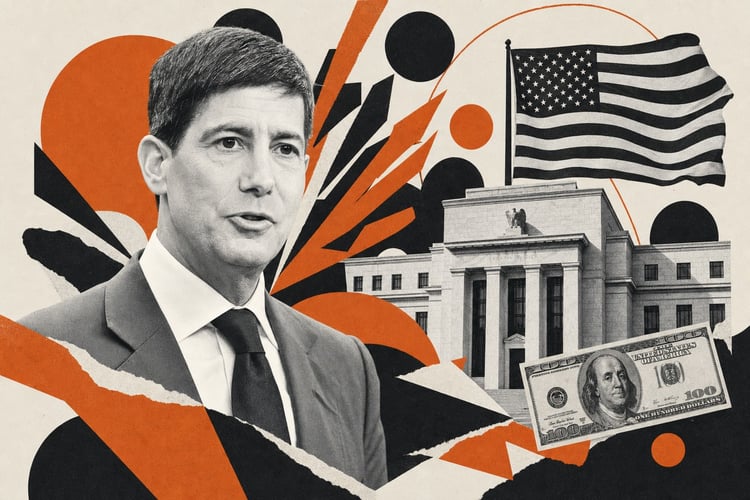
October’s decision to retain the fed funds rate in the 3.75%-4.00% range matched expectations. In its monetary policy statement, the FOMC recognised the strength of economic activity and flagged high inflation. Nevertheless, it chose to gather additional information before determining the policy stance needed to return inflation to the bank’s 2% target.
Speaking at the subsequent press conference, Fed Chairman Kevin Warsh rejected political explanations for the decision. He said the committee would be “better positioned” in December to judge whether further interest rate increases were warranted, describing the intervening period as “information-rich”.
Do labour and inflation figures strengthen the case for more Fed tightening?
The US Nonfarm Payrolls and Consumer Price Index (CPI) reports were likely among the releases Chair Warsh had been awaiting. Published over the past few weeks, both have intensified the pressure for additional monetary tightening by the central bank.
October’s net employment gain of 165K far exceeded the forecast increase of 65K, according to the Nonfarm Payrolls data. Rather than remaining at 4.2% as expected, unemployment fell to 4.1%. Wage growth also surpassed forecasts, rising 0.4% in October and 3.1% over the preceding 12 months.
Within days, the US consumer inflation report delivered a third consecutive month of above-forecast readings. The release prompted hawkish remarks from several influential Federal Reserve policymakers and revived the prospect of a 50-basis-point rate increase.
Against market expectations of 0.3%, headline CPI accelerated to 0.4% in October. Core inflation increased 0.3% over the same period, exceeding analysts’ forecast of 0.2%. The US Bureau of Labor Statistics (BLS) issued the figures in an unusual report that omitted annual data because of the 2025 government shutdown.
In response to these releases, calls for additional monetary tightening have come from Federal Reserve officials in recent days. Chicago Fed President Austan Goolsbee and Kansas Fed President Jeffrey Schmid were arguably the most hawkish: both pressed the central bank to take further action and backed speculation about a large December rate increase. All policymakers, however, have agreed that inflation should currently be the Fed’s primary concern.
Could the FOMC Minutes move the US Dollar, and when are they due?
Wednesday at 19:00 GMT is the scheduled release time for the FOMC Minutes covering the October 27-28 monetary policy meeting.
At that meeting, the bank held rates steady to evaluate the economic effects of September’s increase, the first interest rate hike in three years. Fed Governor Lisa Cook and Cleveland Fed President Beth Hammack favoured consecutive rate increases. Kevin Warsh’s description of the meeting as a “heck of a family fight” pointed to substantial opposition to the decision.
Since the meeting, macroeconomic releases have bolstered the position of the Fed’s hawks. According to the CME’s FedWatch Tool, markets have already priced in a quarter-point increase in December, followed by two to three further hikes in the first half of 2027. With a larger December increase still possible, investors will closely examine how concerned policymakers are about inflation risks.
A gain of more than 2% over the past four weeks has carried the US Dollar Index (DXY) to fresh 19-month highs. The index tracks the US Dollar (USD) against a basket of six major currencies. MUFG analysts note that “US 2-year yields remain elevated above 4.8%, following last week’s sharp Treasury selloff,” and add that “the absence of any pushback against recent Fed repricing leaves elevated US yields and the resilient Dollar as key headwinds for regional currencies.”
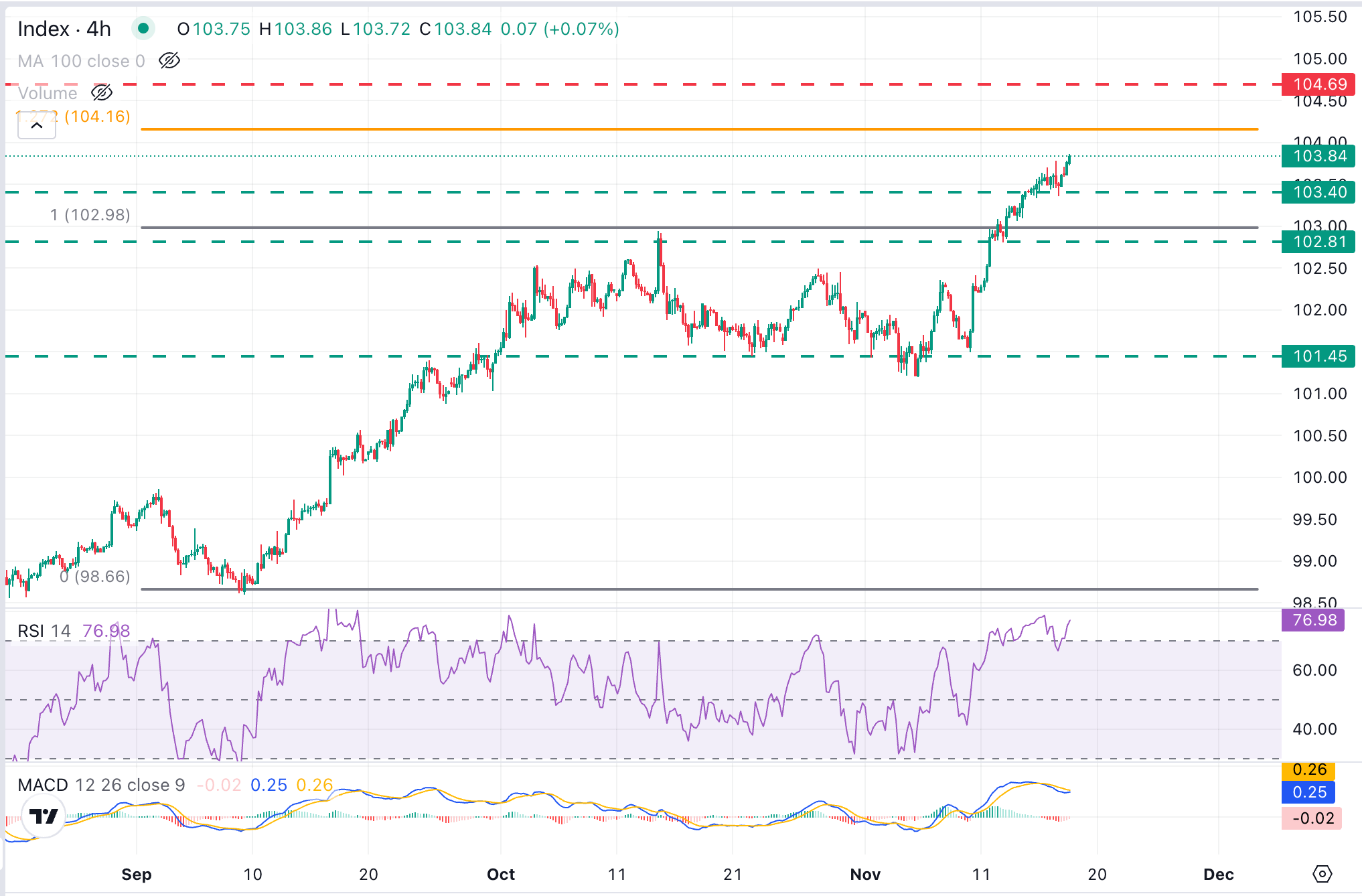
Despite supportive fundamentals, the Relative Strength Index (RSI) above 75 on the 4-hour chart signals deeply overbought conditions and should caution bulls. Guillermo Alcalá, FX analyst at FXstreet, warns that “the technical picture shows an overextended rally that is crying for a bearish correction”.
The zone stretching from the psychological 104.00 mark to the September-October rally’s 127.2% Fibonacci extension, just below 104.20, is likely to offer resistance to bulls. Beyond that zone, the late March 2025 peak around 104.70 would become the next target.
Alcalá nevertheless sees scope for prices to consolidate around current levels or retrace some gains. Tuesday’s low at 103.36 provides immediate support. The more important support zone lies between the 14 October high of 102.94 and the 12 November low of 102.80.
Interest rates: key questions answered
Financial institutions charge borrowers interest on loans, while savers and depositors receive interest on their funds. These rates are influenced by the base lending rates that central banks set in response to economic developments. Maintaining price stability is normally part of a central bank’s mandate; in most cases, that involves a core inflation target of around 2%. When inflation drops below target, the central bank may lower base lending rates to encourage lending and support economic activity. Inflation substantially above 2%, by contrast, normally prompts an increase in base lending rates aimed at bringing price growth down.
By making a country a more appealing destination for global investors’ funds, higher interest rates generally support the strength of its currency.
Holding Gold becomes more costly in terms of forgone returns when interest rates rise, compared with owning an interest-bearing asset or keeping cash in a bank. Higher rates therefore generally put pressure on Gold prices. High interest rates also tend to strengthen the US Dollar (USD). As Gold is denominated in Dollars, that strength has the effect of reducing its price.
US banks lend to one another overnight at the Fed funds rate. This widely cited headline rate is determined by the Federal Reserve at FOMC meetings and specified as a range, such as 4.75%-5.00%. The figure usually quoted is the upper end, which in that example is 5.00%. The CME FedWatch tool tracks market expectations for the future Fed funds rate. Those expectations influence the behaviour of many financial markets ahead of Federal Reserve monetary policy decisions.
Economic Release
What do FOMC Minutes reveal?
The Federal Open Market Committee, abbreviated to FOMC, holds 8 meetings each year. It examines economic and financial conditions, decides the appropriate monetary policy stance and evaluates risks to its long-term objectives of price stability and sustainable economic growth. Published by the Board of Governors of the Federal Reserve, the FOMC Minutes provide a clear guide to the future direction of US interest rate policy.
Upcoming release: Wed 18 Nov 2026 19:00
Release frequency: Irregular
Market consensus: -
Prior reading: -
Published by: Federal Reserve
A bullish tone in the Federal Open Market Committee (FOMC) minutes is likely to support the US dollar, whereas a dovish stance is viewed as negative for the currency. Usually released three weeks after the policy decision, the minutes are scrutinised by investors for signals on the policy outlook and the voting split. However, the market’s response to the FOMC minutes may take time to emerge: unlike the FOMC’s Policy Statement, the minutes are not made available to news outlets ahead of their release.
POPULAR ARTICLES
1Will Fed Minutes shed further light on the central bank’s pace of rate hikes?2Indonesian Rupiah: What Do a Pre-emptive Hike and a Prolonged Hold Signal? – Standard Chartered3Oil: Price rebound held back by supply recovery – ING4United Kingdom: BoE rate hike expectations ease on softer inflation figures – Nomura5Swiss Franc: BNY Views Market Rate Hike Expectations as Incompatible6Mixed UK economic data accompany British Pound’s decline against Japanese Yen7Euro: Could oil and US yields drive weakness against Dollar? – MUFG8Brazilian Real: Do excessive losses signal a recovery against USD? - Commerzbank9Hungarian Forint: How is the dovish MNB weighing on HUF against the Euro? – Societe Generale


Get Started!
Sign up and access the Global Markets in less than 3 minutes

Connect With Us









Contacts
Phone: +61 2 8036 8388
Fax: +61 2 8036 8388
Email: support@tmgm.com



The information provided on this website is of a general nature only and does not constitute personal financial advice. Before acting on any information on this website, you should consider the suitability of the information in relation to your objectives, financial situation and needs. Investing in CFDs and FX Margin Contracts carries significant risks and is not suitable for all investors. You may lose more than your initial deposit. You do not own, or have, any interest in the underlying asset. We recommend that you seek independent advice and ensure you fully understand the risks involved before trading. It is important that you read and consider the disclosure document before you acquire any product listed on the website. The information and advertisements offered on this website are not intended for use by any person in any country or jurisdiction where such use would be contrary to local laws and regulations. The Products and Services offered on this website are not intended for residents of the United States, Malaysia and Thailand.
TMGM is authorized and regulated in various jurisdictions.
Trademax Australia Limited, trading as TMGM, is regulated by the Australian Securities and Investments Commission (ASIC), AFSL no. 436416 and is located at Level 28, One International Tower, 100 Barangaroo Avenue, 2000 Sydney, NSW Australia.
Email: support@tmgm.com.au
Trademax Global Limited, trading as TMGM, is authorized and regulated by the Vanuatu Financial Services Commission (VFSC), registration number 40356 and registered at 1276, Kumul Highway, Port Vila, Vanuatu, Republic of Vanuatu.
Email: support@tmgm.com
Trademax Global Markets (SE) Limited, trading as TMGM, is authorized and regulated by the Financial Services Authority (FSA) of Seychelles, with license number SD224. The company is registered at Office No 13, Providence Estate ABIS Centre, Mahe, Seychelles.
Email: support@tmgm.com
Trademax Global Markets (International) Pty Ltd, trading as TMGM, is authorized and regulated by the Financial Services Commission, Mauritius (FSC) with license no. GB22201012, and registered at 33, Edith Cavell Street C/o IQ EQ Fund Services (Mauritius) Ltd Port Louis, 11324 Mauritius.
Email: support@tmgm.com
Copyright © TMGM. All rights reserved