

Trading
Explore a wide range of markets with competitive pricing, deep liquidity, and advanced trading tools.
Learn More 
Platform
Trade seamlessly with TMGM's powerful platform, built for speed, precision, and a superior trading experience.
Learn More Trading Platform
Academy
Learn the fundamentals of trading with beginner-friendly resources, including guides, webinars, and market insights.
Learn More News & Analysis
Get real-time market updates and expert analysis to stay ahead of trading opportunities
Learn More News & Analysis
About
Learn what sets TMGM apart — our global presence, regulatory strength, and commitment to innovation in trading.
Learn More Why Choose TMGM
Sponsorship
Japan's October CPI is due with the Yen back near 160.00
- USD/JPY rises for the first time in five sessions and tests 160.00 again.
- Japanese investors sought $9.4 billion of Anthropic shares, priced in Dollars.
- Japan's October CPI is due Thursday, with the core rate forecast at 2.3%.
Japan's October inflation figures are due with USD/JPY back within half a Yen of 160.00, where Japan's finance ministry warned on November 12 that the Yen had fallen too quickly. The pair rose for the first time in five sessions, from near 159.50 to just under 160.00, and is trading between the two. The Yen fell alongside the Pound and the Australian Dollar as US stocks dropped 2%.

Reuters reported that Japanese investors sought $9.4 billion of shares in Anthropic's initial public offering (IPO), and whatever they were allotted is paid for in Dollars. That demand came on top of a Fed that is expected to raise its 3.75%-4.00% rate on December 9 while the Bank of Japan (BoJ) has held at 1.25%. A 2% drop in US stocks, which often lifts the Yen, didn't lift it this time.
The pair has now traded within a few pips of 160.00 on four of the last seven sessions and hasn't held above it once. Japan and the US bought Yen together in late July, and USD/JPY fell more than eight Yen in two sessions. The November 12 warning came from Vice Finance Minister for International Affairs Mimura, who told markets not to forget the summer.
On the calendar
Japan's national Consumer Price Index (CPI) for October is due at 23:30 GMT on Thursday. The rate excluding fresh food is forecast at 2.3% YoY after 2.1%; the headline rate was 2.1% in September and the rate excluding food and energy 2.4%. The BoJ held at 1.25% on October 30 by 8-1, with BoJ board member Takata voting for 1.5%, and analysts expect a hike in December.
Philadelphia Fed President Paulson speaks in the same minute as the Japanese release, and Fed Governor Waller follows at 13:25 GMT on Friday. Michigan's November sentiment survey comes out at 15:00 GMT.
On the charts
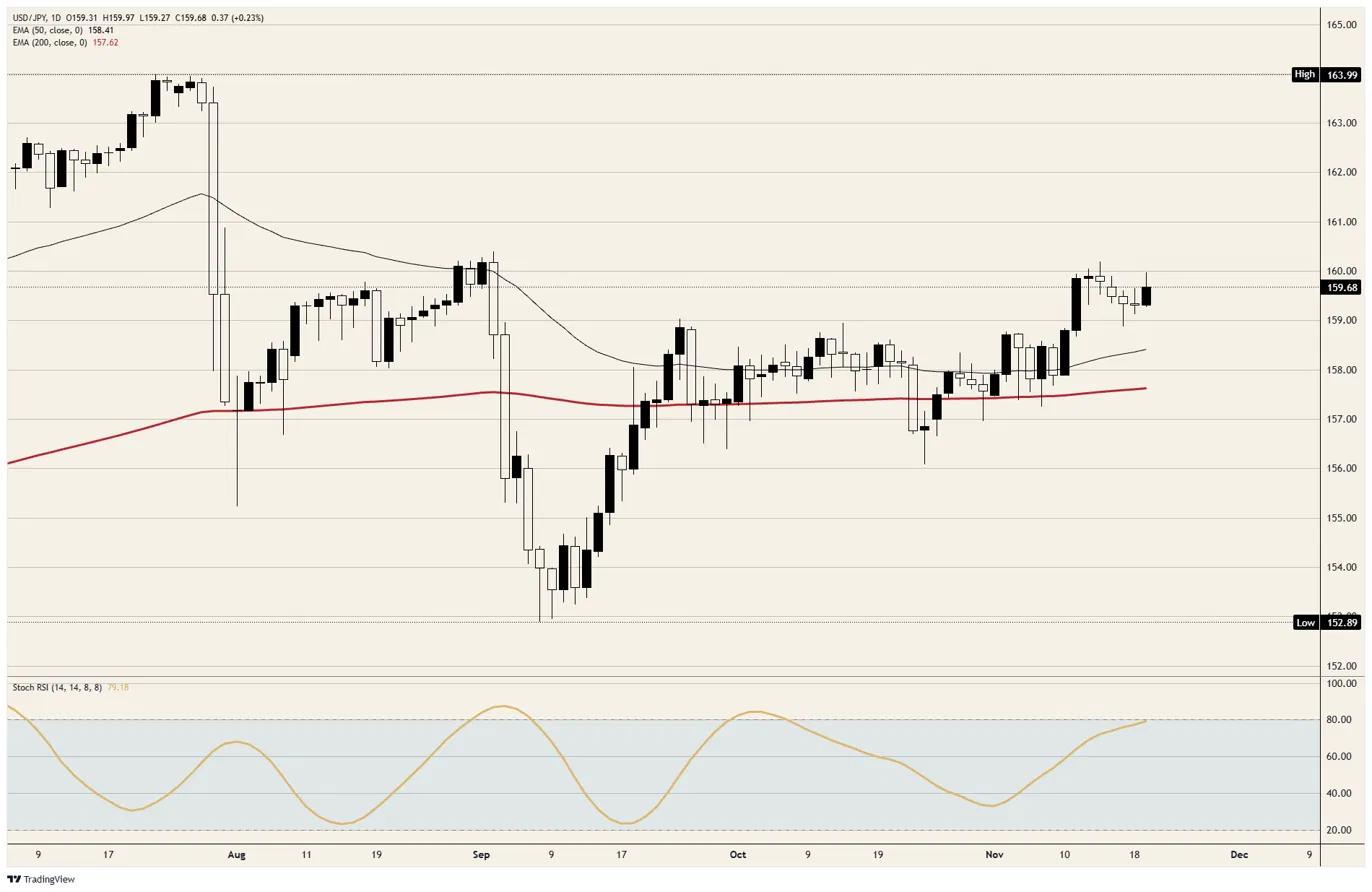
USD/JPY traded between 156.00 and 159.00 for seven weeks before breaking higher on November 11. Both moving averages are below it, the 50-day Exponential Moving Average (EMA) near 158.50 and the 200-day near 157.50. The pair has recovered about three-fifths of its fall from the July high near 164.00 to the September low near 153.00, and daily momentum is close to overbought.
USD/JPY daily chart
Japanese Yen FAQs
The Japanese Yen (JPY) is one of the world’s most traded currencies. Its value is broadly determined by the performance of the Japanese economy, but more specifically by the Bank of Japan’s policy, the differential between Japanese and US bond yields, or risk sentiment among traders, among other factors.
One of the Bank of Japan’s mandates is currency control, so its moves are key for the Yen. The BoJ has directly intervened in currency markets sometimes, generally to lower the value of the Yen, although it refrains from doing it often due to political concerns of its main trading partners. The BoJ ultra-loose monetary policy between 2013 and 2024 caused the Yen to depreciate against its main currency peers due to an increasing policy divergence between the Bank of Japan and other main central banks. More recently, the gradually unwinding of this ultra-loose policy has given some support to the Yen.
Over the last decade, the BoJ’s stance of sticking to ultra-loose monetary policy has led to a widening policy divergence with other central banks, particularly with the US Federal Reserve. This supported a widening of the differential between the 10-year US and Japanese bonds, which favored the US Dollar against the Japanese Yen. The BoJ decision in 2024 to gradually abandon the ultra-loose policy, coupled with interest-rate cuts in other major central banks, is narrowing this differential.
The Japanese Yen is often seen as a safe-haven investment. This means that in times of market stress, investors are more likely to put their money in the Japanese currency due to its supposed reliability and stability. Turbulent times are likely to strengthen the Yen’s value against other currencies seen as more risky to invest in.
POPULAR ARTICLES
1Japan's October CPI is due with the Yen back near 160.002Why does the Euro remain below 1.10 as the Dollar shrugs off weak US data?3Anthropic IPO takes centre stage as Dow Jones Industrial Average drops over 1,000 points4Ethereum Price Forecast: With ETH below $1,800, can Anthropic’s debut shift the outlook?5Indonesian Rupiah: Does BI’s hawkish turn point to further tightening risks? – Commerzbank6Forex Today: How will Japan CPI and UK consumer spending data shape market sentiment?7Oil rebound lifts Canadian Dollar, with gains capped by hawkish Fed8Why is the Australian Dollar plunging to a fresh yearly low as a jobs shock prompts an RBA policy rethink?9Gold slides to 14-month low as markets step up bets on Fed rate hikes

Get Started!
Sign up and access the Global Markets in less than 3 minutes

Connect With Us









Contacts
Phone: +61 2 8036 8388
Fax: +61 2 8036 8388
Email: support@tmgm.com



The information provided on this website is of a general nature only and does not constitute personal financial advice. Before acting on any information on this website, you should consider the suitability of the information in relation to your objectives, financial situation and needs. Investing in CFDs and FX Margin Contracts carries significant risks and is not suitable for all investors. You may lose more than your initial deposit. You do not own, or have, any interest in the underlying asset. We recommend that you seek independent advice and ensure you fully understand the risks involved before trading. It is important that you read and consider the disclosure document before you acquire any product listed on the website. The information and advertisements offered on this website are not intended for use by any person in any country or jurisdiction where such use would be contrary to local laws and regulations. The Products and Services offered on this website are not intended for residents of the United States, Malaysia and Thailand.
TMGM is authorized and regulated in various jurisdictions.
Trademax Australia Limited, trading as TMGM, is regulated by the Australian Securities and Investments Commission (ASIC), AFSL no. 436416 and is located at Level 28, One International Tower, 100 Barangaroo Avenue, 2000 Sydney, NSW Australia.
Email: support@tmgm.com.au
Trademax Global Limited, trading as TMGM, is authorized and regulated by the Vanuatu Financial Services Commission (VFSC), registration number 40356 and registered at 1276, Kumul Highway, Port Vila, Vanuatu, Republic of Vanuatu.
Email: support@tmgm.com
Trademax Global Markets (SE) Limited, trading as TMGM, is authorized and regulated by the Financial Services Authority (FSA) of Seychelles, with license number SD224. The company is registered at Office No 13, Providence Estate ABIS Centre, Mahe, Seychelles.
Email: support@tmgm.com
Trademax Global Markets (International) Pty Ltd, trading as TMGM, is authorized and regulated by the Financial Services Commission, Mauritius (FSC) with license no. GB22201012, and registered at 33, Edith Cavell Street C/o IQ EQ Fund Services (Mauritius) Ltd Port Louis, 11324 Mauritius.
Email: support@tmgm.com
Copyright © TMGM. All rights reserved