

Trading
Explore a wide range of markets with competitive pricing, deep liquidity, and advanced trading tools.
Learn More 
Platform
Trade seamlessly with TMGM's powerful platform, built for speed, precision, and a superior trading experience.
Learn More Trading Platform
Academy
Learn the fundamentals of trading with beginner-friendly resources, including guides, webinars, and market insights.
Learn More News & Analysis
Get real-time market updates and expert analysis to stay ahead of trading opportunities
Learn More News & Analysis
About
Learn what sets TMGM apart — our global presence, regulatory strength, and commitment to innovation in trading.
Learn More Why Choose TMGM
Sponsorship
Silver Price Forecast: XAG/USD regains ground amid a pullback in US Treasury Yields
- Silver price jumps to near $60.40 as the US Dollar and bond yields face correction.
- Market experts see correction in the US Dollar and bond yields as temporary in nature.
- The next key trigger is the US CPI data for September.
Silver price (XAG/USD) is up 2% to near $60.40 during the European trading session on Friday, reversing its entire Thursday’s losses. The white metal strengthens as its appeal has improved due to a pullback in United States (US) Treasury Yields.

At press time, 10-year US bond yields are up 0.17% to near 2.44%. However, they corrected sharply on Thursday after failing to extend rally beyond the two-decade high at 5.36%. A pullback in US bond yields rally has also weighed on the US Dollar (USD). In early European trade, the US Dollar Index (DXY), which gauges the Greenback’s value against six major currencies, trades 0.1% lower to near 102.00. Technically, a lower US Dollar improves risk-reward conditions for the Silver price.
However, financial markets argue that it would be early calling a pause in the US Dollar and US Treasury Yields as the conflict between the US and Iran is still intact.
Dollar dip seen as temporary as geopolitical oil premium persists
Strategists at ING observe that the Dollar "lost a bit of ground yesterday as Treasuries took a breather," but they stress that they "don’t see signs of a broader USD correction brewing." They also highlight the geopolitical backdrop, noting that while US President Donald Trump has indicated the US "won’t attack Iran before the 3 November midterms," the oil market "is reluctant to price out the geopolitical premium that has kept prices above $100/bbl despite improved Gulf supply."
Going forward, the major trigger for the Silver price will be the US Consumer Price Index (CPI) data for September, which will be released on Wednesday.
Silver Technical Analysis
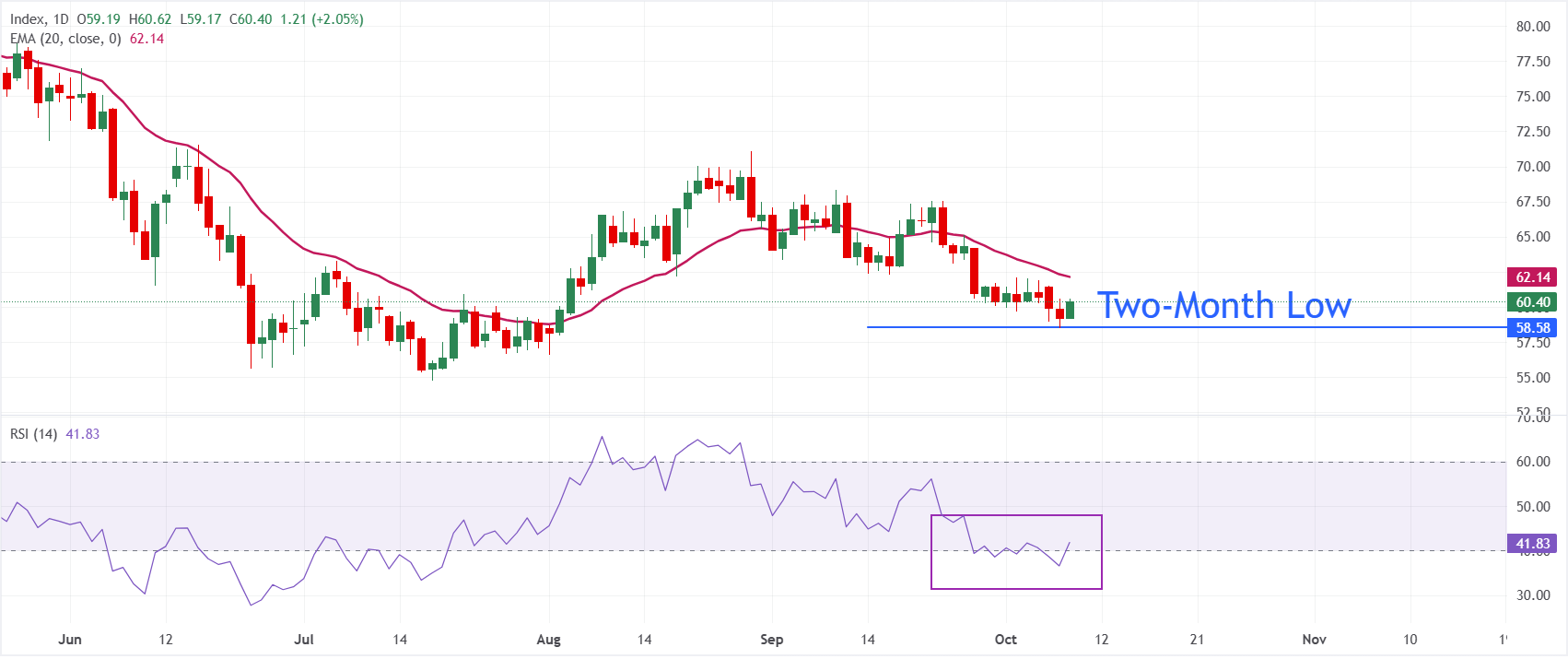
In the daily chart, XAG/USD trades at $60.40, keeping a bearish near-term bias as spot holds beneath the 20-day Exponential Moving Average (EMA) at $62.14. The downside skew is reinforced by the Moving Average Exponential (20, close, 0) capping the price overhead, while the Relative Strength Index (14) at 41.86 remains below the midline, hinting at persistent but not extreme selling pressure.
On the topside, initial resistance is defined by the 20-day EMA at $62.14, and a sustained break above this barrier would be needed to ease the current bearish tone and open the way to higher levels. Looking down, the two-month low at $58.50 is the key supprot level.
(The technical analysis of this story was written with the help of an AI tool. Know more.)
Silver FAQs
Silver is a precious metal highly traded among investors. It has been historically used as a store of value and a medium of exchange. Although less popular than Gold, traders may turn to Silver to diversify their investment portfolio, for its intrinsic value or as a potential hedge during high-inflation periods. Investors can buy physical Silver, in coins or in bars, or trade it through vehicles such as Exchange Traded Funds, which track its price on international markets.
Silver prices can move due to a wide range of factors. Geopolitical instability or fears of a deep recession can make Silver price escalate due to its safe-haven status, although to a lesser extent than Gold's. As a yieldless asset, Silver tends to rise with lower interest rates. Its moves also depend on how the US Dollar (USD) behaves as the asset is priced in dollars (XAG/USD). A strong Dollar tends to keep the price of Silver at bay, whereas a weaker Dollar is likely to propel prices up. Other factors such as investment demand, mining supply – Silver is much more abundant than Gold – and recycling rates can also affect prices.
Silver is widely used in industry, particularly in sectors such as electronics or solar energy, as it has one of the highest electric conductivity of all metals – more than Copper and Gold. A surge in demand can increase prices, while a decline tends to lower them. Dynamics in the US, Chinese and Indian economies can also contribute to price swings: for the US and particularly China, their big industrial sectors use Silver in various processes; in India, consumers’ demand for the precious metal for jewellery also plays a key role in setting prices.
Silver prices tend to follow Gold's moves. When Gold prices rise, Silver typically follows suit, as their status as safe-haven assets is similar. The Gold/Silver ratio, which shows the number of ounces of Silver needed to equal the value of one ounce of Gold, may help to determine the relative valuation between both metals. Some investors may consider a high ratio as an indicator that Silver is undervalued, or Gold is overvalued. On the contrary, a low ratio might suggest that Gold is undervalued relative to Silver.
POPULAR ARTICLES
1Polish Zloty: Dovish NBP signals weigh on PLN – Commerzbank2Canadian Dollar: Jobs data and BoC path – ING3Ethereum activates Glamsterdam on Sepolia testnet: Why the price is falling anyway4Euro extends recovery due to relief from drop in French bond yields5British Pound: Mild downside bias against US Dollar - UOB6WTI Price Forecast: Slides back to mid-$89.00s as Mideast jitters limit losses7USD/CHF Price Forecast: Testing support at 0.8300 with bearish momentum building up8Euro: ECB minutes signal limited need for further tightening - Danske Bank9Pyth Network Price Forecast: PYTH gains bullish momentum as 100% revenue buyback rule takes hold
LIVE QUOTES


ALL ABOUT FOREX
What Is an Islamic Account in Forex?
Best Indicators for Forex Trading and How to Use Them
The Top 10 Most Traded Currency Pairs in the World
What are the Major Forex Pairs? 7 Major Currency Pairs in the World
5 Best Forex Trading Apps In India In 2026
Top 15 Weakest Currencies in the World
Best Time to Trade Forex
Forex Trading Regulations in India
How to Start Forex Trading in India: A Guide for Beginners
Get Started!
Sign up and access the Global Markets in less than 3 minutes

Connect With Us









Contacts
Phone: +61 2 8036 8388
Fax: +61 2 8036 8388
Email: support@tmgm.com



The information provided on this website is of a general nature only and does not constitute personal financial advice. Before acting on any information on this website, you should consider the suitability of the information in relation to your objectives, financial situation and needs. Investing in CFDs and FX Margin Contracts carries significant risks and is not suitable for all investors. You may lose more than your initial deposit. You do not own, or have, any interest in the underlying asset. We recommend that you seek independent advice and ensure you fully understand the risks involved before trading. It is important that you read and consider the disclosure document before you acquire any product listed on the website. The information and advertisements offered on this website are not intended for use by any person in any country or jurisdiction where such use would be contrary to local laws and regulations. The Products and Services offered on this website are not intended for residents of the United States, Malaysia and Thailand.
TMGM is authorized and regulated in various jurisdictions.
Trademax Australia Limited, trading as TMGM, is regulated by the Australian Securities and Investments Commission (ASIC), AFSL no. 436416 and is located at Level 28, One International Tower, 100 Barangaroo Avenue, 2000 Sydney, NSW Australia.
Email: support@tmgm.com.au
Trademax Global Limited, trading as TMGM, is authorized and regulated by the Vanuatu Financial Services Commission (VFSC), registration number 40356 and registered at 1276, Kumul Highway, Port Vila, Vanuatu, Republic of Vanuatu.
Email: support@tmgm.com
Trademax Global Markets (SE) Limited, trading as TMGM, is authorized and regulated by the Financial Services Authority (FSA) of Seychelles, with license number SD224. The company is registered at Office No 13, Providence Estate ABIS Centre, Mahe, Seychelles.
Email: support@tmgm.com
Trademax Global Markets (International) Pty Ltd, trading as TMGM, is authorized and regulated by the Financial Services Commission, Mauritius (FSC) with license no. GB22201012, and registered at 33, Edith Cavell Street C/o IQ EQ Fund Services (Mauritius) Ltd Port Louis, 11324 Mauritius.
Email: support@tmgm.com
Copyright © TMGM. All rights reserved