

Trading
Explore a wide range of markets with competitive pricing, deep liquidity, and advanced trading tools.
Learn More 
Platform
Trade seamlessly with TMGM's powerful platform, built for speed, precision, and a superior trading experience.
Learn More Trading Platform
Academy
Learn the fundamentals of trading with beginner-friendly resources, including guides, webinars, and market insights.
Learn More News & Analysis
Get real-time market updates and expert analysis to stay ahead of trading opportunities
Learn More News & Analysis
About
Learn what sets TMGM apart — our global presence, regulatory strength, and commitment to innovation in trading.
Learn More Why Choose TMGM
Sponsorship
British Pound heads towards retail sales release with November rate hike already factored in
- GBP/USD remains little changed below 1.3400 despite UK inflation climbing to this year's high of 3.5%.
- Markets now assign about a 48% probability to a second BoE hike by December, down from 58%.
- Friday's UK retail sales data are expected to show a 0.1% decline, following a 0.5% increase.
Sterling showed little reaction to Wednesday's UK inflation figures, even as the headline, core and monthly readings all exceeded forecasts. GBP/USD remains marginally below 1.3400, a level it has not closed above on a daily basis since September 15. With traders having almost fully factored in a Bank of England (BoE) rate increase on November 5 ahead of the data, the release could only influence the small portion of that hike still available to price in.

Why did hotter inflation add only three points to a hike already priced at 93%?
September's Consumer Price Index (CPI) inflation reached 3.5%, up from 3.1% and above the 3.4% forecast, while core inflation increased from 2.6% to 2.8%. On a monthly basis, prices advanced 0.4%, exceeding the 0.3% estimate. The biggest upward contribution came from transport: diesel was at its most expensive since July 2022, while the US-Iran war kept Brent near $109.00 a barrel. Producer output prices also increased 0.8% month on month, a tenth above expectations, indicating that costs set to feed into shop prices over the coming months continue to rise.
Following the release, traders assigned about a 96% probability to the BoE raising the UK's Bank Rate from 3.75% on November 5, compared with about 93% beforehand. Rate increases support the Pound when markets price them in, and 93% of this hike had already been accounted for. Meanwhile, the probability of a second increase by December dropped from 58% to about 48% after the same data. Despite the hotter inflation reading, markets therefore anticipated fewer UK rate increases this year rather than more.
Does rising services inflation challenge Governor Bailey's view of limited spillover?
In remarks on October 16, BoE Governor Bailey said there was little evidence so far that the energy shock was spreading to wages and other prices, a process economists describe as second-round effects. Wednesday brought the first inflation report since those remarks. Services inflation, the BoE's most closely watched measure of such effects, increased from 3.4% to 3.7%, while inflation in recreation and culture prices accelerated from 1.6% to 2.3%.
If the shock spreads into services, a single rate increase can become a series of hikes. It is that prospect of several increases which Sterling has yet to price in. Since October's inflation data will be published only after the November 5 decision, Wednesday's figures are the last inflation report available to the Monetary Policy Committee (MPC) before its vote.
Separately, the Office for National Statistics (ONS) reported September public sector net borrowing of £24.52 billion, as expenditure, including debt interest, outpaced income growth. That borrowing bill feeds into Chancellor Healey's first Budget on October 28. After touching a 19-year high earlier in September, the 10-year gilt yield finished the month just under 5.4%. A Budget involving additional borrowing could consequently affect Sterling through the bond market before the BoE's vote.
What could the Budget and Fed decision mean a week before the BoE vote?
Thursday's GfK consumer confidence release, due at 23:01 GMT, is expected to show a reading of -15, against -13 previously. At 06:00 GMT on Friday, retail sales are projected to decline 0.1% month on month following a 0.5% increase, while annual growth is expected to ease from 2.4% to 1%. Sales excluding fuel are forecast to rise 1.5% year on year, outpacing overall sales growth. These forecasts therefore imply that Britons are purchasing less fuel than a year earlier, with diesel prices at their highest since 2022.
Friday's preliminary UK Purchasing Managers Index (PMI) readings from S&P Global, scheduled for 08:30 GMT, are expected at 51.8 for manufacturing and services alike. The equivalent US readings, due at 13:45 GMT, are forecast at 55.6 and 57.9 respectively. At 14:00 GMT, University of Michigan sentiment is expected to remain unchanged at 46.3. With November's hike already priced in, any weakness across the UK releases would first weigh on the probability of a December increase.
October 28 brings both Chancellor Healey's Budget and the Fed's decision, with prediction markets assigning close to an 86% probability to rates being held at 3.75%-4.00%. The BoE decision follows on November 5. Sterling already reflects a November hike, but the prospect of a December increase remains unresolved.
Which Pound levels matter around the 200-day average?
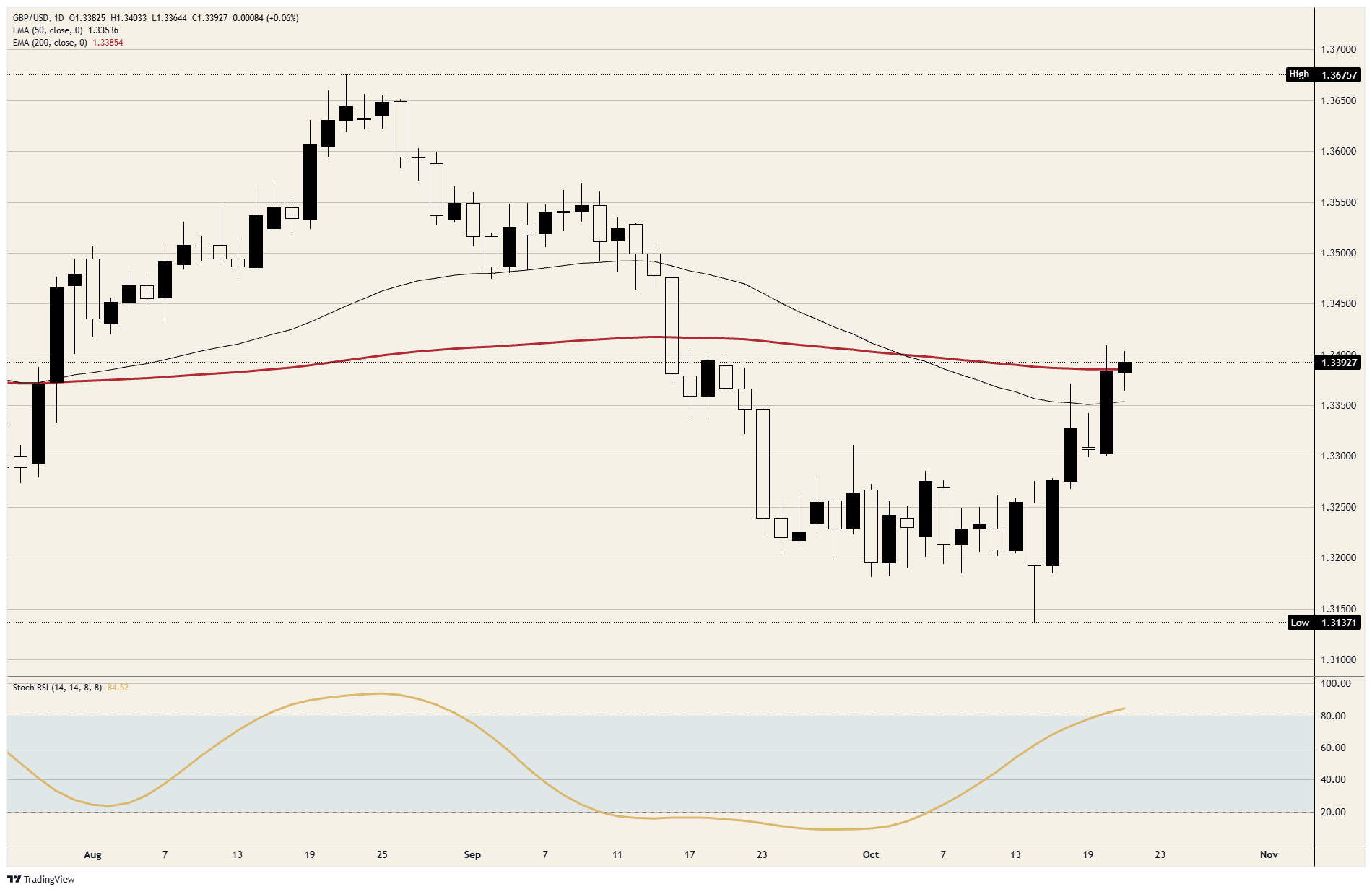
Resistance: GBP/USD's advances stalled at 1.3400 on both Tuesday and Wednesday, with no daily close above that level since September 15. The next level, 1.3500, marks the starting point of the September 16 decline.
Support: Immediately beneath the current price lies the 200-day Exponential Moving Average (EMA), marginally below 1.3400. Tuesday marked the pair's first move above this average since mid-September. Further support comes at Wednesday's low, just above 1.3350, followed by 1.3300, where Monday's decline found a floor.
Bias: The short view remains in place on a closing basis below 1.3400, targeting 1.3350 first and 1.3300 thereafter. Following the rise from the October 14 low, the daily Stochastic Relative Strength Index (Stoch RSI) has entered overbought territory near 85. A daily close above 1.3450 invalidates the short position.
Daily chart: GBP/USD
Pound Sterling: frequently asked questions
The United Kingdom's official currency, the Pound Sterling (GBP), dates back to 886 AD, making it the world's oldest currency. According to 2022 data, it ranks fourth among the most traded currencies in the global foreign exchange (FX) market, representing 12% of all transactions and an average daily turnover of $630 billion. Among its principal currency pairs, GBP/USD, known as ‘Cable’, represents 11% of FX trading. GBP/JPY, which traders call the ‘Dragon’, accounts for 3%, while EUR/GBP represents 2%. Responsibility for issuing the Pound Sterling rests with the Bank of England (BoE).
Monetary policy set by the Bank of England has the greatest influence on the Pound Sterling's value. Policy decisions depend on whether the BoE has met its principal objective of “price stability”, meaning a steady inflation rate of around 2%. Adjusting interest rates is its main means of pursuing that objective. To curb excessively high inflation, the BoE raises interest rates, increasing borrowing costs for households and businesses. GBP generally benefits because higher rates make the UK more appealing to international investors looking to place their funds. Conversely, very low inflation signals a slowdown in economic growth. The BoE will then consider reducing interest rates to make credit cheaper, encouraging businesses to borrow more and invest in projects that generate growth.
The Pound Sterling can respond to economic releases because they provide a measure of the economy's health. GDP, Manufacturing and Services PMIs, and employment figures are among the indicators that can determine GBP's direction. Sterling benefits from a robust economy, which draws in additional overseas investment and may also prompt the BoE to raise interest rates, directly strengthening GBP. Weak economic readings, by contrast, are likely to push the Pound Sterling lower.
The Trade Balance is another important release for the Pound Sterling, showing the difference between a country's export earnings and its import expenditure over a specified period. Strong overseas demand for a country's exports supports its currency through the additional demand generated by foreign buyers purchasing those goods. Accordingly, a positive net Trade Balance strengthens the currency, while a negative balance has the opposite effect.
POPULAR ARTICLES
1Why Is Gold Flat Below $4,150 as Traders Weigh the Fed Rate Path Amid Middle East Risk?2Why is the Japanese Yen barely moving as a Bank of Japan deputy flags inflation risk?3AUD/JPY Price Forecast: Can a Double Bottom Help Bulls Reach 113.50?4Chinese Yuan: Can gradual gains against US Dollar extend towards 6.6640? – UOB5GBP/JPY Price Forecast: Can bulls withstand the Doji challenge below 212.00?6How will the Euro respond to PMIs first and France’s credit rating over the weekend?7Why is the Australian Dollar shrugging off Iran war jitters as RBA hike bets double?8British Pound heads towards retail sales release with November rate hike already factored in9Below the 3.8% forecast: New Zealand’s Q3 CPI inflation slows to 3.7% YoY
LIVE QUOTES


ALL ABOUT FOREX
Margin Call Meaning: What It Is, What Triggers It, and How to Avoid One
What Is an Islamic Account in Forex?
Best Indicators for Forex Trading and How to Use Them
The Top 10 Most Traded Currency Pairs in the World
What are the Major Forex Pairs? 7 Major Currency Pairs in the World
5 Best Forex Trading Apps In India In 2026
Top 15 Weakest Currencies in the World
Best Time to Trade Forex
Forex Trading Regulations in India
Get Started!
Sign up and access the Global Markets in less than 3 minutes

Connect With Us









Contacts
Phone: +61 2 8036 8388
Fax: +61 2 8036 8388
Email: support@tmgm.com



The information provided on this website is of a general nature only and does not constitute personal financial advice. Before acting on any information on this website, you should consider the suitability of the information in relation to your objectives, financial situation and needs. Investing in CFDs and FX Margin Contracts carries significant risks and is not suitable for all investors. You may lose more than your initial deposit. You do not own, or have, any interest in the underlying asset. We recommend that you seek independent advice and ensure you fully understand the risks involved before trading. It is important that you read and consider the disclosure document before you acquire any product listed on the website. The information and advertisements offered on this website are not intended for use by any person in any country or jurisdiction where such use would be contrary to local laws and regulations. The Products and Services offered on this website are not intended for residents of the United States, Malaysia and Thailand.
TMGM is authorized and regulated in various jurisdictions.
Trademax Australia Limited, trading as TMGM, is regulated by the Australian Securities and Investments Commission (ASIC), AFSL no. 436416 and is located at Level 28, One International Tower, 100 Barangaroo Avenue, 2000 Sydney, NSW Australia.
Email: support@tmgm.com.au
Trademax Global Limited, trading as TMGM, is authorized and regulated by the Vanuatu Financial Services Commission (VFSC), registration number 40356 and registered at 1276, Kumul Highway, Port Vila, Vanuatu, Republic of Vanuatu.
Email: support@tmgm.com
Trademax Global Markets (SE) Limited, trading as TMGM, is authorized and regulated by the Financial Services Authority (FSA) of Seychelles, with license number SD224. The company is registered at Office No 13, Providence Estate ABIS Centre, Mahe, Seychelles.
Email: support@tmgm.com
Trademax Global Markets (International) Pty Ltd, trading as TMGM, is authorized and regulated by the Financial Services Commission, Mauritius (FSC) with license no. GB22201012, and registered at 33, Edith Cavell Street C/o IQ EQ Fund Services (Mauritius) Ltd Port Louis, 11324 Mauritius.
Email: support@tmgm.com
Copyright © TMGM. All rights reserved