

Trading
Explore a wide range of markets with competitive pricing, deep liquidity, and advanced trading tools.
Learn More 
Platform
Trade seamlessly with TMGM's powerful platform, built for speed, precision, and a superior trading experience.
Learn More Trading Platform
Academy
Learn the fundamentals of trading with beginner-friendly resources, including guides, webinars, and market insights.
Learn More News & Analysis
Get real-time market updates and expert analysis to stay ahead of trading opportunities
Learn More News & Analysis
About
Learn what sets TMGM apart — our global presence, regulatory strength, and commitment to innovation in trading.
Learn More Why Choose TMGM
Sponsorship
Yen stays below 160.00 as markets await Tokyo CPI on a US holiday
- Trading marginally above 159.00, USD/JPY has not recorded a daily close above 160.00 since September 1.
- Markets have priced in a Fed rate increase a week before the December hike signalled by the BoJ.
- With US markets closed for Thanksgiving, Thursday brings November's Tokyo CPI release.
USD/JPY remains confined to a range of less than 200 pips since November 11, caught between intervention warnings at 160.00 and continued Fed rate increases. Following a one-session decline on Friday after Japan's inflation release, the pair has advanced in each of the subsequent two sessions. It now trades marginally above 159.00; all daily closes since September 1 have remained below 160.00.

Expectations of a BoJ rate increase drove Friday's decline in USD/JPY. Japan's October inflation accelerated from 2.1% to 2.3%, while core inflation stood at 2.2%, exceeding the Bank of Japan's (BoJ) 2% target for the second consecutive month. Addressing parliament on November 19, BoJ Governor Ueda said the bank expects to continue raising rates. Markets are factoring in an increase from 1.25% to 1.50% at the December 17-18 meeting.
A BoJ increase a week after the Fed's decision would keep the interest-rate gap unchanged. The Fed holds its meeting first, on December 8-9, with the priced-in probability of a quarter-point rise from 3.75%-4.00% above 95%. On November 13, Finance Minister Katayama described moves as rapid and one-sided, saying she would coordinate with the US Treasury. The Treasury had joined Japan in purchasing Yen on July 31, and USD/JPY has not traded above 160.50 since then.
Which releases are next?
With US markets observing the Thanksgiving break, November's Tokyo Consumer Price Index (CPI) is scheduled for release on Thursday at 23:30 GMT. This will be the BoJ's first November inflation reading ahead of its December policy decision.
Before that, the US Personal Consumption Expenditures Price Index (PCE) for October is scheduled for Wednesday at 13:30 GMT. The Fed enters its pre-meeting quiet period on November 28. The two central banks will then announce decisions within nine days of one another, with USD/JPY having tracked their interest-rate differential.
What do the charts indicate?
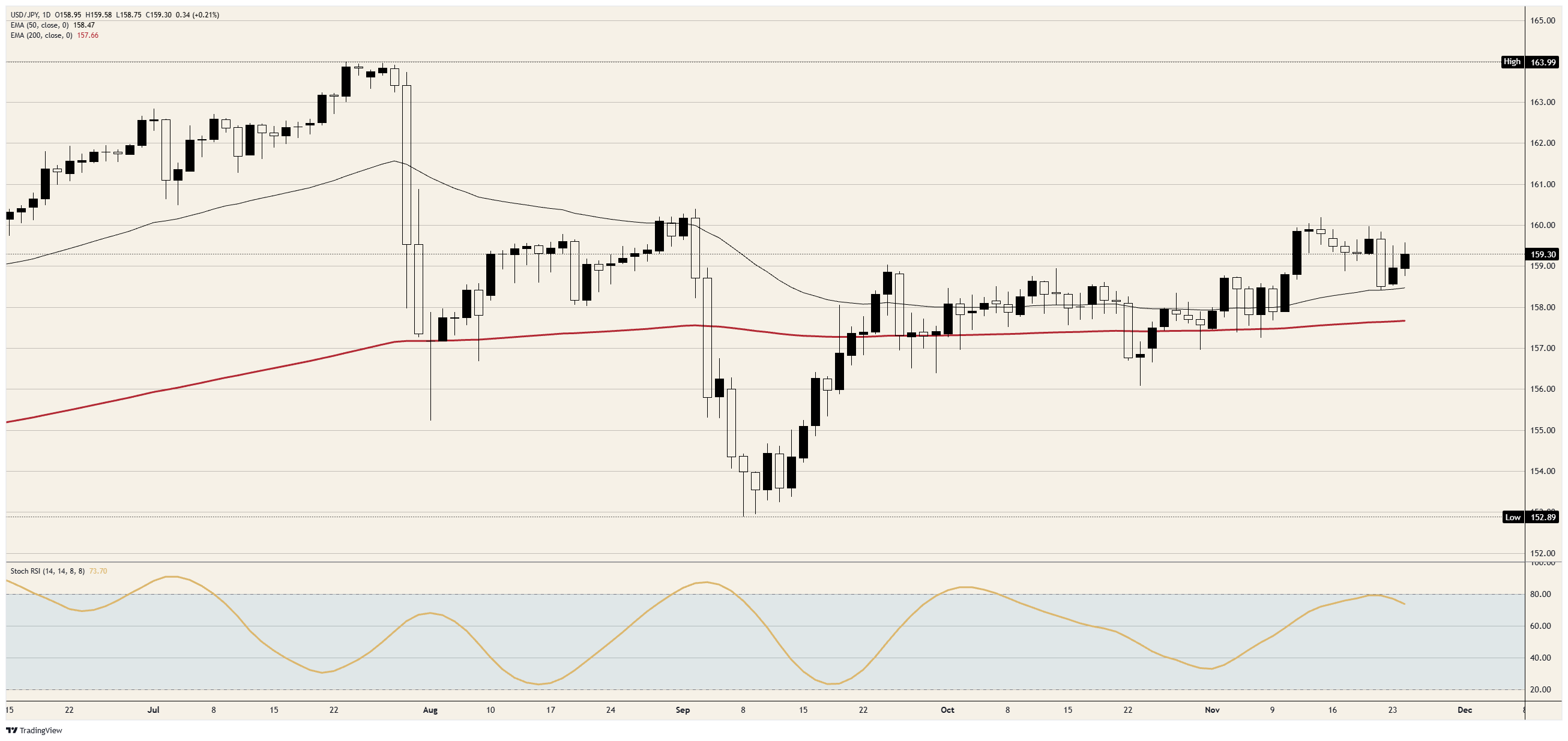
The 50-day Exponential Moving Average (EMA), near 158.50, arrested Friday's decline, while the 200-day EMA sits slightly below 158.00. In early September, USD/JPY dropped from marginally above 160.00 to 153.00 within a week; it did not revisit 160.00 until November 12. Daily momentum has since turned lower from a level just below overbought territory.
Daily price chart for USD/JPY
Japanese Yen: Common Questions
Among the world's most actively traded currencies, the Japanese Yen (JPY) takes its broad direction from Japan's economic performance. More specific influences include Bank of Japan policy, the gap between Japanese and US bond yields, and traders' appetite for risk, alongside other factors.
Currency control forms part of the Bank of Japan's mandate, making its actions an important influence on the Yen. At times, the BoJ has intervened directly in foreign exchange markets, usually to weaken the currency. Such intervention is infrequent, however, because of political concerns among Japan's main trading partners. Between 2013 and 2024, the BoJ's ultra-loose monetary policy weakened the Yen against its major peers as policy increasingly diverged from that of other leading central banks. More recently, a gradual withdrawal of this ultra-loose policy has provided the Yen with some support.
By maintaining ultra-loose monetary policy over the past decade, the BoJ allowed its policy stance to diverge increasingly from those of other central banks, notably the US Federal Reserve. This helped widen the yield gap between 10-year US and Japanese bonds, supporting the US Dollar against the Japanese Yen. That gap is now narrowing following the BoJ's 2024 decision to move gradually away from ultra-loose policy, alongside interest-rate reductions by other major central banks.
Investors often regard the Japanese Yen as a safe-haven asset, turning more readily to the currency during periods of market stress because of its perceived stability and reliability. As a result, turbulent conditions are likely to lift the Yen against currencies considered riskier investments.
POPULAR ARTICLES
1New Zealand Dollar meets US inflation data near its 2026 low2Yen stays below 160.00 as markets await Tokyo CPI on a US holiday3Softer core inflation and Fed hike threat send Mexican Peso sharply lower4Euro recovers from a 19-month low as ECB minutes and US inflation data approach5What will US inflation data bring for the Pound after its return above 1.31?6Could BTC fall to $53,200 as Bitcoin realised losses reach FTX-era levels?7Dow Jones Industrial Average returns to 50,000 amid Nvidia-led tech decline8Ethereum Price Forecast: Tariff concerns pressure crypto as ETH drops below $1,7009Is Australia’s CPI likely to complicate the RBA’s task?


Get Started!
Sign up and access the Global Markets in less than 3 minutes

Connect With Us









Contacts
Phone: +61 2 8036 8388
Fax: +61 2 8036 8388
Email: support@tmgm.com



The information provided on this website is of a general nature only and does not constitute personal financial advice. Before acting on any information on this website, you should consider the suitability of the information in relation to your objectives, financial situation and needs. Investing in CFDs and FX Margin Contracts carries significant risks and is not suitable for all investors. You may lose more than your initial deposit. You do not own, or have, any interest in the underlying asset. We recommend that you seek independent advice and ensure you fully understand the risks involved before trading. It is important that you read and consider the disclosure document before you acquire any product listed on the website. The information and advertisements offered on this website are not intended for use by any person in any country or jurisdiction where such use would be contrary to local laws and regulations. The Products and Services offered on this website are not intended for residents of the United States, Malaysia and Thailand.
TMGM is authorized and regulated in various jurisdictions.
Trademax Australia Limited, trading as TMGM, is regulated by the Australian Securities and Investments Commission (ASIC), AFSL no. 436416 and is located at Level 28, One International Tower, 100 Barangaroo Avenue, 2000 Sydney, NSW Australia.
Email: support@tmgm.com.au
Trademax Global Limited, trading as TMGM, is authorized and regulated by the Vanuatu Financial Services Commission (VFSC), registration number 40356 and registered at 1276, Kumul Highway, Port Vila, Vanuatu, Republic of Vanuatu.
Email: support@tmgm.com
Trademax Global Markets (SE) Limited, trading as TMGM, is authorized and regulated by the Financial Services Authority (FSA) of Seychelles, with license number SD224. The company is registered at Office No 13, Providence Estate ABIS Centre, Mahe, Seychelles.
Email: support@tmgm.com
Trademax Global Markets (International) Pty Ltd, trading as TMGM, is authorized and regulated by the Financial Services Commission, Mauritius (FSC) with license no. GB22201012, and registered at 33, Edith Cavell Street C/o IQ EQ Fund Services (Mauritius) Ltd Port Louis, 11324 Mauritius.
Email: support@tmgm.com
Copyright © TMGM. All rights reserved