

Trading
Explore a wide range of markets with competitive pricing, deep liquidity, and advanced trading tools.
Learn More 
Platform
Trade seamlessly with TMGM's powerful platform, built for speed, precision, and a superior trading experience.
Learn More Trading Platform
Academy
Learn the fundamentals of trading with beginner-friendly resources, including guides, webinars, and market insights.
Learn More News & Analysis
Get real-time market updates and expert analysis to stay ahead of trading opportunities
Learn More News & Analysis
About
Learn what sets TMGM apart — our global presence, regulatory strength, and commitment to innovation in trading.
Learn More Why Choose TMGM
Sponsorship
4.7%: Australia’s unemployment rate expected to hold steady
- 4.7% is the forecast for Australia’s October Unemployment Rate, unchanged at a five-year high.
- 25K new jobs are forecast to have been created in Australia during the month.
- 0.6600 is in focus as AUD/USD seeks to break below its yearly low and deepen its decline.
25K new jobs are expected in Australia’s October employment report. The Australian Bureau of Statistics (ABS) will release the figures on Thursday at 00:30 GMT. The market forecast follows a loss of 39.3K jobs in August.

The monthly Employment Change release from ABS provides separate figures for full-time and part-time roles. Full-time employment generally involves 38 hours or more each week, usually offers additional benefits and typically delivers steady income. Part-time roles, by contrast, generally pay higher hourly rates but lack consistent income and benefits. Full-time employment is therefore preferable for the economy. August saw 73.7K part-time jobs lost and 34.4K full-time positions added. The forecast puts the Unemployment Rate unchanged at 4.7%.
Ahead of the release, the Australian Dollar (AUD) is trading just a few pips above 0.6700 against the US Dollar (USD). That leaves it close to January’s yearly low of 0.6663.
4.7% unemployment forecast: Australia’s labour market outlook
Later revisions put Australia’s August Unemployment Rate at 4.7%, the highest in roughly five years. September also brought an unexpected fall in employment. Yet weaker economic momentum did not prevent the Reserve Bank of Australia (RBA) from raising the Official Cash Rate (OCR) at its meeting earlier this month.
4.85% is the current OCR after the fifth increase in 2026. The Board was divided: six members backed a rise because inflation remained too high, while three favoured waiting for earlier increases to feed fully through to the economy. For December, market participants currently expect the RBA to leave rates unchanged.
For the majority, the key concerns were elevated unit labour costs, strong market services inflation, widespread cost pressures and a probable increase in the neutral rate.
Alongside the Unemployment Rate, investors will examine both total job creation and the split between full-time and part-time employment. Weak figures are unlikely to increase the probability of a December rate rise. They would, however, probably leave further increases in 2027 on the table.
Inflation concerns dominated the latest RBA meeting minutes. On employment, the document states: “The unemployment rate had increased by more than expected over preceding months. The staff’s judgment was that this largely reflected stronger-than-expected labor supply,” and includes a revision to the Unemployment Rate forecast, which now stands at 5.1% for 2028, roughly ¼ percentage point above the previous projection.
Expectations of a December rate rise by the United States (US) Federal Reserve (Fed) are meanwhile supporting broad USD gains. Markets already price in a 25-basis-point (bps) increase. Recent hawkish signals from policymakers have also raised the possibility of more aggressive increases.
AUD/USD: Employment report implications
Taken together, these factors leave limited scope for AUD gains. Unemployment below forecasts and robust hiring would normally lift the Aussie by reinforcing expectations of an RBA rate rise. That response looks unlikely, however, after five increases already this year. Any resulting short-term AUD/USD rebound would probably draw sellers.
Conversely, further deterioration in the Unemployment Rate alongside weaker-than-forecast job creation would strengthen the argument for the RBA to hold in December. AUD/USD would then face additional selling pressure.
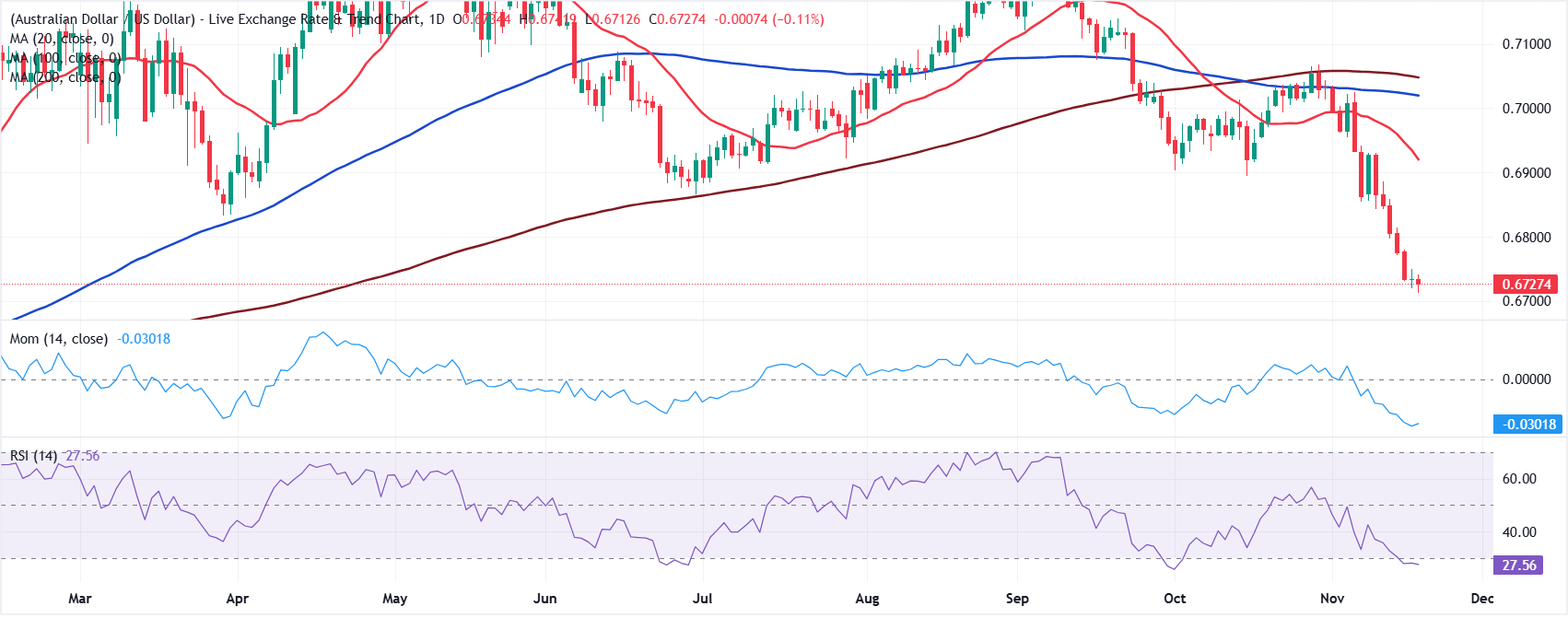
On the technical outlook, FXStreet Chief Analyst Valeria Bednarik says: “The AUD/USD pair trades at levels that were last seen in January, and despite looking oversold in the daily chart, there are no signs it has already found an interim bottom. A decline beyond the yearly low in the 0.6660 region is on the cards, particularly if 0.6700 gives up, with the pair likely to test the 0.6600 psychological threshold in the upcoming sessions.”
Turning to resistance, Bednarik adds: “As previously mentioned, the bearish case is strong, although technical indicators have lost momentum within oversold territory on the daily chart. Initial resistance can be found at 0.6770 ahead of the 0.6810 price zone.”
Economic data indicator
Unemployment Rate, seasonally adjusted
Published by the Australian Bureau of Statistics, the Unemployment Rate expresses unemployed workers as a percentage of the total civilian labour force. A rising rate signals that Australia’s labour market is not expanding and points to weakness in the economy. For the Australian Dollar (AUD), a lower reading is regarded as bullish; a higher reading is regarded as bearish.
View details.Upcoming release: Thu 19 November 2026 00:30
Release frequency: Every month
Market consensus: 4.7%
Prior reading: 4.7%
Data source: Australian Bureau of Statistics
About 15 days after month-end, the Australian Bureau of Statistics (ABS) releases its labour market overview. The unemployment rate is a closely monitored indicator within the report. Its strong correlation with consumer spending and inflation offers insight into broader economic conditions. Although it is a lagging indicator, it influences interest rate decisions by the Reserve Bank of Australia (RBA), which in turn move the Australian dollar. A strong reading generally supports the AUD.
Employment: Key Questions
By signalling the health of an economy, labour market conditions play a major role in currency valuations. Strong employment, or low unemployment, supports consumer spending and economic growth, strengthening the domestic currency. When the labour market is particularly tight, with too few workers available to fill vacancies, the effects can extend to inflation and monetary policy. High demand for workers combined with limited supply pushes wages higher.
For policymakers, the rate of wage increases across an economy is a crucial consideration. Faster wage growth gives households more money to spend, typically pushing up consumer goods prices. Pay increases are unlikely to be reversed, making wage growth an important element of underlying, persistent inflation, unlike more volatile drivers such as energy prices. Wage data therefore receive close scrutiny from central banks worldwide as they set monetary policy.
A central bank’s objectives determine how much emphasis it places on labour market conditions. For some, an explicit employment-related mandate sits alongside inflation control. The US Federal Reserve (Fed), for instance, has a dual mandate to promote maximum employment and stable prices. By contrast, the European Central Bank (ECB) has the sole mandate of keeping inflation under control. Regardless of their mandates, policymakers regard labour market conditions as important because they indicate economic health and have a direct relationship with inflation.
POPULAR ARTICLES
133.00: Taiwan Dollar Shows Signs of Recovery Against US Dollar – OCBC24.7%: Australia’s unemployment rate expected to hold steady3Singapore Dollar: Export support underpins stable trading range outlook – Commerzbank4Indonesian Rupiah: Limited pressure relief from surprise BI rate hike – BBH5US yields steer Singapore Dollar (SGD) recovery outlook - OCBC66.6520 in View as Chinese Yuan Shows Gradual Upside Bias Against US Dollar – UOB7Silver Price Forecast: RSI turns oversold as downtrend intensifies84.5% inflation peak forecast for United Kingdom in Q1 2027 - Societe Generale9US Dollar: Fed tightening expectations fuel upside pressure – ING


Get Started!
Sign up and access the Global Markets in less than 3 minutes

Connect With Us









Contacts
Phone: +61 2 8036 8388
Fax: +61 2 8036 8388
Email: support@tmgm.com



The information provided on this website is of a general nature only and does not constitute personal financial advice. Before acting on any information on this website, you should consider the suitability of the information in relation to your objectives, financial situation and needs. Investing in CFDs and FX Margin Contracts carries significant risks and is not suitable for all investors. You may lose more than your initial deposit. You do not own, or have, any interest in the underlying asset. We recommend that you seek independent advice and ensure you fully understand the risks involved before trading. It is important that you read and consider the disclosure document before you acquire any product listed on the website. The information and advertisements offered on this website are not intended for use by any person in any country or jurisdiction where such use would be contrary to local laws and regulations. The Products and Services offered on this website are not intended for residents of the United States, Malaysia and Thailand.
TMGM is authorized and regulated in various jurisdictions.
Trademax Australia Limited, trading as TMGM, is regulated by the Australian Securities and Investments Commission (ASIC), AFSL no. 436416 and is located at Level 28, One International Tower, 100 Barangaroo Avenue, 2000 Sydney, NSW Australia.
Email: support@tmgm.com.au
Trademax Global Limited, trading as TMGM, is authorized and regulated by the Vanuatu Financial Services Commission (VFSC), registration number 40356 and registered at 1276, Kumul Highway, Port Vila, Vanuatu, Republic of Vanuatu.
Email: support@tmgm.com
Trademax Global Markets (SE) Limited, trading as TMGM, is authorized and regulated by the Financial Services Authority (FSA) of Seychelles, with license number SD224. The company is registered at Office No 13, Providence Estate ABIS Centre, Mahe, Seychelles.
Email: support@tmgm.com
Trademax Global Markets (International) Pty Ltd, trading as TMGM, is authorized and regulated by the Financial Services Commission, Mauritius (FSC) with license no. GB22201012, and registered at 33, Edith Cavell Street C/o IQ EQ Fund Services (Mauritius) Ltd Port Louis, 11324 Mauritius.
Email: support@tmgm.com
Copyright © TMGM. All rights reserved