

Trading
Explore a wide range of markets with competitive pricing, deep liquidity, and advanced trading tools.
Learn More 
Platform
Trade seamlessly with TMGM's powerful platform, built for speed, precision, and a superior trading experience.
Learn More Trading Platform
Academy
Learn the fundamentals of trading with beginner-friendly resources, including guides, webinars, and market insights.
Learn More News & Analysis
Get real-time market updates and expert analysis to stay ahead of trading opportunities
Learn More News & Analysis
About
Learn what sets TMGM apart — our global presence, regulatory strength, and commitment to innovation in trading.
Learn More Why Choose TMGM
Sponsorship
Crypto Today: Selling pressure eases in Bitcoin, Ethereum, XRP following Binance security breach
- $78,000 offers immediate support for Bitcoin, slowing its slide following Binance's $6.3 billion hack.
- $2,200 remains in focus for Ethereum as weakening momentum indicators keep trading under pressure.
- $1.20 support draws XRP bulls back after a test, though structural barriers could constrain the rebound.
$78,000 is Bitcoin's fragile short-term support on Friday. Cryptocurrency markets remain unsettled, with Bitcoin (BTC) barely holding that level, Ethereum (ETH) slipping towards $2,200 and Ripple (XRP) seeking to rebound above support at $1.20. The pullback comes after Binance, the largest crypto exchange, reported a hack affecting about $6.3 billion.
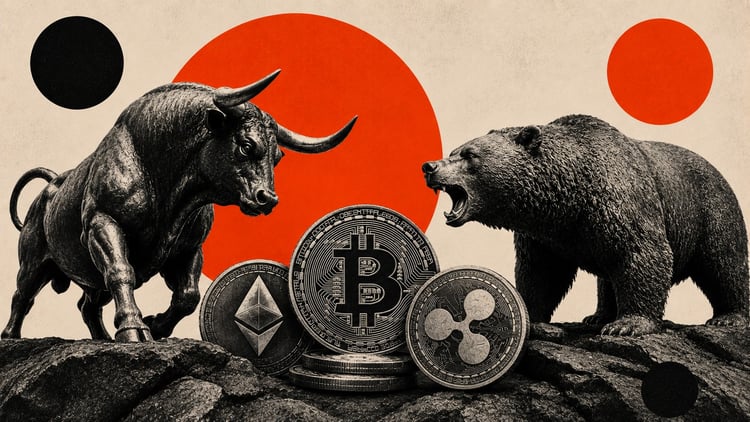
Liquidations across the derivatives market totalled $1.5 billion in 24 hours, as the reaction to the news appeared to send the wider cryptocurrency market into a slump.
$6.3 billion breach: Binance turns to SAFU as asset freezes continue
With roughly $6.3 billion reportedly affected by the security breach, Binance temporarily halted deposits and withdrawals to conduct an internal investigation and review.
A compromised DevOps engineer's laptop may have been involved, according to Binance. This may have enabled the attacker to reach a container service used to submit unauthorised withdrawal transactions.
On X, Binance said, “We have found no evidence of any wallet private key leak,” adding, “We will share a detailed technical post-mortem once the investigation is complete and the facts are fully verified.”
Approximately $3 billion in on-chain assets has been frozen through collaboration with blockchain partners including Tether, Circle and Ripple, according to updates from Binance.
User assets remain safe, Binance has stressed. The exchange says its Secure Asset Fund for Users (SAFU) programme and company assets will cover all losses.
Alongside the suspension of deposits and withdrawals, Binance revoked authorisation for the affected address. It also worked with law enforcement and blockchain partners to trace and recover the funds.
In an update on X, Binance said: “This was a complex attack, and we are doing all we can in coordination with law enforcement to resolve it. We are still gathering the facts, and will share more directly as we have them,”
As the industry matures, crypto scams and fraud continue to pose a major challenge. The ‘The Chainalysis 2026 Crypto Crime Report’ points to a 162% annual increase. On-chain theft through cryptocurrency scams amounted to $14 billion, while AI-enabled schemes rose 1,400% annually.
$78,012: Bitcoin defends lower support in technical analysis
At $78,012, Bitcoin remains below its 50-day Exponential Moving Average (EMA) of $80,608, leaving the near-term outlook bearish. Underneath the price, however, the 100-day EMA at $77,825 and the longer-term 200-day EMA at $76,455 form a dense support zone. This suggests the broader uptrend remains intact, albeit under pressure.
At $84,056, the SuperTrend indicator stands well above the spot price as a level to reclaim, highlighting substantial overhead supply on any advance. The Relative Strength Index (RSI) of around 36 also signals continued downside pressure, in line with the negative Moving Average Convergence Divergence (MACD) reading.
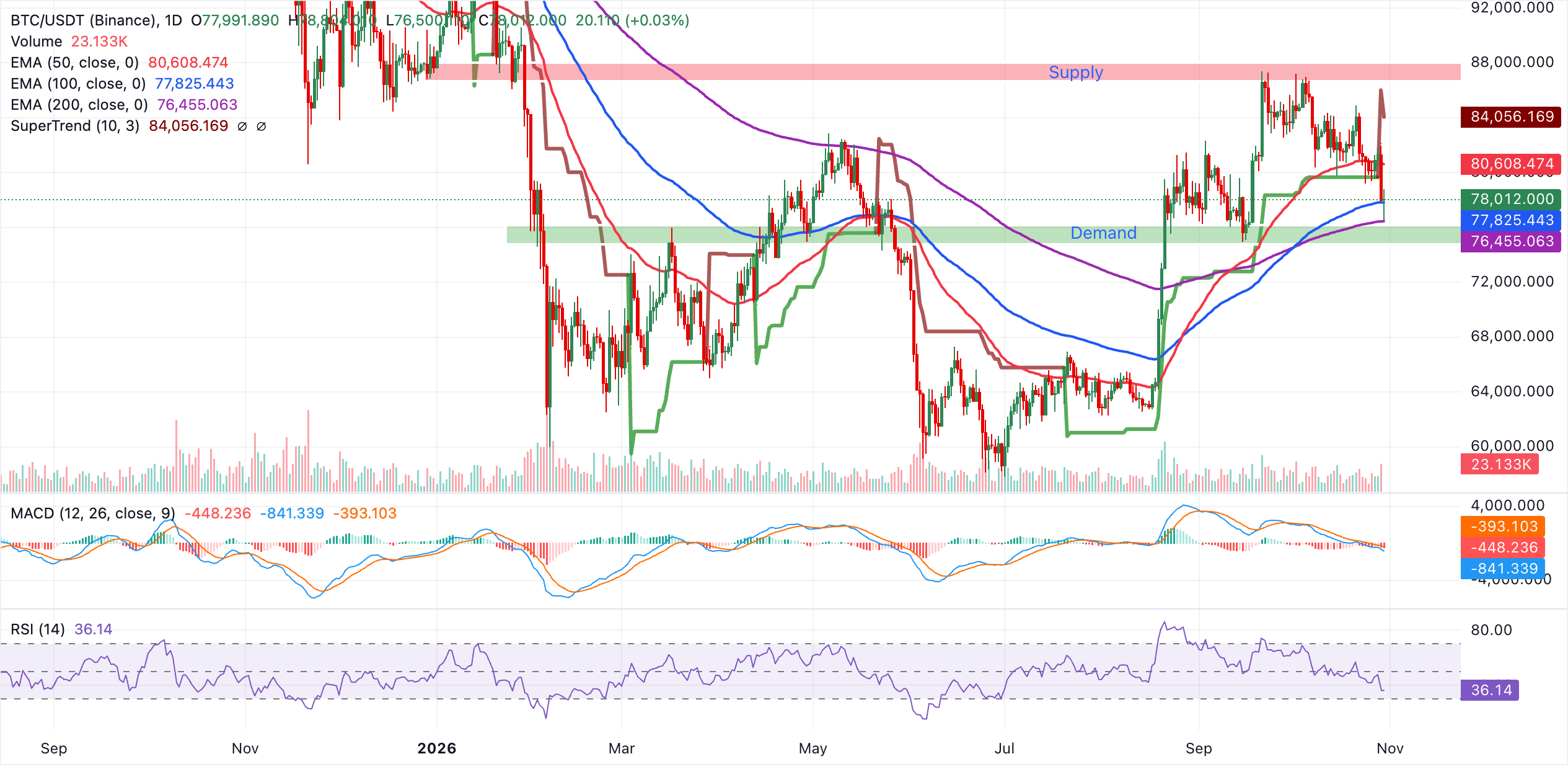
To soften the bearish tone and clear a path towards the SuperTrend line at $84,056, Bitcoin would need a daily close above initial resistance at the 50-day EMA of 80,608. Immediate downside support is provided by the 100-day EMA at $77,825. Below that, the 200-day EMA around $76,455 marks a stronger area of structural demand. Losing this latter level would materially weaken the broader technical outlook and leave the price exposed to deeper retracements.
$2,231: Ethereum weakens as selling pressure builds
At $2,231, Ethereum's bearish phase continues following the loss of its rising trendline. The price remains beneath a tight cluster of moving averages: the 200-day EMA at $2,316, the 100-day EMA at $2,358 and the 50-day EMA at $2,435. Together, these levels indicate continued pressure on the broader trend despite the recent retreat from higher levels.
The momentum picture is similarly weak. The RSI has dropped into oversold territory around 29, while the MACD sits below both zero and its signal line. Its largely negative histogram also points to a sustained downside bias.
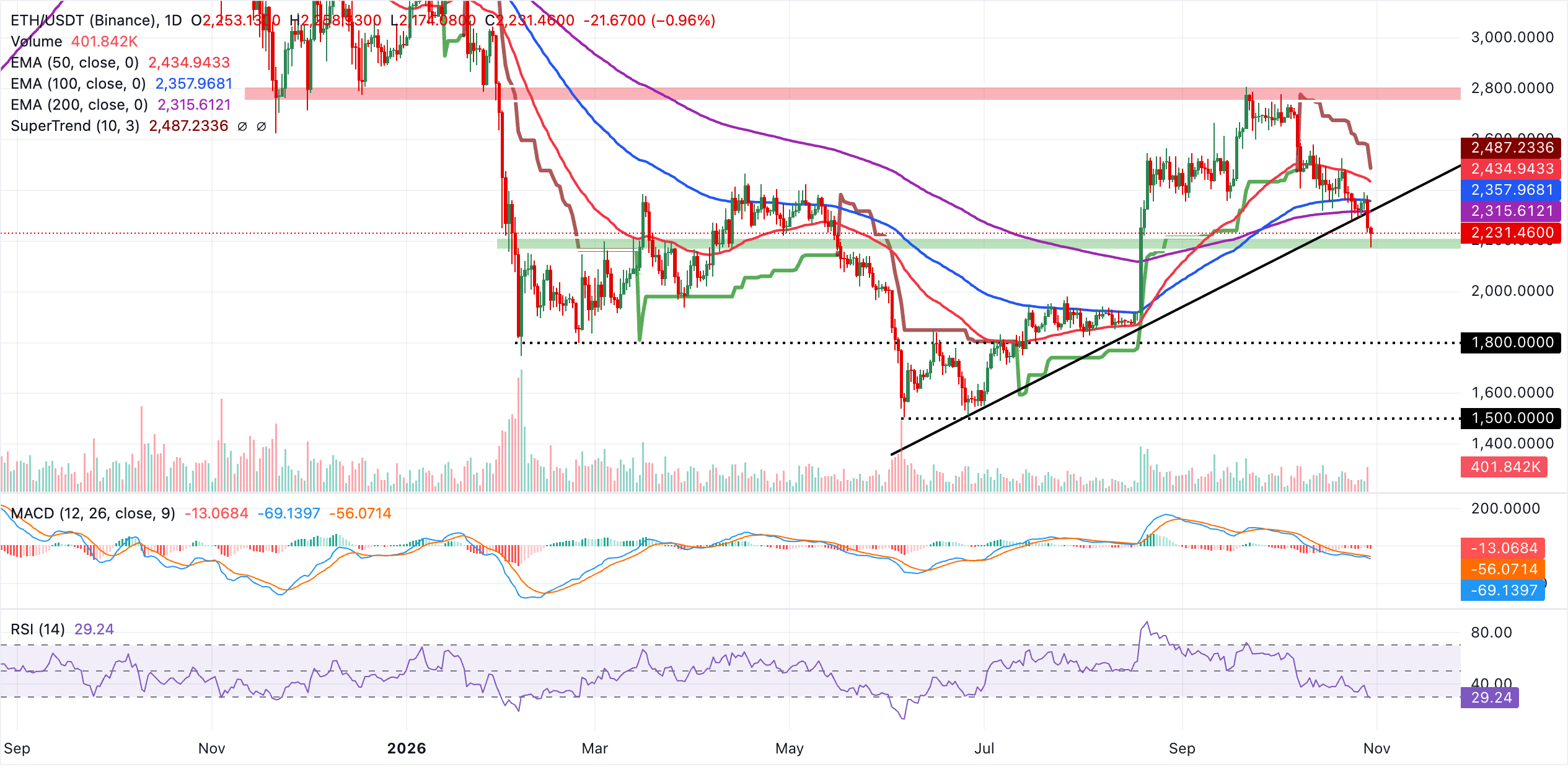
Sellers could regain control of a corrective bounce around initial resistance at the 200-day EMA near $2,316 or the former trendline break near $2,320. Further hurdles follow at the 100-day EMA of $2,358 and the 50-day EMA of $2,435, ahead of a more substantial supply zone around the SuperTrend line at $2,487. The daily chart identifies no nearby structural support below the current price. As a result, the pair would likely need to recover at least the 200-day EMA cluster to reduce immediate bearish pressure and create scope for a more sustained recovery.
$1.20: XRP buyers return at support
At $1.25, XRP is staging a modest recovery from near-term support at $1.25. This demand zone has not removed the bearish near-term bias: the price remains well below the main EMAs and the SuperTrend line. Overhead, the 100-day EMA at $1.33, the 50-day EMA at $1.35 and the 200-day EMA at $1.37 create successive technical obstacles. The SuperTrend at $1.41 adds to the broader bearish structure.
Selling pressure also persists in the momentum readings, though these have yet to reach oversold extremes. The RSI is around 37, while the MACD remains below zero and has resumed its decline.
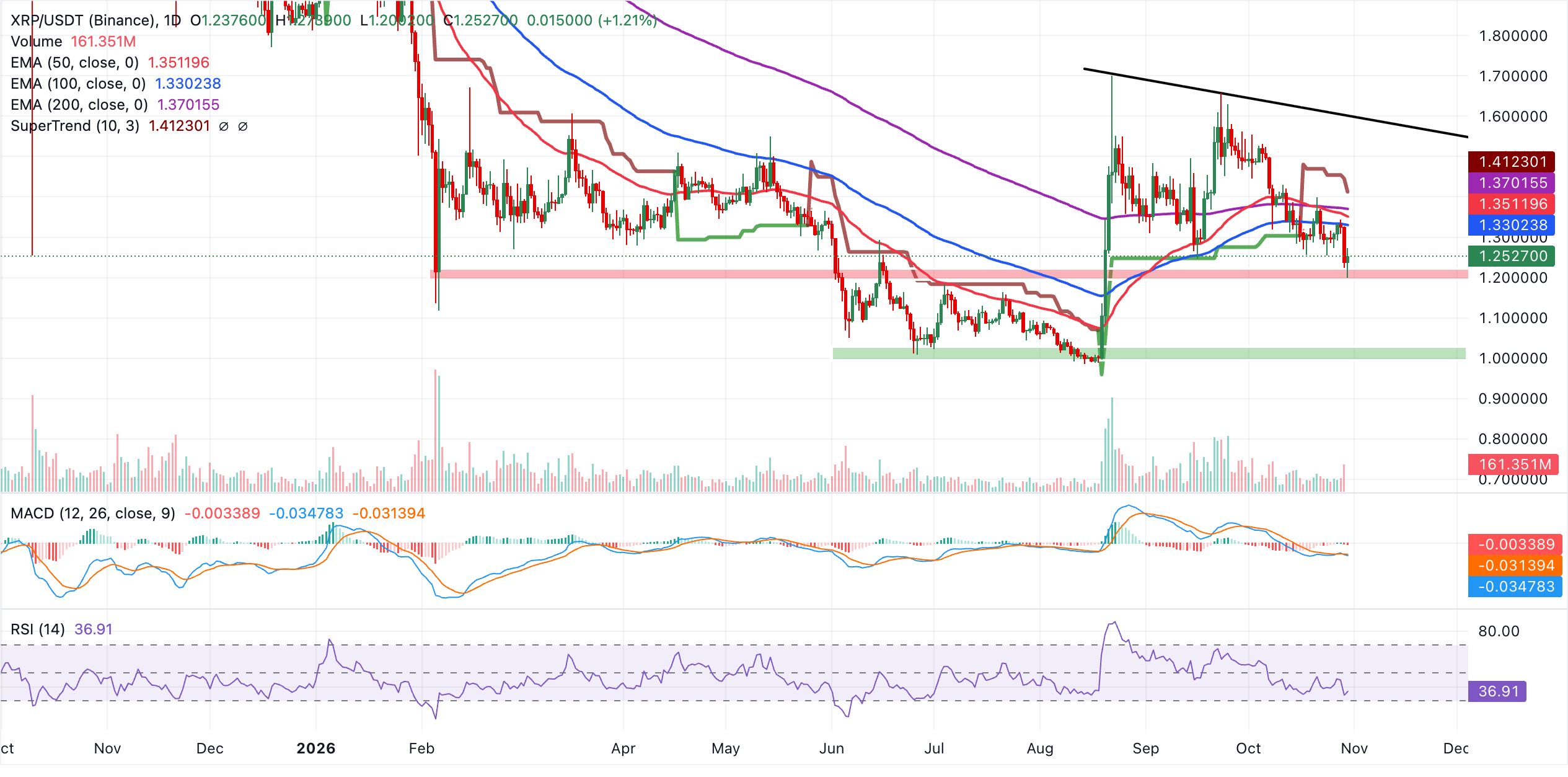
A sustained break by buyers would be needed to prevent a recovery from stalling at the initial resistance levels: the 100-day EMA near $1.33, the 50-day EMA around $1.35 and the 200-day EMA at $1.37. Beyond that cluster, the SuperTrend at $1.41 and the broader descending resistance trendline form a stronger ceiling. Reclaiming those levels would be necessary to reduce the bearish bias and allow a more meaningful rebound.
(The technical analysis of this story was written with the help of an AI tool. Know more.)
Bitcoin, altcoins and stablecoins: key questions
By market capitalisation, Bitcoin ranks as the largest cryptocurrency. It is a virtual currency created to function as money. No single person, group or entity can control this payment method, removing the need for third parties to participate in financial transactions.
Any cryptocurrency other than Bitcoin is classed as an altcoin. Some also exclude Ethereum, however, because forks originate from these two cryptocurrencies. Under that interpretation, Litecoin is the first altcoin: it was forked from the Bitcoin protocol and is therefore an “improved” version of it.
Designed to maintain a stable price, stablecoins are cryptocurrencies backed by reserves of the assets they represent. Each stablecoin is pegged to a commodity or financial instrument, such as the US Dollar (USD), while an algorithm or demand regulates its supply. Their primary purpose is to give investors a route into and out of cryptocurrency trading and investment. They also offer a way to store value, as cryptocurrencies are generally subject to volatility.
Measured as Bitcoin's market capitalisation divided by the combined market capitalisation of all cryptocurrencies, Bitcoin dominance shows the degree of investor interest in Bitcoin. BTC dominance is typically high before and during a bull run, when investors favour relatively stable cryptocurrencies with large market capitalisations, such as Bitcoin. Falling BTC dominance generally signals that investors are shifting capital and/or profits into altcoins in pursuit of higher returns. This usually sparks sharp rallies across altcoins.
POPULAR ARTICLES
1Swiss Franc: Sharp sell-off followed by further gains against US Dollar – UOB2Australian Dollar: RBA Rate Hike Expected to Provide Little Support – TD Securities30.8336: Euro slides to 19-month lows versus British Pound despite encouraging Eurozone GDP4Bitcoin Weekly Forecast: BTC falls under pressure from Binance security breach and hawkish Fed5Japanese Yen: Upside hedge potential against US Dollar despite range-bound trading – BBH6$4,000 gives way: gold retreats despite risk-off sentiment as hawkish Fed expectations weigh7Crypto Today: Selling pressure eases in Bitcoin, Ethereum, XRP following Binance security breach8ECB’s Nagel: Central bank will act decisively to lower inflation if needed9Dogecoin Price Forecast: ETF outflows and long unwinding heighten downside risk for DOGE


Get Started!
Sign up and access the Global Markets in less than 3 minutes

Connect With Us









Contacts
Phone: +61 2 8036 8388
Fax: +61 2 8036 8388
Email: support@tmgm.com



The information provided on this website is of a general nature only and does not constitute personal financial advice. Before acting on any information on this website, you should consider the suitability of the information in relation to your objectives, financial situation and needs. Investing in CFDs and FX Margin Contracts carries significant risks and is not suitable for all investors. You may lose more than your initial deposit. You do not own, or have, any interest in the underlying asset. We recommend that you seek independent advice and ensure you fully understand the risks involved before trading. It is important that you read and consider the disclosure document before you acquire any product listed on the website. The information and advertisements offered on this website are not intended for use by any person in any country or jurisdiction where such use would be contrary to local laws and regulations. The Products and Services offered on this website are not intended for residents of the United States, Malaysia and Thailand.
TMGM is authorized and regulated in various jurisdictions.
Trademax Australia Limited, trading as TMGM, is regulated by the Australian Securities and Investments Commission (ASIC), AFSL no. 436416 and is located at Level 28, One International Tower, 100 Barangaroo Avenue, 2000 Sydney, NSW Australia.
Email: support@tmgm.com.au
Trademax Global Limited, trading as TMGM, is authorized and regulated by the Vanuatu Financial Services Commission (VFSC), registration number 40356 and registered at 1276, Kumul Highway, Port Vila, Vanuatu, Republic of Vanuatu.
Email: support@tmgm.com
Trademax Global Markets (SE) Limited, trading as TMGM, is authorized and regulated by the Financial Services Authority (FSA) of Seychelles, with license number SD224. The company is registered at Office No 13, Providence Estate ABIS Centre, Mahe, Seychelles.
Email: support@tmgm.com
Trademax Global Markets (International) Pty Ltd, trading as TMGM, is authorized and regulated by the Financial Services Commission, Mauritius (FSC) with license no. GB22201012, and registered at 33, Edith Cavell Street C/o IQ EQ Fund Services (Mauritius) Ltd Port Louis, 11324 Mauritius.
Email: support@tmgm.com
Copyright © TMGM. All rights reserved