

Trading
Explore a wide range of markets with competitive pricing, deep liquidity, and advanced trading tools.
Learn More 
Platform
Trade seamlessly with TMGM's powerful platform, built for speed, precision, and a superior trading experience.
Learn More Trading Platform
Academy
Learn the fundamentals of trading with beginner-friendly resources, including guides, webinars, and market insights.
Learn More News & Analysis
Get real-time market updates and expert analysis to stay ahead of trading opportunities
Learn More News & Analysis
About
Learn what sets TMGM apart — our global presence, regulatory strength, and commitment to innovation in trading.
Learn More Why Choose TMGM
Sponsorship
Euro rises as French bond demand recovers; focus turns to ECB-Fed policy
- 1.1210 is within reach as EUR/USD edges higher, with the Euro outperforming its peers.
- France retained its Aa3 sovereign rating from Moody’s despite expectations of a downgrade.
- Unchanged interest rates are expected from both the Fed and the ECB this week.
EUR/USD is slightly higher at around 1.1210 in European trading on Monday. Some early gains have faded, although the Euro (EUR) remains stronger against its peers, including the US Dollar.
Euro Performance Today
Today’s percentage moves in the Euro (EUR) against the major currencies listed appear in the table below. Its largest gain was against the Japanese Yen.
| USD | EUR | GBP | JPY | CAD | AUD | NZD | CHF | |
|---|---|---|---|---|---|---|---|---|
| USD | -0.08% | 0.15% | 0.28% | 0.06% | -0.04% | 0.12% | 0.09% | |
| EUR | 0.08% | 0.27% | 0.35% | 0.13% | 0.05% | 0.22% | 0.18% | |
| GBP | -0.15% | -0.27% | 0.08% | -0.13% | -0.22% | -0.05% | -0.10% | |
| JPY | -0.28% | -0.35% | -0.08% | -0.20% | -0.32% | -0.14% | -0.18% | |
| CAD | -0.06% | -0.13% | 0.13% | 0.20% | -0.12% | 0.08% | 0.04% | |
| AUD | 0.04% | -0.05% | 0.22% | 0.32% | 0.12% | 0.18% | 0.14% | |
| NZD | -0.12% | -0.22% | 0.05% | 0.14% | -0.08% | -0.18% | -0.04% | |
| CHF | -0.09% | -0.18% | 0.10% | 0.18% | -0.04% | -0.14% | 0.04% |
Percentage movements between major currencies are displayed in the heat map. Select the base currency in the left-hand column and the quote currency in the top row. Selecting the Euro on the left and following that row across to the US Dollar, for instance, gives the percentage change for EUR (base)/USD (quote) in the corresponding cell.

Aa3 Rating Retained: Support for the Euro
Buying interest in the Euro follows Moody’s decision to retain France’s Aa3 sovereign rating, contrary to expectations of a downgrade.
The decision late on Friday to retain France’s Aa3 sovereign rating and negative outlook defied "wide market expectations of a downgrade," according to analysts at Danske Bank. They say Moody's position assumes "that a deficit-reducing 2027 budget will be adopted and that financing costs and social tensions will abate somewhat in the coming months."
On the fiscal outlook, Danske Bank notes that Moody's now "expects a deficit of 5.2% of GDP next year, down from the 5.4% the government expects this year but slightly above its 5% target."
Although Moody’s retained the Aa3 sovereign rating, it warned that social unrest "could constrain fiscal consolidation efforts," and unrest persisted over the weekend. It was calmer than the previous week, but unions have already called a nationwide strike for 5 November.
Attention now turns to monetary policy decisions from the Federal Reserve (Fed) on Wednesday and the European Central Bank (ECB) on Thursday.
Neither central bank is expected to alter its current interest rates. Investors will scrutinise policy guidance and comments on whether energy supply shocks have begun feeding through to wages and wider consumer prices.
In eurozone data, Germany’s IFO Institute Business Climate Index delivered an unexpected improvement. The sentiment gauge rose to 90.2 in October from 89.9 in September, against expectations of a decline to 89.8.
1.1254 EMA Caps EUR/USD: Technical Outlook
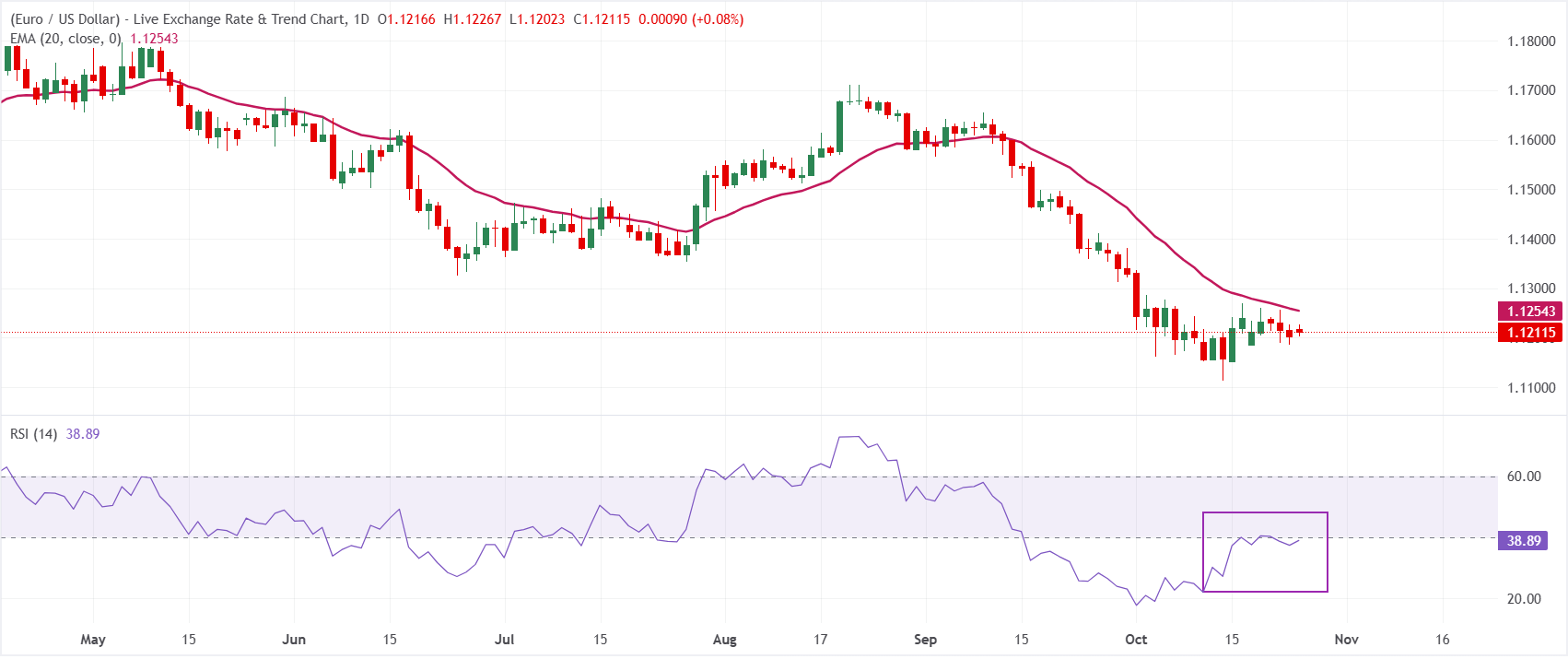
At around 1.1212 on the daily chart, EUR/USD retains a bearish short-term bias below the 20-period exponential moving average (EMA) at 1.1254. Failure to regain this dynamic resistance suggests that recent declines continue to weigh on the pair. With the Relative Strength Index (RSI) near 39, below the neutral 50 threshold, recovery attempts appear modest within a broadly weak trend.
The 20-day EMA near 1.1254 marks the first resistance level. A sustained move above it would be required to relieve downside pressure and allow a more constructive corrective phase. No nearby support levels are mapped in the dataset, leaving the recent lows as an informal floor for now. Below that moving-average ceiling, the pair is likely to remain exposed to further declines.
(The technical analysis of this story was written with the help of an AI tool. Know more.)
Economic Data Indicator
Fed Rate Decision
At eight scheduled meetings each year, the Federal Reserve (Fed) reviews monetary policy and decides where to set interest rates. Its dual mandate is to maintain full employment and keep inflation at 2%. Interest rates are its primary policy instrument, covering both lending to banks and lending between banks. A rate increase tends to support the US Dollar (USD) by drawing in more foreign capital. Conversely, a cut tends to weaken the USD as capital moves to countries offering better returns. When rates remain unchanged, the focus shifts to the Federal Open Market Committee (FOMC) statement: a hawkish tone signals expectations of higher future interest rates, while a dovish tone points to expectations of lower rates.
View details.Next scheduled release: Wed 28 Oct 2026 18:00
Release frequency: No fixed schedule
Consensus forecast: 4%
Previous reading: 4%
Data source: Federal Reserve
POPULAR ARTICLES
1Stronger PMIs: Hawkish Tilt for BoE – Danske Bank on British Pound2December hike odds supported by BoJ outlook: Japanese Yen – BBH3Pi Network Forecast: Bearish pressure persists on PI token despite network access and security upgrade40.8400 test for Euro against British Pound as German business climate tops expectations5Swiss Franc: UOB expects range-bound trading against US Dollar6Brazilian Real: Lula Victory Puts Volatility Risks in Focus – Societe Generale7Silver price today: FXStreet data show silver advancing8December Hike Odds Rise on October Fed Pause: US Dollar - TD Securities9Euro rises as French bond demand recovers; focus turns to ECB-Fed policy
LIVE QUOTES


Get Started!
Sign up and access the Global Markets in less than 3 minutes

Connect With Us









Contacts
Phone: +61 2 8036 8388
Fax: +61 2 8036 8388
Email: support@tmgm.com



The information provided on this website is of a general nature only and does not constitute personal financial advice. Before acting on any information on this website, you should consider the suitability of the information in relation to your objectives, financial situation and needs. Investing in CFDs and FX Margin Contracts carries significant risks and is not suitable for all investors. You may lose more than your initial deposit. You do not own, or have, any interest in the underlying asset. We recommend that you seek independent advice and ensure you fully understand the risks involved before trading. It is important that you read and consider the disclosure document before you acquire any product listed on the website. The information and advertisements offered on this website are not intended for use by any person in any country or jurisdiction where such use would be contrary to local laws and regulations. The Products and Services offered on this website are not intended for residents of the United States, Malaysia and Thailand.
TMGM is authorized and regulated in various jurisdictions.
Trademax Australia Limited, trading as TMGM, is regulated by the Australian Securities and Investments Commission (ASIC), AFSL no. 436416 and is located at Level 28, One International Tower, 100 Barangaroo Avenue, 2000 Sydney, NSW Australia.
Email: support@tmgm.com.au
Trademax Global Limited, trading as TMGM, is authorized and regulated by the Vanuatu Financial Services Commission (VFSC), registration number 40356 and registered at 1276, Kumul Highway, Port Vila, Vanuatu, Republic of Vanuatu.
Email: support@tmgm.com
Trademax Global Markets (SE) Limited, trading as TMGM, is authorized and regulated by the Financial Services Authority (FSA) of Seychelles, with license number SD224. The company is registered at Office No 13, Providence Estate ABIS Centre, Mahe, Seychelles.
Email: support@tmgm.com
Trademax Global Markets (International) Pty Ltd, trading as TMGM, is authorized and regulated by the Financial Services Commission, Mauritius (FSC) with license no. GB22201012, and registered at 33, Edith Cavell Street C/o IQ EQ Fund Services (Mauritius) Ltd Port Louis, 11324 Mauritius.
Email: support@tmgm.com
Copyright © TMGM. All rights reserved