

Trading
Explore a wide range of markets with competitive pricing, deep liquidity, and advanced trading tools.
Learn More 
Platform
Trade seamlessly with TMGM's powerful platform, built for speed, precision, and a superior trading experience.
Learn More Trading Platform
Academy
Learn the fundamentals of trading with beginner-friendly resources, including guides, webinars, and market insights.
Learn More News & Analysis
Get real-time market updates and expert analysis to stay ahead of trading opportunities
Learn More News & Analysis
About
Learn what sets TMGM apart — our global presence, regulatory strength, and commitment to innovation in trading.
Learn More Why Choose TMGM
Sponsorship
Lowest in over a year: Gold plunges as Fed rate hike bets mount
- Nearly 2% lost in Gold as rising US rate expectations curb demand.
- The Fed's October meeting minutes are in focus as traders seek fresh signals on the policy path.
- Further losses remain in view on technical indicators, with XAU/USD nearing oversold conditions.
Gold (XAU/USD) trades around $3,770 at the time of writing. The metal is down 2% on Wednesday, having slipped below $3,800 to its lowest level since September 2025. Traders increasingly anticipate that the Federal Reserve (Fed) will maintain higher interest rates for longer.

Consecutive rate increases look more likely following robust US data and hawkish comments from Fed officials. According to the CME FedWatch Tool, markets fully price in a December hike and assign roughly a 70% probability to another increase in January. Further tightening is also expected later in 2027.
Solid US Data Bolster Fed Hawks and Sustain Dollar Support
Highlighting the economy's resilience, OCBC strategists note that "October data showed solid US momentum heading into 4Q26," adding that "retail sales rose 0.2% MoM, with the control group up 0.6%, while manufacturing output gained 0.3%." In their view, robust consumption alongside stronger production "supports a 25bp Fed hike in December."
Pointing to Alberto Musalem's warning that "several rate hikes may be needed before spring 2027," OCBC stresses that "Fed rhetoric remains hawkish," and notes that John Williams "pushed back against a 50bp December move but acknowledged that strong AI investment and demand could require further tightening."
Expectations of further tightening continue to support the US Dollar (USD), while Treasury yields stay elevated. At 103.80, the US Dollar Index (DXY) reaches its highest point since April 2025. The index measures the Greenback against six major currencies. Meanwhile, the 10-year US Treasury yield holds well above 5%.
Higher yields reduce the appeal of non-interest-bearing Gold, while Dollar strength raises its cost for buyers paying in other currencies. Due at 19:00 GMT, the minutes of the Fed’s October meeting will be scrutinised for evidence of how widely further rate increases are supported.
Gold is now more than 30% below its January record of near $5,600. A reassessment of the Fed outlook since the start of the US-Iran war accounts for much of that pressure. By driving energy prices higher, the conflict added to inflationary pressures.
Recovering Middle East exports and increased global supply are currently weighing on Oil prices, outweighing worries over renewed regional tensions. Lower Oil prices nevertheless provide scant relief for Gold, with the Fed still intent on returning inflation to its 2% target.
XAU/USD Technical Outlook:
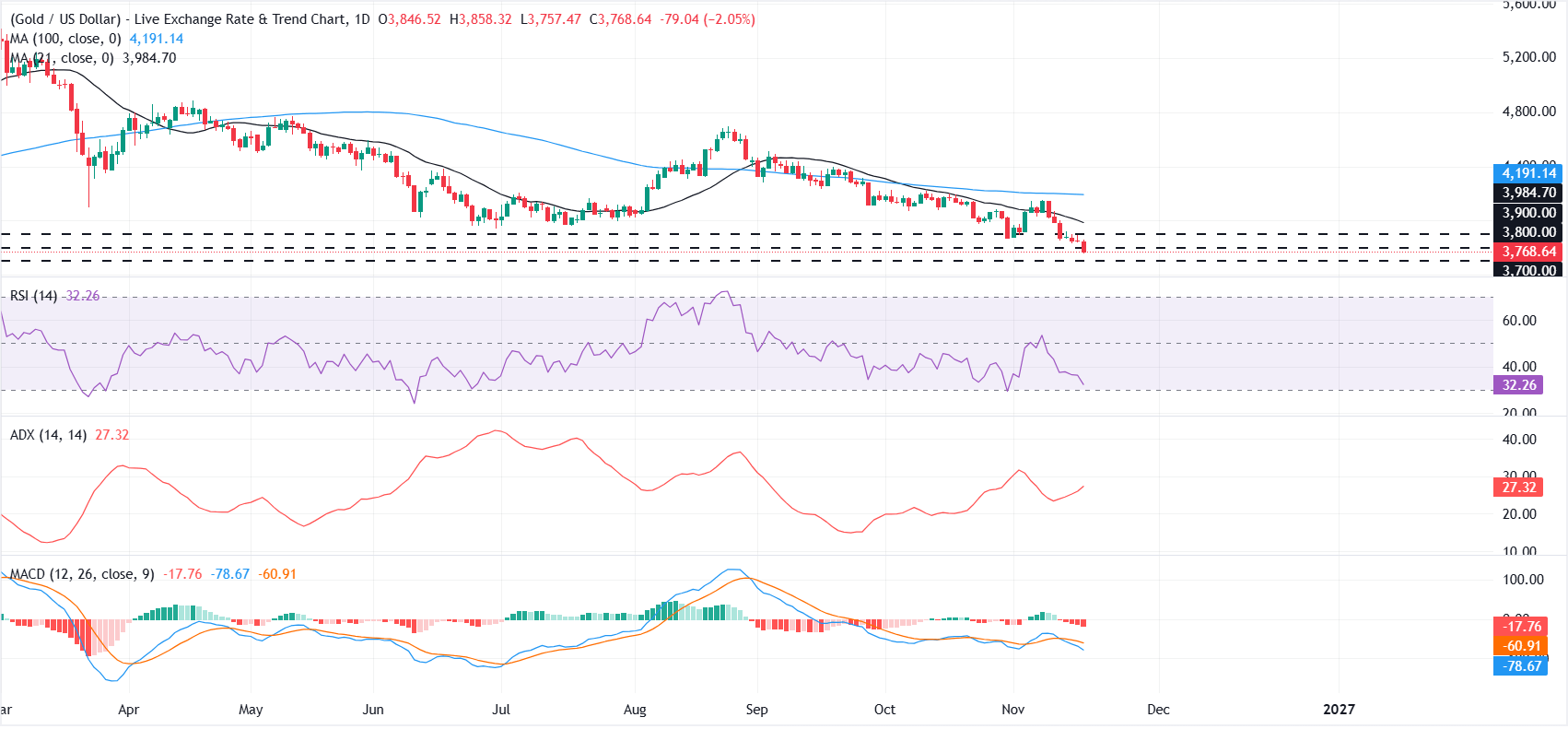
On the daily chart, XAU/USD extends its losses at $3,770.78. A firmly bearish bias persists as the price remains well below the 21-day simple moving average (SMA) of $3,984.80 and the 100-day SMA of $4,191.16. Immediate overhead resistance is concentrated around $3,800.00 and $3,900.00. With the Moving Average Convergence Divergence (MACD) negative at -17.62 and the Average Directional Index (ADX) near 27.32, indicators suggest the downtrend is gaining strength. The Relative Strength Index (RSI), meanwhile, is approaching oversold conditions near 32.35.
Any recovery first faces horizontal resistance at $3,800.00, then $3,900.00. Beyond those levels, the 21-day SMA at $3,984.80 and the 100-day SMA at $4,191.16 present successively stronger hurdles. Bulls would need to regain these levels to relieve immediate selling pressure. Below the current price, the next major support is the horizontal level around $3,700.00. A sustained breach would likely pave the way for an extended decline; defending that floor could instead permit a corrective rebound towards the nearby resistance zone.
(The technical analysis of this story was written with the help of an AI tool. Know more.)
POPULAR ARTICLES
1Swiss Franc drops on monetary policy divergence; focus turns to Fed minutes2British Pound: MUFG Expects Inflation Spike to Remain Contained3Lowest in over a year: Gold plunges as Fed rate hike bets mount4Seven-month high for Indian Rupee: Societe Generale points to "Three powerful tailwinds"5Chainlink Price Forecast: Key support intact for LINK despite persistent ETF outflows and bearish bias6Below 1.1000: Euro stays subdued after mixed Eurozone inflation data7Below $65K: Bitcoin faces pressure as ETH tests $1,800 and XRP retakes $1.00 | Crypto Today80.8430 limits further Swiss Franc losses against US Dollar – UOB9Below 1.10: US Dollar strength keeps Euro (EUR) under pressure – ING

Get Started!
Sign up and access the Global Markets in less than 3 minutes

Connect With Us









Contacts
Phone: +61 2 8036 8388
Fax: +61 2 8036 8388
Email: support@tmgm.com



The information provided on this website is of a general nature only and does not constitute personal financial advice. Before acting on any information on this website, you should consider the suitability of the information in relation to your objectives, financial situation and needs. Investing in CFDs and FX Margin Contracts carries significant risks and is not suitable for all investors. You may lose more than your initial deposit. You do not own, or have, any interest in the underlying asset. We recommend that you seek independent advice and ensure you fully understand the risks involved before trading. It is important that you read and consider the disclosure document before you acquire any product listed on the website. The information and advertisements offered on this website are not intended for use by any person in any country or jurisdiction where such use would be contrary to local laws and regulations. The Products and Services offered on this website are not intended for residents of the United States, Malaysia and Thailand.
TMGM is authorized and regulated in various jurisdictions.
Trademax Australia Limited, trading as TMGM, is regulated by the Australian Securities and Investments Commission (ASIC), AFSL no. 436416 and is located at Level 28, One International Tower, 100 Barangaroo Avenue, 2000 Sydney, NSW Australia.
Email: support@tmgm.com.au
Trademax Global Limited, trading as TMGM, is authorized and regulated by the Vanuatu Financial Services Commission (VFSC), registration number 40356 and registered at 1276, Kumul Highway, Port Vila, Vanuatu, Republic of Vanuatu.
Email: support@tmgm.com
Trademax Global Markets (SE) Limited, trading as TMGM, is authorized and regulated by the Financial Services Authority (FSA) of Seychelles, with license number SD224. The company is registered at Office No 13, Providence Estate ABIS Centre, Mahe, Seychelles.
Email: support@tmgm.com
Trademax Global Markets (International) Pty Ltd, trading as TMGM, is authorized and regulated by the Financial Services Commission, Mauritius (FSC) with license no. GB22201012, and registered at 33, Edith Cavell Street C/o IQ EQ Fund Services (Mauritius) Ltd Port Louis, 11324 Mauritius.
Email: support@tmgm.com
Copyright © TMGM. All rights reserved