

Trading
Explore a wide range of markets with competitive pricing, deep liquidity, and advanced trading tools.
Learn More 
Platform
Trade seamlessly with TMGM's powerful platform, built for speed, precision, and a superior trading experience.
Learn More Trading Platform
Academy
Learn the fundamentals of trading with beginner-friendly resources, including guides, webinars, and market insights.
Learn More News & Analysis
Get real-time market updates and expert analysis to stay ahead of trading opportunities
Learn More News & Analysis
About
Learn what sets TMGM apart — our global presence, regulatory strength, and commitment to innovation in trading.
Learn More Why Choose TMGM
Sponsorship
Six-month low: Indian Rupee sets fresh trough as AI slowdown fears drive global sector rotation
- Multiple supportive factors drive further Indian Rupee gains against the US Dollar.
- Lower oil prices and global sector rotation driven by fears of slower AI spending support the INR.
- Rs. 32,210.20 crore has flowed into Indian equities from FIIs over the past four trading days.
94.08 marks a fresh low for USD/INR in nearly six months at the time of writing. The Indian Rupee (INR) extends its advance against the US Dollar (USD) on Friday.
Cheaper oil and sustained foreign inflows into Indian equities have supported the Indian currency’s outperformance.
At the time of writing, the MCX Crude Oil contract due to expire on 19 November has gained 1.36%, trading near Rs. 8,670. The recovery follows a fresh low of Rs. 8,191, the weakest level in almost two months. Prices nevertheless remain almost 13.5% below the multi-month peak of Rs. 9,972.
When oil prices are low, currencies of economies heavily reliant on imported oil for their energy requirements, including India, typically outperform.
FII inflows into India accelerate sharply
Strong foreign capital inflows into Indian equities over recent weeks have helped ease concerns about dwindling foreign exchange (forex) reserves.
Rs. 32,210.20 crore is the investment committed by Foreign Institutional Investors (FIIs) so far in November.
Global sector rotation has prompted a marked pickup in FII buying. The shift follows the Democrats’ victory in the United States (US) midterm elections, which has raised concerns about slower spending on Artificial Intelligence (AI). A substantial oil-price correction and robust Q2 corporate earnings from India Inc. are other key drivers.
Whether FII buying can maintain its momentum depends mainly on developments outside India, market experts warn. The New Indian Express quoted Akash Garg at Choice Wealth as saying: “Much of the capital that left chased the US-led AI and semiconductor trade; some returns only if that trade cools. For flows to turn durable, the rupee must stabilise, crude must stay soft, clarity must emerge on a US–India trade deal, and — above all — Indian corporate earnings must deliver upgrades. For now, this is welcome stabilisation, not yet a trend,"
12:30 GMT: October US NFP report in focus
Scheduled for release at 12:30 GMT, October’s US Nonfarm Payrolls (NFP) report is a key focus for investors. The jobs figures are expected to materially influence the outlook for the US Dollar.
With the US NFP release approaching, the US Dollar Index (DXY) is up 0.2% at around 101.77. The index measures the Greenback against six major currencies.
Only modest employment growth is likely in October’s US jobs report, according to TD Securities. Its economists expect nonfarm payrolls to “remain subdued at 40K after job gains moderated to 29K in September.” The underlying picture may be firmer than the headline suggests: they note that “despite the subdued, below-consensus print, our forecast would be within the range of breakeven job gains and result in an increase in the three-month moving average,”. TD also highlights that “risks to our payrolls forecast are to the upside,” and warns that “seasonal factors could reverse again more than expected and lead to a stronger print.”
USD/INR technical outlook: bearish pressure persists
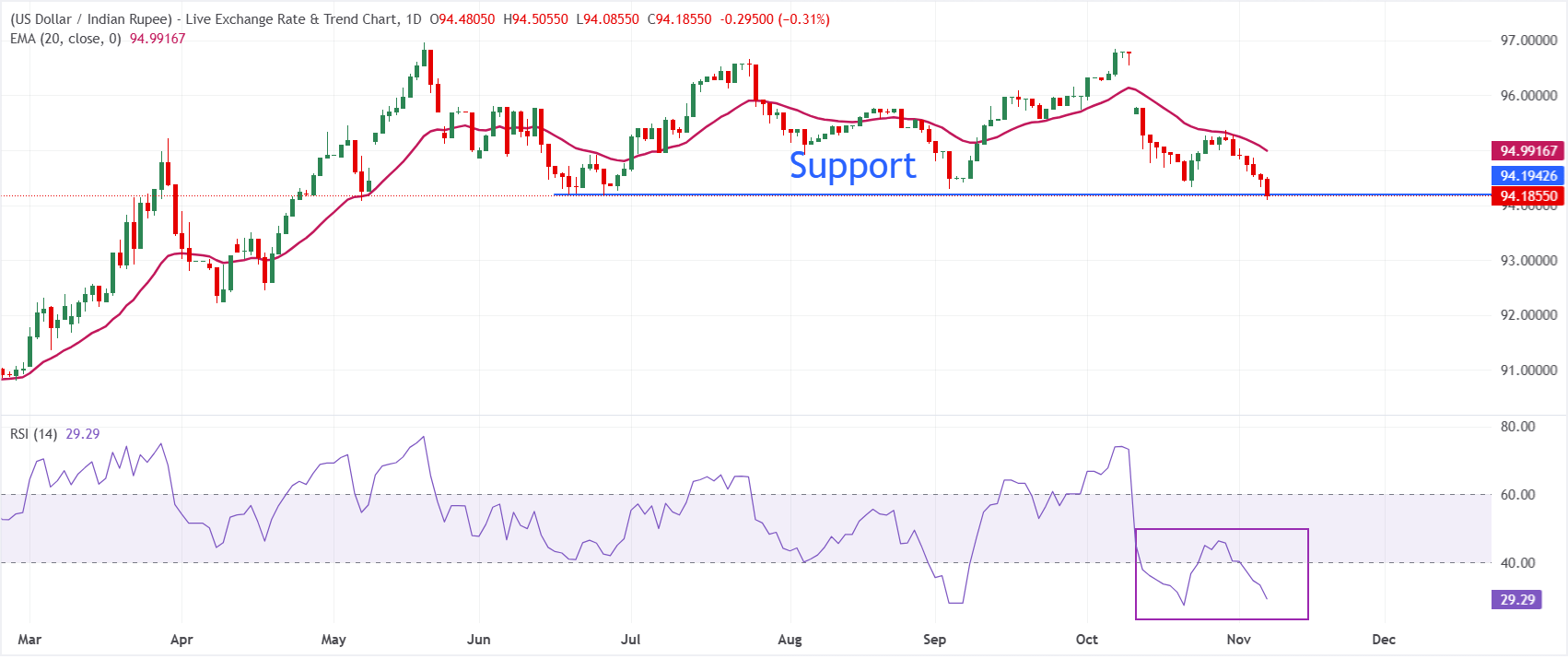
94.08 is the level USD/INR approaches as its decline continues on Friday. The pair remains beneath the 20-day exponential moving average (EMA) of 94.99, which restricts upside potential and strengthens the near-term bearish bias. At 29.29, the latest Relative Strength Index (RSI) reading is in oversold territory. Selling pressure remains dominant, although the short-term decline may be overstretched.
A sustained move back above the 20-day EMA near 94.99, the immediate resistance level, would be required to temper the prevailing bearish outlook. Further losses could take the pair towards 94.00.
(The technical analysis of this story was written with the help of an AI tool. Know more.)
Indian Rupee: frequently asked questions
External developments have a particularly strong influence on the Indian Rupee (INR). Key drivers include Crude Oil prices, given India’s heavy reliance on imported Oil; the US Dollar’s value, as most trade is settled in USD; and foreign investment levels. The Reserve Bank of India (RBI) also plays a major role through direct FX market intervention aimed at exchange-rate stability and through the interest rates it sets.
To support trade, the Reserve Bank of India (RBI) actively intervenes in the forex market to keep the exchange rate stable. It also adjusts interest rates with the aim of holding inflation at its 4% target. Higher rates typically support the Rupee through the ‘carry trade’: investors borrow in lower-interest-rate countries and invest the proceeds in countries offering comparatively higher rates, earning the difference.
Inflation, interest rates, economic growth (GDP), the trade balance and foreign investment inflows all help determine the Rupee’s value. Faster growth can attract additional overseas capital and increase demand for the currency. A narrowing trade deficit will ultimately strengthen the Rupee, while higher interest rates are also supportive, particularly higher real rates, which are interest rates minus inflation. Greater risk appetite can encourage inflows of Foreign Direct and Indirect Investment (FDI and FII), further supporting the currency.
Inflation generally weighs on the Rupee, especially when it exceeds levels in India’s peer economies, because it reflects a loss of value through excess supply. It also raises export costs, resulting in more Rupees being sold to pay for foreign imports and putting further pressure on the currency. However, higher inflation typically prompts the Reserve Bank of India (RBI) to raise interest rates. By attracting greater demand from international investors, those higher rates can support the Rupee. Lower inflation has the opposite effect.
POPULAR ARTICLES
1Polish Zloty: PLN outlook remains weak despite hawkish rhetoric – Commerzbank220-day EMA reclaimed: US Dollar Index price forecast as safe-haven demand supports recovery ahead of US NFP3Upbeat German factory data leaves Euro rangebound against British Pound4Czech Koruna: ING Expects Rangebound Trading Against Euro5Below 158.00: USD/JPY Price Forecast as traders appear hesitant ahead of US NFP6Austria Wholesale Prices n.s.a (MoM) fell from previous 1.9% to -0.2% in October7Austria Wholesale Prices n.s.a (YoY) fell from previous 10.2% to 10% in October8Switzerland Foreign Currency Reserves above forecasts (0B) in October: Actual (759B)9157.00–159.00 band: Bullish bias for Japanese Yen against US Dollar – UOB


Get Started!
Sign up and access the Global Markets in less than 3 minutes

Connect With Us









Contacts
Phone: +61 2 8036 8388
Fax: +61 2 8036 8388
Email: support@tmgm.com



The information provided on this website is of a general nature only and does not constitute personal financial advice. Before acting on any information on this website, you should consider the suitability of the information in relation to your objectives, financial situation and needs. Investing in CFDs and FX Margin Contracts carries significant risks and is not suitable for all investors. You may lose more than your initial deposit. You do not own, or have, any interest in the underlying asset. We recommend that you seek independent advice and ensure you fully understand the risks involved before trading. It is important that you read and consider the disclosure document before you acquire any product listed on the website. The information and advertisements offered on this website are not intended for use by any person in any country or jurisdiction where such use would be contrary to local laws and regulations. The Products and Services offered on this website are not intended for residents of the United States, Malaysia and Thailand.
TMGM is authorized and regulated in various jurisdictions.
Trademax Australia Limited, trading as TMGM, is regulated by the Australian Securities and Investments Commission (ASIC), AFSL no. 436416 and is located at Level 28, One International Tower, 100 Barangaroo Avenue, 2000 Sydney, NSW Australia.
Email: support@tmgm.com.au
Trademax Global Limited, trading as TMGM, is authorized and regulated by the Vanuatu Financial Services Commission (VFSC), registration number 40356 and registered at 1276, Kumul Highway, Port Vila, Vanuatu, Republic of Vanuatu.
Email: support@tmgm.com
Trademax Global Markets (SE) Limited, trading as TMGM, is authorized and regulated by the Financial Services Authority (FSA) of Seychelles, with license number SD224. The company is registered at Office No 13, Providence Estate ABIS Centre, Mahe, Seychelles.
Email: support@tmgm.com
Trademax Global Markets (International) Pty Ltd, trading as TMGM, is authorized and regulated by the Financial Services Commission, Mauritius (FSC) with license no. GB22201012, and registered at 33, Edith Cavell Street C/o IQ EQ Fund Services (Mauritius) Ltd Port Louis, 11324 Mauritius.
Email: support@tmgm.com
Copyright © TMGM. All rights reserved