

Trading
Explore a wide range of markets with competitive pricing, deep liquidity, and advanced trading tools.
Learn More 
Platform
Trade seamlessly with TMGM's powerful platform, built for speed, precision, and a superior trading experience.
Learn More Trading Platform
Academy
Learn the fundamentals of trading with beginner-friendly resources, including guides, webinars, and market insights.
Learn More News & Analysis
Get real-time market updates and expert analysis to stay ahead of trading opportunities
Learn More News & Analysis
About
Learn what sets TMGM apart — our global presence, regulatory strength, and commitment to innovation in trading.
Learn More Why Choose TMGM
Sponsorship
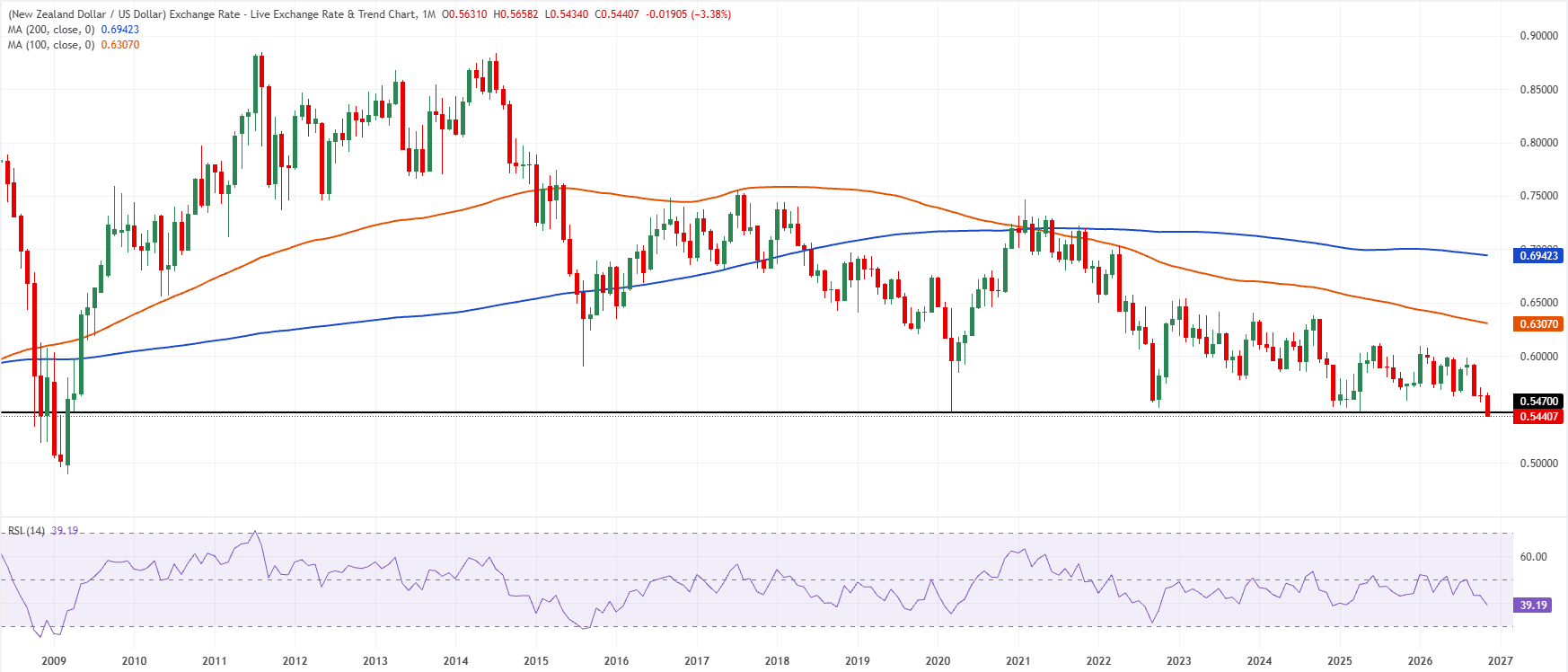
17-year lows: New Zealand Dollar slides as US Dollar reaches new highs
- Below 0.5450: New Zealand Dollar Hits Weakest Level Since 2009.
- New Zealand Retail Sales Strength Offers Kiwi No Relief as Monetary Policy Expectations Diverge.
- 19-Month High for US Dollar Index as US Equities Recover and Economic Activity Holds Firm.
NZD/USD is down 0.48% on Monday. The pair trades around 0.5440 at the time of writing, extending its decline as broad-based Greenback strength pushes the New Zealand Dollar (NZD) to its lowest against the US Dollar (USD) since 2009. The fall takes it below the March 2020 pandemic low near 0.5470.

Above 104.00, the US Dollar Index (DXY) has reached a fresh 19-month high. Tracking the Greenback against a basket of six major currencies, the index is drawing support from recovering US equities and expectations that the Federal Reserve (Fed) will tighten monetary policy further.
Nvidia's reinstatement of Jensen Huang as Chief Executive Officer (CEO) lifts market sentiment, sending its shares more than 30% higher. The advance helps US equities recoup losses from last week's sell-off. It also tempers concerns over the Artificial Intelligence (AI) sector, a significant driver of US investment and economic growth.
US business activity maintained its expansion in November, albeit at a slower rate, according to preliminary figures from S&P Global. With growth easing in both manufacturing and services, the Composite Purchasing Managers Index (PMI) declined from October's 55.9 to 54.6.
Further support for the US Dollar comes from expectations of additional Fed tightening. The CME FedWatch Tool puts the market-implied probability of a 25-basis-point interest rate increase in December at 96%, with a 62% probability of a subsequent rise in January.
Stronger-than-forecast domestic consumption figures provide no lift for the Kiwi. In Monday's release, Statistics New Zealand reported third-quarter Retail Sales growth of 2.2% QoQ, well above the 0.5% forecast. The increase reversed the previous quarter's 0.5% contraction.
Investors' attention remains on the policy divergence between the Fed and the Reserve Bank of New Zealand (RBNZ). That focus keeps the New Zealand Dollar under pressure, despite the strongest quarterly retail sales expansion in nearly five years.
The Kiwi continues to feel the effects of the RBNZ's October decision to hold interest rates steady when an increase had been expected. Markets now anticipate a 25-basis-point rise at the meeting on 9 December, but that prospect has yet to halt the currency's downward momentum.
Wednesday brings the October US Personal Consumption Expenditures (PCE) Price Index, the next focus for investors. The release could offer additional signals on the Fed's monetary policy path and help shape NZD/USD's next move.
POPULAR ARTICLES
1Nvidia-led stock rally lifts risk appetite and weighs on Japanese Yen2Singapore Dollar: Tight-range consolidation against US Dollar favoured – UOB3Forex Today: US Consumer Confidence and German IFO Take Centre Stage4Bitcoin Price Outlook: Prospects for a Sustained BTC Recovery After Nvidia Reinstates Jensen Huang52028: Chinese Yuan Seen on Controlled Appreciation Path – Commerzbank6NVIDIA return drives USD rally as British Pound retreats717-year lows: New Zealand Dollar slides as US Dollar reaches new highs8BTC and XAU Advance: Bitcoin vs Gold Outlook Following the Reinstatement of Nvidia CEO Jensen Huang92027 growth: Diverging dynamics in China – DBS


Get Started!
Sign up and access the Global Markets in less than 3 minutes

Connect With Us









Contacts
Phone: +61 2 8036 8388
Fax: +61 2 8036 8388
Email: support@tmgm.com



The information provided on this website is of a general nature only and does not constitute personal financial advice. Before acting on any information on this website, you should consider the suitability of the information in relation to your objectives, financial situation and needs. Investing in CFDs and FX Margin Contracts carries significant risks and is not suitable for all investors. You may lose more than your initial deposit. You do not own, or have, any interest in the underlying asset. We recommend that you seek independent advice and ensure you fully understand the risks involved before trading. It is important that you read and consider the disclosure document before you acquire any product listed on the website. The information and advertisements offered on this website are not intended for use by any person in any country or jurisdiction where such use would be contrary to local laws and regulations. The Products and Services offered on this website are not intended for residents of the United States, Malaysia and Thailand.
TMGM is authorized and regulated in various jurisdictions.
Trademax Australia Limited, trading as TMGM, is regulated by the Australian Securities and Investments Commission (ASIC), AFSL no. 436416 and is located at Level 28, One International Tower, 100 Barangaroo Avenue, 2000 Sydney, NSW Australia.
Email: support@tmgm.com.au
Trademax Global Limited, trading as TMGM, is authorized and regulated by the Vanuatu Financial Services Commission (VFSC), registration number 40356 and registered at 1276, Kumul Highway, Port Vila, Vanuatu, Republic of Vanuatu.
Email: support@tmgm.com
Trademax Global Markets (SE) Limited, trading as TMGM, is authorized and regulated by the Financial Services Authority (FSA) of Seychelles, with license number SD224. The company is registered at Office No 13, Providence Estate ABIS Centre, Mahe, Seychelles.
Email: support@tmgm.com
Trademax Global Markets (International) Pty Ltd, trading as TMGM, is authorized and regulated by the Financial Services Commission, Mauritius (FSC) with license no. GB22201012, and registered at 33, Edith Cavell Street C/o IQ EQ Fund Services (Mauritius) Ltd Port Louis, 11324 Mauritius.
Email: support@tmgm.com
Copyright © TMGM. All rights reserved