

Trading
Explore a wide range of markets with competitive pricing, deep liquidity, and advanced trading tools.
Learn More 
Platform
Trade seamlessly with TMGM's powerful platform, built for speed, precision, and a superior trading experience.
Learn More Trading Platform
Academy
Learn the fundamentals of trading with beginner-friendly resources, including guides, webinars, and market insights.
Learn More News & Analysis
Get real-time market updates and expert analysis to stay ahead of trading opportunities
Learn More News & Analysis
About
Learn what sets TMGM apart — our global presence, regulatory strength, and commitment to innovation in trading.
Learn More Why Choose TMGM
Sponsorship
Silver Price Forecast: Downside risk persists amid weak momentum
- A hawkish Fed outlook leaves Silver buyers wary, limiting follow-through from Monday’s rebound.
- Wednesday’s US PCE inflation release is in focus as investors seek guidance on the Fed’s rate-hike trajectory.
- Weak RSI and MACD readings leave the wider technical picture tilted towards sellers.
More than 5% was added to Silver (XAG/USD) in the previous session. On Tuesday, however, buying interest remains subdued. A weaker US Dollar (USD) cushions the downside, but a hawkish Federal Reserve (Fed) outlook still pressures the metal. Technical signals also point to an advantage for sellers.

Around $42.50 is the current level for XAG/USD, representing a daily decline of 1.35% at the time of writing. Following Monday’s 20-month peak of 104.53, the US Dollar Index (DXY) has slipped to around 103.93.
Further Fed hikes expected as US economy withstands tighter policy
TD Securities now expects the Fed “to hike three consecutive times starting in December.” The bank sees a more hawkish policy outlook. Its strategists point out that “inflation remains above target and is moving in the wrong direction,” adding that “the labor market has stabilized, with some signs of strengthening, and activity data has been robust.”
While arguing that “the economy can handle more restriction, and the Fed is likely to provide it,” the strategists emphasise that “the evolution of inflation data will determine the extent and pace of hikes later in the cycle.”
Wednesday brings the October US Personal Consumption Expenditures (PCE) Price Index, now the market’s next focus. Should the reading exceed expectations, bets on additional rate increases could strengthen, putting Silver under pressure.
$48.85 SMA caps Silver’s technical outlook
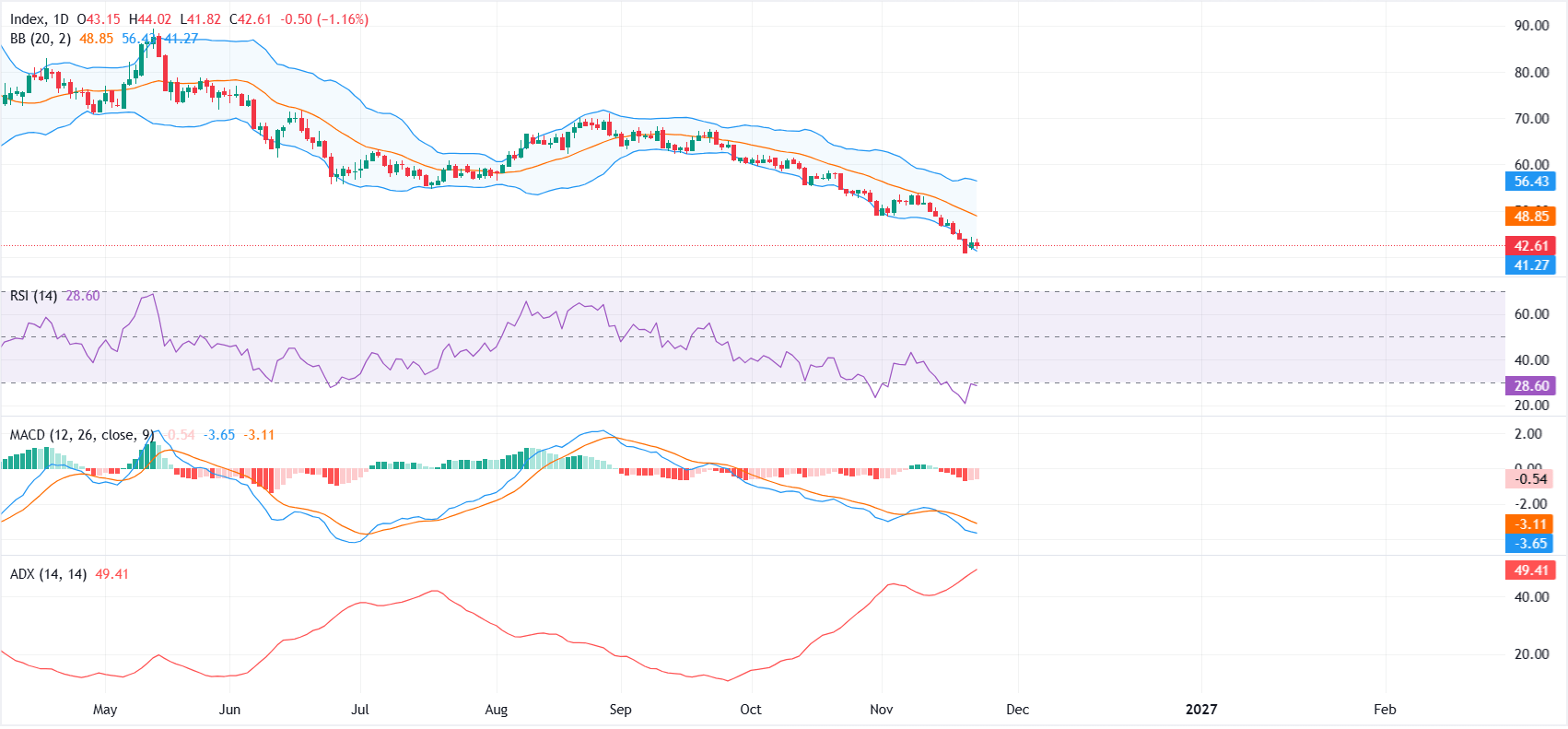
Well below the 20-day Bollinger Simple Moving Average (SMA) of $48.85, XAG/USD retains a bearish short-term bias on the daily chart. The metal remains beneath this near-term trend reference, with volatility bands widening overhead.
An oversold Relative Strength Index (RSI) near 28 and a deeply negative Moving Average Convergence Divergence (MACD) line signal weak momentum. Together, these indicators point to sustained downward pressure, even after the steep decline already recorded.
Near $48.85, the Bollinger middle band provides the first resistance level. Beyond it, the upper band around $56.43 presents a further barrier where a rebound would likely lose traction.
At $41.28, the lower Bollinger band provides immediate support, while the current trading zone serves as a fragile pivot. A decisive breach of that floor would open the way to further declines. Meanwhile, the elevated Average Directional Index (ADX), near 49, underlines the strength of the established downtrend.
(The technical analysis of this story was written with the help of an AI tool. Know more.)
Silver: key investor questions
Historically a store of value and a means of exchange, Silver remains an actively traded precious metal. Gold attracts greater interest, but traders may choose Silver for portfolio diversification, its intrinsic value or its potential to hedge against high inflation. Exposure can take the form of physical coins and bars. Alternatively, investors can trade through instruments such as Exchange Traded Funds that track Silver’s price in international markets.
Several forces shape Silver’s price. Its safe-haven appeal can lift prices during geopolitical turmoil or when fears of a severe recession intensify, though this effect is less pronounced than for Gold. Lower interest rates generally support Silver because it generates no yield. Pricing in US Dollars (USD), as reflected in XAG/USD, also makes the currency’s performance important: Dollar strength tends to restrain Silver, while weakness is likely to lift it. Investment demand, mine supply and recycling rates are additional influences. Silver is far more abundant than Gold.
With electrical conductivity among the highest of any metal, exceeding both Copper and Gold, Silver has extensive industrial applications, notably in electronics and solar energy. Rising demand can push prices higher; falling demand generally has the opposite effect. Developments in the US, Chinese and Indian economies can also drive price fluctuations. Large industrial sectors in the US and, especially, China consume Silver in multiple processes. In India, consumer demand for Silver jewellery is another important influence on prices.
Gold’s price direction often sets the course for Silver. Their similar safe-haven status means that gains in Gold are typically accompanied by gains in Silver. To assess their relative valuations, investors may use the Gold/Silver ratio: the number of ounces of Silver equivalent in value to one ounce of Gold. Some interpret a high ratio as a sign that Silver is undervalued or Gold overvalued. A low reading, by contrast, may indicate that Gold is undervalued against Silver.
POPULAR ARTICLES
1Brazilian Real: Rebound potential constrained by debt concerns – BBH2Silver Price Forecast: Downside risk persists amid weak momentum3XRP Retreats Under ETF Pressure: Ripple Price Forecast4Canadian Dollar recovery gains momentum as US Dollar buyers step back5Euro downside against US Dollar could be constrained by fiscal rule – MUFG6Stronger German business confidence lifts Euro against British Pound7US Dollar: Further upside may not last, ING says8Canadian Dollar: December hike outlook hinges on Macklem speech – BBH9Australian Dollar consolidates following overextended slide against US Dollar – UOB


Get Started!
Sign up and access the Global Markets in less than 3 minutes

Connect With Us









Contacts
Phone: +61 2 8036 8388
Fax: +61 2 8036 8388
Email: support@tmgm.com



The information provided on this website is of a general nature only and does not constitute personal financial advice. Before acting on any information on this website, you should consider the suitability of the information in relation to your objectives, financial situation and needs. Investing in CFDs and FX Margin Contracts carries significant risks and is not suitable for all investors. You may lose more than your initial deposit. You do not own, or have, any interest in the underlying asset. We recommend that you seek independent advice and ensure you fully understand the risks involved before trading. It is important that you read and consider the disclosure document before you acquire any product listed on the website. The information and advertisements offered on this website are not intended for use by any person in any country or jurisdiction where such use would be contrary to local laws and regulations. The Products and Services offered on this website are not intended for residents of the United States, Malaysia and Thailand.
TMGM is authorized and regulated in various jurisdictions.
Trademax Australia Limited, trading as TMGM, is regulated by the Australian Securities and Investments Commission (ASIC), AFSL no. 436416 and is located at Level 28, One International Tower, 100 Barangaroo Avenue, 2000 Sydney, NSW Australia.
Email: support@tmgm.com.au
Trademax Global Limited, trading as TMGM, is authorized and regulated by the Vanuatu Financial Services Commission (VFSC), registration number 40356 and registered at 1276, Kumul Highway, Port Vila, Vanuatu, Republic of Vanuatu.
Email: support@tmgm.com
Trademax Global Markets (SE) Limited, trading as TMGM, is authorized and regulated by the Financial Services Authority (FSA) of Seychelles, with license number SD224. The company is registered at Office No 13, Providence Estate ABIS Centre, Mahe, Seychelles.
Email: support@tmgm.com
Trademax Global Markets (International) Pty Ltd, trading as TMGM, is authorized and regulated by the Financial Services Commission, Mauritius (FSC) with license no. GB22201012, and registered at 33, Edith Cavell Street C/o IQ EQ Fund Services (Mauritius) Ltd Port Louis, 11324 Mauritius.
Email: support@tmgm.com
Copyright © TMGM. All rights reserved