

Trading
Explore a wide range of markets with competitive pricing, deep liquidity, and advanced trading tools.
Learn More 
Platform
Trade seamlessly with TMGM's powerful platform, built for speed, precision, and a superior trading experience.
Learn More Trading Platform
Academy
Learn the fundamentals of trading with beginner-friendly resources, including guides, webinars, and market insights.
Learn More News & Analysis
Get real-time market updates and expert analysis to stay ahead of trading opportunities
Learn More News & Analysis
About
Learn what sets TMGM apart — our global presence, regulatory strength, and commitment to innovation in trading.
Learn More Why Choose TMGM
Sponsorship
Above $43: XAG/USD holds recovery; Silver Price Forecast stays cautious
- $43.20: Silver sustains its rebound as oversold indicators provide support.
- A December interest rate increase by the Fed is viewed as almost certain.
- A recovery in global AI stocks is likely to weaken demand for precious metals.
$43.20 is the approximate level for Silver (XAG/USD) in flat Asian trading on Tuesday. The metal is retaining its rebound from last week’s fresh 14-month low of $40.78.
Rather than signalling a structural change, Silver’s rebound appears largely driven by indicators reaching oversold levels following last week’s turmoil. Financial markets are becoming more confident that the Federal Reserve (Fed) will deliver consecutive interest rate increases in the near term.

According to analysts at Rabobank, the OIS curve now “implies that investors are positioned for a full hike in December, followed by close to 70% of a 25bp hike priced in for the January meeting,” an arrangement they describe as “in line with Waller’s comments, after having moved from one of the most hawkish to one of the most dovish FOMC members and now back among the most hawkish.” His latest guidance has also become more explicit, Rabobank says, citing “recent calls…for either a 50bp hike at the December meeting or a 25bp hike accompanied by clear forward guidance from Warsh that an additional hike will follow in January,” as markets refocus on a more aggressive Fed tightening trajectory.
For assets that generate no yield, including Silver, higher Fed interest rates are theoretically unfavourable.
Precious metals are also likely to lose some appeal as global Artificial Intelligence (AI) stocks attract renewed interest following chipmaker Nvidia’s board calling Jensen Huang back to lead the company into the future.
Nvidia’s share price surged over 31% in a single trading day after Monday’s call for Jensen Huang to return.
$50.61 EMA Caps Silver’s Technical Outlook
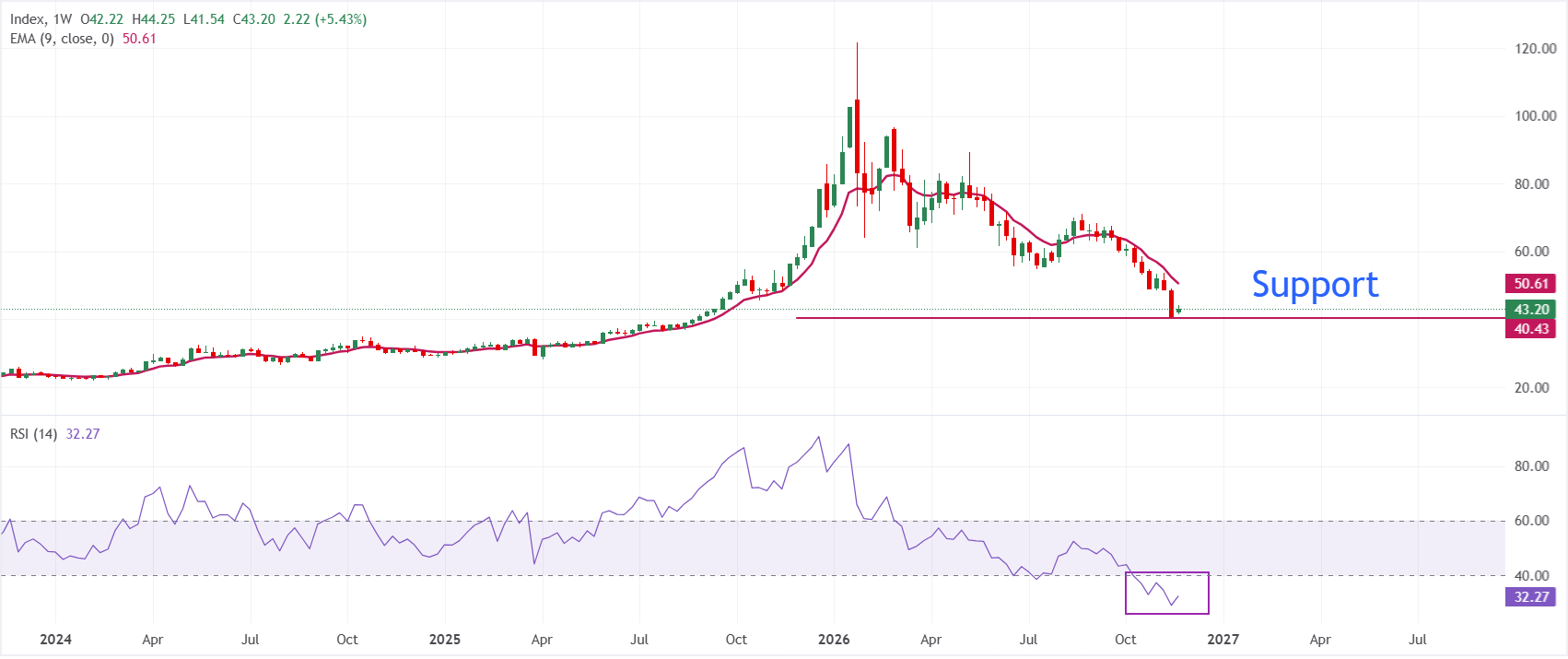
At $43.18 on the weekly chart, XAG/USD remains well beneath the 9-period exponential moving average (EMA) of $50.61, leaving its near-term bias bearish. The gap to that overhead EMA points to sustained selling pressure. Meanwhile, the Relative Strength Index (RSI), at 32.24, sits close to oversold territory. This suggests downward momentum still dominates but may be becoming stretched.
The 9-period EMA at $50.61 provides the first upside resistance. While Silver stays below it, the average limits recovery attempts and supports the broader bearish structure. On the downside, last week’s low of $40.78 represents key support.
(The technical analysis of this story was written with the help of an AI tool. Know more.)
Silver: Key Questions
Investors actively trade Silver, a precious metal with a long history as both a store of value and a means of exchange. Gold remains more popular, but traders may choose Silver for portfolio diversification, its intrinsic value or its potential to hedge against high inflation. Exposure can come through physical Silver coins and bars, or through instruments such as Exchange Traded Funds that follow its international market price.
A broad set of influences shapes Silver prices. Its safe-haven role can lift prices when geopolitical tensions rise or investors fear a severe recession, though this effect is weaker than for Gold. Lower interest rates generally support Silver because it pays no yield. The US Dollar (USD) is another important driver: Silver is dollar-denominated (XAG/USD), so a stronger Dollar typically restrains prices, while a weaker one is likely to lift them. Investment demand, recycling rates and mine supply also matter; Silver is considerably more abundant than Gold.
Among metals, Silver has one of the highest levels of electrical conductivity, exceeding those of Copper and Gold. This makes it widely used across industry, notably in electronics and solar energy. Rising demand can push prices higher, while falling demand usually weighs on them. Economic developments in the US, China and India can also cause price fluctuations. Large industrial sectors in the US and, especially, China consume Silver in a range of processes. In India, consumer demand for Silver jewellery is another key influence on prices.
Gold and Silver share similar safe-haven characteristics, so Silver generally tracks Gold’s direction and typically rises when Gold advances. Their relative valuations may be assessed using the Gold/Silver ratio, which measures how many ounces of Silver equal the value of one ounce of Gold. A high reading may indicate to some investors that Silver is undervalued or Gold is overvalued. A low reading, by contrast, may signal that Gold is undervalued compared with Silver.
POPULAR ARTICLES
1Australian Dollar steady against US Dollar with Aussie/US inflation data in focus2Above $43: XAG/USD holds recovery; Silver Price Forecast stays cautious33-month low: WTI falls as Libyan pipeline resumes operations despite US-Iran tensions4Canadian Dollar under pressure against US Dollar as US PCE takes centre stage5US PCE inflation data awaited as Japanese Yen gains on intervention concerns66.7111: PBOC fixes USD/CNY reference rate, compared with 6.7120 previously7Above 1.0900: Euro retains gains as risk-on sentiment prevails819-month low for Pound with BoE's Greene next in focus9Middle East cannot afford further US-Iran escalation, Qatar warns

Get Started!
Sign up and access the Global Markets in less than 3 minutes

Connect With Us









Contacts
Phone: +61 2 8036 8388
Fax: +61 2 8036 8388
Email: support@tmgm.com



The information provided on this website is of a general nature only and does not constitute personal financial advice. Before acting on any information on this website, you should consider the suitability of the information in relation to your objectives, financial situation and needs. Investing in CFDs and FX Margin Contracts carries significant risks and is not suitable for all investors. You may lose more than your initial deposit. You do not own, or have, any interest in the underlying asset. We recommend that you seek independent advice and ensure you fully understand the risks involved before trading. It is important that you read and consider the disclosure document before you acquire any product listed on the website. The information and advertisements offered on this website are not intended for use by any person in any country or jurisdiction where such use would be contrary to local laws and regulations. The Products and Services offered on this website are not intended for residents of the United States, Malaysia and Thailand.
TMGM is authorized and regulated in various jurisdictions.
Trademax Australia Limited, trading as TMGM, is regulated by the Australian Securities and Investments Commission (ASIC), AFSL no. 436416 and is located at Level 28, One International Tower, 100 Barangaroo Avenue, 2000 Sydney, NSW Australia.
Email: support@tmgm.com.au
Trademax Global Limited, trading as TMGM, is authorized and regulated by the Vanuatu Financial Services Commission (VFSC), registration number 40356 and registered at 1276, Kumul Highway, Port Vila, Vanuatu, Republic of Vanuatu.
Email: support@tmgm.com
Trademax Global Markets (SE) Limited, trading as TMGM, is authorized and regulated by the Financial Services Authority (FSA) of Seychelles, with license number SD224. The company is registered at Office No 13, Providence Estate ABIS Centre, Mahe, Seychelles.
Email: support@tmgm.com
Trademax Global Markets (International) Pty Ltd, trading as TMGM, is authorized and regulated by the Financial Services Commission, Mauritius (FSC) with license no. GB22201012, and registered at 33, Edith Cavell Street C/o IQ EQ Fund Services (Mauritius) Ltd Port Louis, 11324 Mauritius.
Email: support@tmgm.com
Copyright © TMGM. All rights reserved