

Trading
Explore a wide range of markets with competitive pricing, deep liquidity, and advanced trading tools.
Learn More 
Platform
Trade seamlessly with TMGM's powerful platform, built for speed, precision, and a superior trading experience.
Learn More Trading Platform
Academy
Learn the fundamentals of trading with beginner-friendly resources, including guides, webinars, and market insights.
Learn More News & Analysis
Get real-time market updates and expert analysis to stay ahead of trading opportunities
Learn More News & Analysis
About
Learn what sets TMGM apart — our global presence, regulatory strength, and commitment to innovation in trading.
Learn More Why Choose TMGM
Sponsorship
XAG/USD reverses as global AI stocks stage a strong rebound: Silver Price Forecast
- Silver retreats as Jensen Huang’s return to Nvidia’s board bolsters traders’ support for the global AI trade.
- Over 31%: Nvidia shares surge after the board reinstates Jensen Huang.
- Hawkish Fed expectations and a US technology stock rally lift the US Dollar.
Silver (XAG/USD) is down 1.58% at the time of writing. Trading near $42.45 after pulling back from the session high of $44.00, the metal has surrendered its early advance and turned negative during Tuesday’s European session.
An apparent shift of global capital back into Artificial Intelligence (AI) equities is weighing on the white metal. The move follows Nvidia’s announcement that Jense Huang has been reinstated as CEO. The decision marks an unexpected reversal after the board explicitly ruled out his return following confirmation of his extramarital affairs, including one with an alleged Chinese spy.
Nvidia rally revives AI trade as US sector gains remain narrow
The extraordinary corporate and market developments surrounding Nvidia are in focus for Danske Bank analysts. They note that, in the US, the company “reinstated Jensen Huang as CEO, less than a week after the board had ruled out his return.” According to the board, input had come from “senior levels” of the US government, and it identified no national security risk. President Donald Trump, meanwhile, said he had personally persuaded the board.
A “stunning reversal” is how Danske Bank characterises the market response. Nvidia shares finished “31.5% higher”, helping lift the wider indices: the S&P 500 gained “4.7%” and the Nasdaq advanced “6.9%.” However, the analysts warn that Nvidia “still faces SEC and Justice Department investigations over issues ranging from potential accounting irregularities to alleged chip smuggling,” while senior Democrats “have also pledged to investigate the matter once they take control of Congress in January.”
Regional performance has diverged in the immediate aftermath. Danske Bank observes that “the AI trade is carrying through to Asia this morning,” citing “Taiwan up 9% and South Korea up 7% at the time of writing.” Elsewhere, however, “European equity futures are flat, and US futures point to a slightly higher open,” the bank notes.
The breadth of the advance also draws scepticism from Danske Bank analysts, who “take issue with calling yesterday a broad rally.” They note that “US tech rose 9%, while energy and consumer staples both fell,” and argue that “gaps of around 10 percentage points between sectors are rare and not broad rally in our opinion.” Their interpretation of “yesterday’s move” is “a partial reversal of the AI sell-off over the past month,” rather than a broad advance. Volatility remains elevated despite the decline: “the VIX fell from 36 to 26.”
Silver also faces pressure from a strengthening US Dollar (USD). Increased inflows into US equities and hawkish expectations for the Federal Reserve (Fed) are supporting the currency. A firmer US Dollar makes Silver a less favourable proposition for investors on a risk-reward basis.
Near 104.38 at the time of writing, the US Dollar Index (DXY) is edging higher. It remains close to the previous day’s 20-month peak of 104.53.
$42.38: Silver’s Technical Outlook Remains Bearish
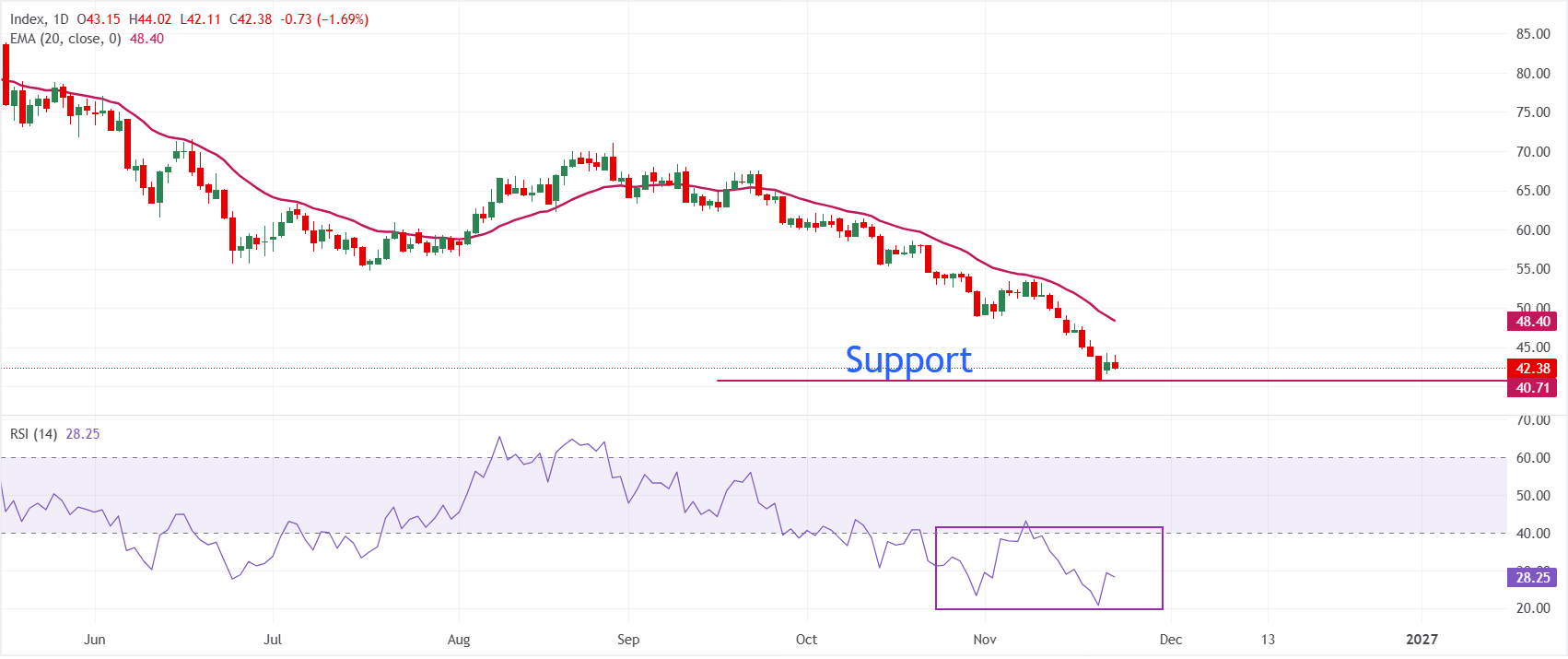
At $42.38 on the daily chart, XAG/USD remains well below its 20-day Exponential Moving Average (EMA) of $48.40, leaving the near-term outlook bearish. Pressure persists following the steep retreat from recent highs. With the Relative Strength Index (RSI) at 28.25, the metal is oversold, suggesting stretched downward momentum but no decisive reversal yet.
The first resistance level is the 20-day EMA at $48.40. A recovery would likely encounter initial selling there, testing whether a rebound can last. On the downside, an oversold RSI near 28 suggests sellers may start to hesitate at current prices. Nevertheless, while XAG/USD remains below the $48.40 EMA barrier, advances are likely to be treated as corrective moves within a broader bearish phase.
(The technical analysis of this story was written with the help of an AI tool. Know more.)
Silver: Frequently Asked Questions
Historically both a store of value and a medium of exchange, Silver remains a heavily traded precious metal. It attracts less attention than Gold, but traders may hold it for its intrinsic value, to diversify portfolios or as a potential hedge against high inflation. Exposure can take the form of physical coins and bars. Alternatively, investors can use instruments such as Exchange Traded Funds that track Silver’s price in international markets.
Several forces shape Silver prices. Its safe-haven status can attract buying during geopolitical instability or fears of a severe recession, though the effect is typically weaker than for Gold. Lower interest rates also tend to support Silver because it pays no yield. Pricing in US Dollars (USD), reflected in XAG/USD, makes the currency another important influence: Dollar strength generally restrains Silver, while a weaker Dollar is likely to lift it. Investment demand, mine supply and recycling rates can also move prices. Silver is far more abundant than Gold.
Among metals, Silver has one of the highest levels of electrical conductivity, exceeding both Copper and Gold. This makes it widely used in industries including electronics and solar energy. Rising demand can push prices higher; falling demand tends to have the opposite effect. Economic developments in the US, China and India can therefore drive price fluctuations. Large industrial sectors in the US and, especially, China consume Silver across numerous processes. In India, consumer demand for Silver jewellery is another key influence on prices.
The similar safe-haven roles of Gold and Silver mean their prices often move together. An increase in Gold prices is typically accompanied by a rise in Silver. To assess their relative valuations, investors may use the Gold/Silver ratio: the number of ounces of Silver equal in value to one ounce of Gold. A high ratio may be interpreted by some investors as a sign that Silver is undervalued or Gold overvalued. A low ratio, conversely, may indicate that Gold is undervalued against Silver.
POPULAR ARTICLES
1Forex Today: Global stocks rally led by tech shares, US Dollar stabilizes at 20-month highs219-month lows for euro as hopes of aggressive Fed hikes revive3160.40: USD/JPY needs a break above to begin a fresh leg higher4XAG/USD reverses as global AI stocks stage a strong rebound: Silver Price Forecast5Equities: Tech recovery drives greater sector divergence - Danske Bank6Top Altcoins Price Forecast: Nvidia-fuelled relief rally unravels for Ripple, Cardano and Solana7Above 0.6600: Australian Dollar strengthens on risk appetite as traders await US PCE data8Indian Rupee gains against US Dollar to draw support from RBI hikes - Commerzbank9Euro: Oversold risks accompany continued weakness against US Dollar – UOB


Get Started!
Sign up and access the Global Markets in less than 3 minutes

Connect With Us









Contacts
Phone: +61 2 8036 8388
Fax: +61 2 8036 8388
Email: support@tmgm.com



The information provided on this website is of a general nature only and does not constitute personal financial advice. Before acting on any information on this website, you should consider the suitability of the information in relation to your objectives, financial situation and needs. Investing in CFDs and FX Margin Contracts carries significant risks and is not suitable for all investors. You may lose more than your initial deposit. You do not own, or have, any interest in the underlying asset. We recommend that you seek independent advice and ensure you fully understand the risks involved before trading. It is important that you read and consider the disclosure document before you acquire any product listed on the website. The information and advertisements offered on this website are not intended for use by any person in any country or jurisdiction where such use would be contrary to local laws and regulations. The Products and Services offered on this website are not intended for residents of the United States, Malaysia and Thailand.
TMGM is authorized and regulated in various jurisdictions.
Trademax Australia Limited, trading as TMGM, is regulated by the Australian Securities and Investments Commission (ASIC), AFSL no. 436416 and is located at Level 28, One International Tower, 100 Barangaroo Avenue, 2000 Sydney, NSW Australia.
Email: support@tmgm.com.au
Trademax Global Limited, trading as TMGM, is authorized and regulated by the Vanuatu Financial Services Commission (VFSC), registration number 40356 and registered at 1276, Kumul Highway, Port Vila, Vanuatu, Republic of Vanuatu.
Email: support@tmgm.com
Trademax Global Markets (SE) Limited, trading as TMGM, is authorized and regulated by the Financial Services Authority (FSA) of Seychelles, with license number SD224. The company is registered at Office No 13, Providence Estate ABIS Centre, Mahe, Seychelles.
Email: support@tmgm.com
Trademax Global Markets (International) Pty Ltd, trading as TMGM, is authorized and regulated by the Financial Services Commission, Mauritius (FSC) with license no. GB22201012, and registered at 33, Edith Cavell Street C/o IQ EQ Fund Services (Mauritius) Ltd Port Louis, 11324 Mauritius.
Email: support@tmgm.com
Copyright © TMGM. All rights reserved