

Trading
Explore a wide range of markets with competitive pricing, deep liquidity, and advanced trading tools.
Learn More 
Platform
Trade seamlessly with TMGM's powerful platform, built for speed, precision, and a superior trading experience.
Learn More Trading Platform
Academy
Learn the fundamentals of trading with beginner-friendly resources, including guides, webinars, and market insights.
Learn More News & Analysis
Get real-time market updates and expert analysis to stay ahead of trading opportunities
Learn More News & Analysis
About
Learn what sets TMGM apart — our global presence, regulatory strength, and commitment to innovation in trading.
Learn More Why Choose TMGM
Sponsorship
The Euro gives back its bounce as French bonds sell off again
- EUR/USD gives back Tuesday's bounce and slips toward its 17-month low as French bonds sell off.
- Speculators held a record 301K short Euro contracts in the week to September 29.
- European gas storage at 71.5% full, against 82.6% a year earlier.
Banque de France Governor Moulin said on Wednesday that the strain in French bonds is serious but doesn't meet the conditions for help from the European Central Bank (ECB). French 10-year yields went back up after Tuesday's relief. EUR/USD trades just under 1.1200, having handed back all of Tuesday's rebound.

With no backstop on offer, the extra yield on French debt is a risk carried by every holder of Euro assets, and EUR/USD has moved with the French-German gap since late September. Governor Moulin, an ECB Governing Council member, said the ECB's job is inflation near 2% and that France can fix its own budget by holding the deficit to 5% of output. France is on course for 5.4% this year, so the remedy is a smaller version of the problem.
A record bet against the Euro that nets out to April 2025
Speculative traders held about 301K futures contracts betting on a weaker Euro in the week to September 29, the most on record in US regulators' data and worth about €38 billion. Netting off their bets on a rise leaves about 63K contracts short, the most since April 2025. Every one of those shorts has to be bought back to close, so a French budget deal or cheaper gas could lift EUR/USD faster than the news alone would.
Gas is the second half of the bet. European storage was 71.5% full on October 2 against 82.6% a year earlier. The Dutch benchmark price is about 120% higher than a year ago, so the region's energy import bill is rising, and paying it means selling Euros for other currencies. Europe goes into the heating season with less gas stored than a year ago and a weaker currency to buy the rest with.
The ECB's account arrives a full hike behind the market
The account of the ECB's September 10 meeting, which raised the deposit rate to 2.50%, is due on Thursday at 11:30 GMT, after ECB Chief Economist Lane speaks at 10:00 GMT. Money markets price about two and a half more hikes, down from three and a half at the end of September, after ECB President Lagarde said higher borrowing costs were already slowing the economy.
ECB Executive Board member Schnabel speaks on Friday at 13:30 GMT. An account or a speech that revives hike bets would narrow the rate gap with the Fed and lift EUR/USD.
US weekly jobless claims are due on Thursday at 12:30 GMT, forecast at 200K from 197K. Friday's University of Michigan (UoM) sentiment survey at 14:00 GMT is forecast at 47.6 from 48.1, in a series that never read below 50 before April and has done so four times since. EUR/USD is more than six cents below its April high, so American gloom has yet to cost the Dollar anything against the Euro.
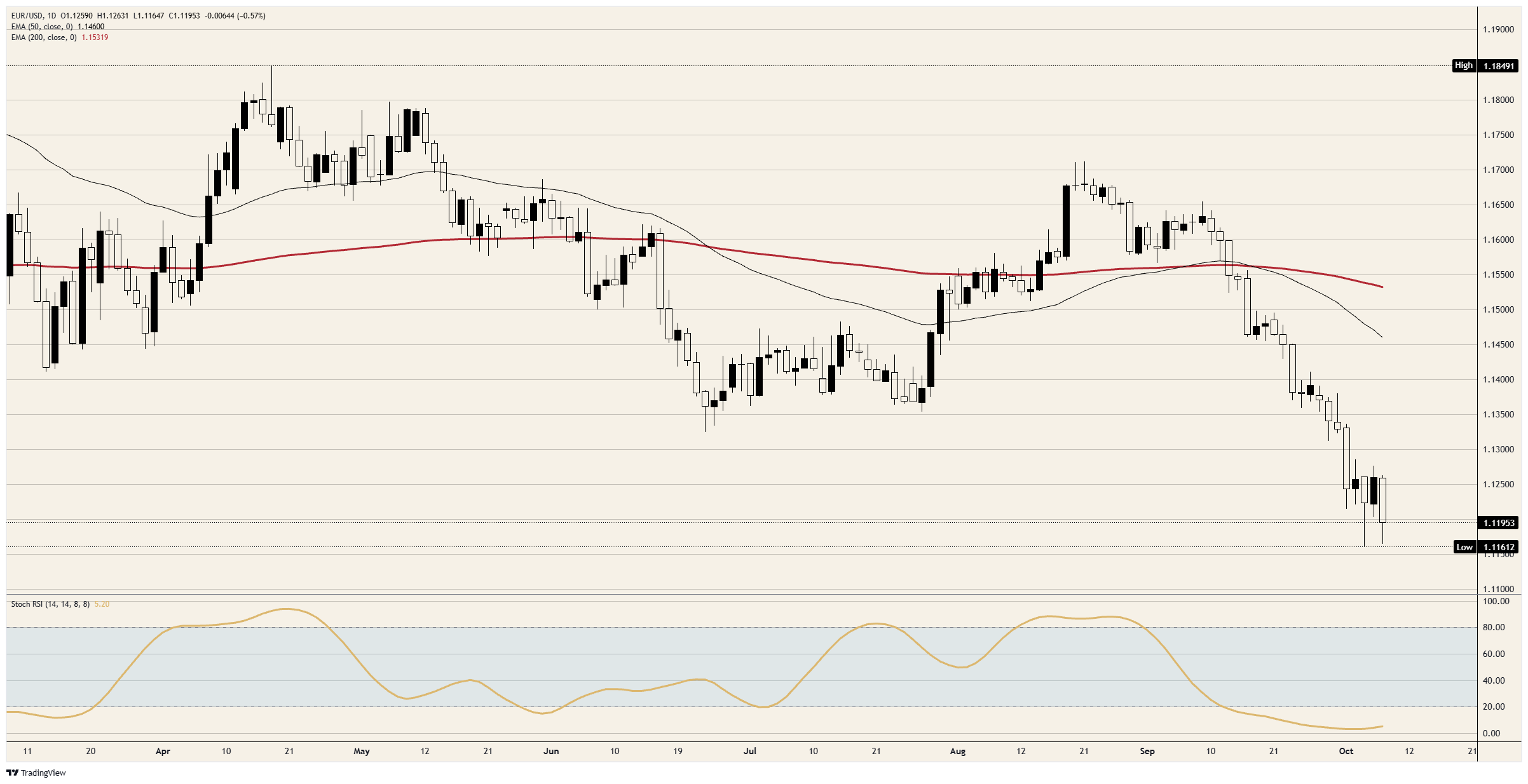
Euro levels near the 17-month low
Upside: Wednesday's high, just above 1.1250, came in under Tuesday's, and no session since October 1 has reached 1.1300. 1.1350 caps the October 1 session that started the slide to the current lows.
Downside: Monday's low, just above 1.1150, is the lowest since May 2025, and Wednesday's low stopped just short of it. 1.1100 is the next round level below.
Bias: The lean stays short below 1.1300, with 1.1150 the first objective and 1.1100 after it. On the daily chart the Stochastic Relative Strength Index (Stoch RSI), under 20 since September 14, is near 5, so a squeeze toward 1.1300 as shorts are bought back wouldn't change the call. The call is wrong on a daily close above 1.1350.
EUR/USD daily chart
Euro FAQs
The Euro is the currency for the 20 European Union countries that belong to the Eurozone. It is the second most heavily traded currency in the world behind the US Dollar. In 2022, it accounted for 31% of all foreign exchange transactions, with an average daily turnover of over $2.2 trillion a day. EUR/USD is the most heavily traded currency pair in the world, accounting for an estimated 30% off all transactions, followed by EUR/JPY (4%), EUR/GBP (3%) and EUR/AUD (2%).
The European Central Bank (ECB) in Frankfurt, Germany, is the reserve bank for the Eurozone. The ECB sets interest rates and manages monetary policy. The ECB’s primary mandate is to maintain price stability, which means either controlling inflation or stimulating growth. Its primary tool is the raising or lowering of interest rates. Relatively high interest rates – or the expectation of higher rates – will usually benefit the Euro and vice versa. The ECB Governing Council makes monetary policy decisions at meetings held eight times a year. Decisions are made by heads of the Eurozone national banks and six permanent members, including the President of the ECB, Christine Lagarde.
Eurozone inflation data, measured by the Harmonized Index of Consumer Prices (HICP), is an important econometric for the Euro. If inflation rises more than expected, especially if above the ECB’s 2% target, it obliges the ECB to raise interest rates to bring it back under control. Relatively high interest rates compared to its counterparts will usually benefit the Euro, as it makes the region more attractive as a place for global investors to park their money.
Data releases gauge the health of the economy and can impact on the Euro. Indicators such as GDP, Manufacturing and Services PMIs, employment, and consumer sentiment surveys can all influence the direction of the single currency. A strong economy is good for the Euro. Not only does it attract more foreign investment but it may encourage the ECB to put up interest rates, which will directly strengthen the Euro. Otherwise, if economic data is weak, the Euro is likely to fall. Economic data for the four largest economies in the euro area (Germany, France, Italy and Spain) are especially significant, as they account for 75% of the Eurozone’s economy.
Another significant data release for the Euro is the Trade Balance. This indicator measures the difference between what a country earns from its exports and what it spends on imports over a given period. If a country produces highly sought after exports then its currency will gain in value purely from the extra demand created from foreign buyers seeking to purchase these goods. Therefore, a positive net Trade Balance strengthens a currency and vice versa for a negative balance.
POPULAR ARTICLES
1Pentagon orders readiness for potential Iran strikes as Trump weighs timing2Gold falls to two‑month low near $4,100 on stronger US Dollar3The Yen round-trips after Japanese pay beats its forecast4Australian Dollar slips as Fed hike bets meet Middle East Oil risk5The Euro gives back its bounce as French bonds sell off again6Mexican Peso holds firm as FOMC Minutes signal further rate hikes7The Pound slides back to the bottom of its range as the bond selloff resumes8Ethereum Price Forecast: ETH drops below $2,600 as Tom Lee says BitMine will end buying spree9Chinese Yuan: Tight ranges persist against US Dollar – UOB
LIVE QUOTES


Get Started!
Sign up and access the Global Markets in less than 3 minutes

Connect With Us









Contacts
Phone: +61 2 8036 8388
Fax: +61 2 8036 8388
Email: support@tmgm.com



The information provided on this website is of a general nature only and does not constitute personal financial advice. Before acting on any information on this website, you should consider the suitability of the information in relation to your objectives, financial situation and needs. Investing in CFDs and FX Margin Contracts carries significant risks and is not suitable for all investors. You may lose more than your initial deposit. You do not own, or have, any interest in the underlying asset. We recommend that you seek independent advice and ensure you fully understand the risks involved before trading. It is important that you read and consider the disclosure document before you acquire any product listed on the website. The information and advertisements offered on this website are not intended for use by any person in any country or jurisdiction where such use would be contrary to local laws and regulations. The Products and Services offered on this website are not intended for residents of the United States, Malaysia and Thailand.
TMGM is authorized and regulated in various jurisdictions.
Trademax Australia Limited, trading as TMGM, is regulated by the Australian Securities and Investments Commission (ASIC), AFSL no. 436416 and is located at Level 28, One International Tower, 100 Barangaroo Avenue, 2000 Sydney, NSW Australia.
Email: support@tmgm.com.au
Trademax Global Limited, trading as TMGM, is authorized and regulated by the Vanuatu Financial Services Commission (VFSC), registration number 40356 and registered at 1276, Kumul Highway, Port Vila, Vanuatu, Republic of Vanuatu.
Email: support@tmgm.com
Trademax Global Markets (SE) Limited, trading as TMGM, is authorized and regulated by the Financial Services Authority (FSA) of Seychelles, with license number SD224. The company is registered at Office No 13, Providence Estate ABIS Centre, Mahe, Seychelles.
Email: support@tmgm.com
Trademax Global Markets (International) Pty Ltd, trading as TMGM, is authorized and regulated by the Financial Services Commission, Mauritius (FSC) with license no. GB22201012, and registered at 33, Edith Cavell Street C/o IQ EQ Fund Services (Mauritius) Ltd Port Louis, 11324 Mauritius.
Email: support@tmgm.com
Copyright © TMGM. All rights reserved