

United States Dollar Index edges higher to near 99.00 ahead of US NFP data
- The US Dollar Index ticks up to near 99.00 in the countdown to the US NFP data for August.
- Fed officials deliver encouraging remarks on inflation.
- Traders have trimmed hawkish Fed bets as officials seem confident on progress in inflation cooling down.
The US Dollar (USD) is marginally up on Friday ahead of the United States (US) Nonfarm Payrolls (NFP) data for August, which will be published at 12:30 GMT.
At press time, the US Dollar Index (DXY), which gauges the Greenback’s value against six major currencies, trades slightly higher at around 99.07.

Investors will pay close attention to the US NFP data to get fresh cues regarding the Federal Reserve’s (Fed) monetary policy outlook.
The US NFP report is expected to show that employers hired 56K fresh workers after firing 23K employees in July. The Unemployment Rate is seen as steady at 4.1%. Average Hourly Earnings, a key measure of wage growth, is seen arriving lower at 3% Year-on-Year (YoY) from 3.2% in July.
According to TD Securities, the upcoming US payrolls release could trigger an uneven response in rates markets. Strategists warn that a "firm NFP may increase hike fears, but inflation keeps markets nervous and the reaction asymmetric," with investors reluctant to fully price in a more aggressive Fed path until they see the next CPI print. At the same time, TD Securities argues that "a modestly softer payroll print would allow the market to lower the pricing for a September rate hike," underscoring their view that downside surprises in employment data are more likely to be reflected in near-term policy expectations than upside ones.
Meanwhile, financial markets have trimmed hawkish Fed interest rate expectations after encouraging comments from Federal Open Market Committee (FOMC) board members on inflation.
Analysts at Commerzbank said that lingering uncertainty over the US rate outlook was “underscored Thursday by comments from Fed Governor Christopher Waller,” who, in their words, signalled that “a rate hike is by no means necessary.” They add that Waller “also confirmed what we have been arguing: next week’s inflation data are likely to be the key input for the Fed’s upcoming policy decision,” a shift in emphasis that, in their view, “further [reduces] the significance of today’s employment report.”
On Wednesday, New York Fed Bank President John Williams also said, "Recent data have been encouraging on inflation." Williams added, "Inflation expectations are contained," and I am “not seeing second-round inflation impact from tariffs".
US Dollar Index Technical Analysis
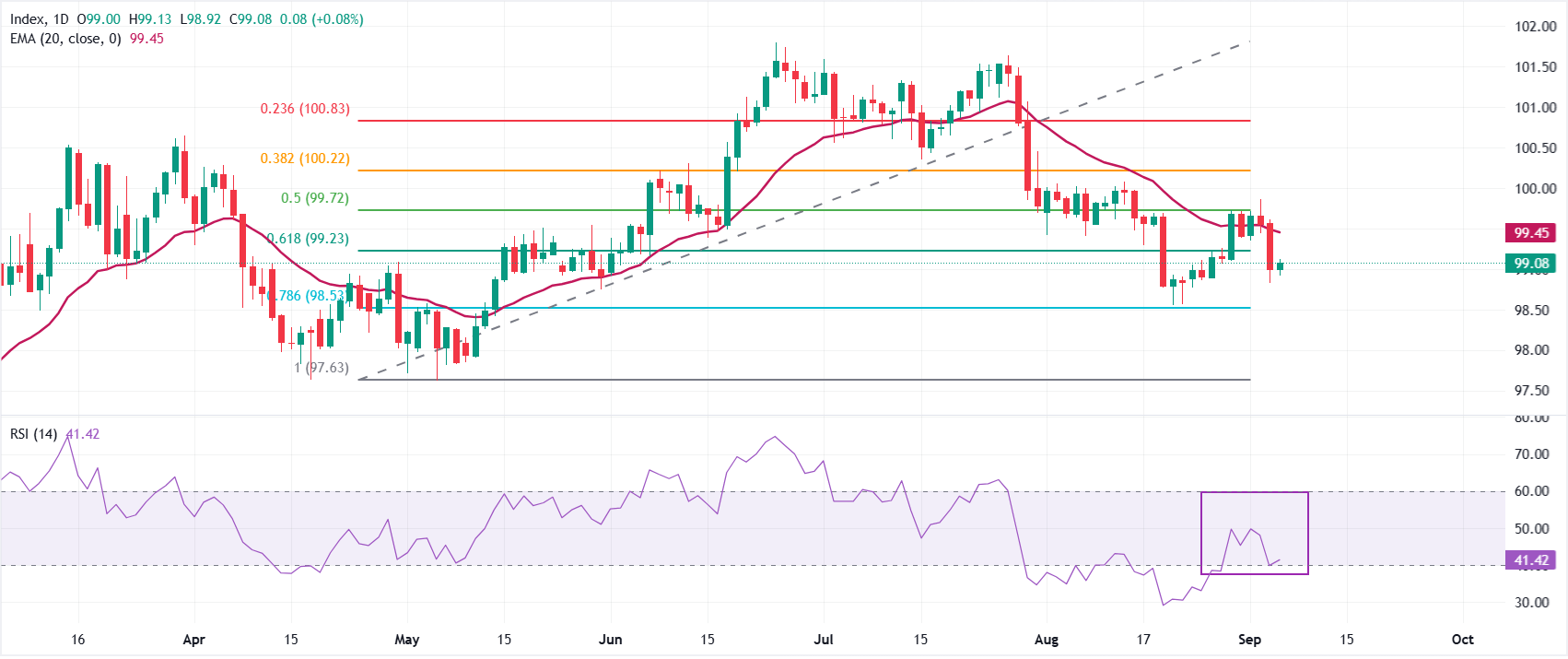
In the daily chart, the Dollar Index Spot trades at 99.07, keeping a bearish near-term tone as it holds below the 20-day exponential moving average (EMA) at 99.45 and the 61.8% Fibonacci retracement at 99.23.
The Relative Strength Index (RSI) at 41.30 hovers below the midline, hinting at lingering downside pressure but without oversold conditions, suggesting scope for further downside or a shallow consolidation under these caps.
On the topside, initial resistance aligns at the 61.8% retracement near 99.23, followed by the 20-day EMA at 99.45 and the 50% retracement around 99.72, while higher barriers emerge at the 38.2% level near 100.22 and the 23.6% retracement at 100.83. On the downside, immediate support is seen at the 78.6% Fibonacci level around 98.53, with a firmer floor at the 100% retracement near 97.63, where buyers may attempt to stabilize the index if the current decline extends.
(The technical analysis of this story was written with the help of an AI tool. Know more.)
Economic Indicator
Nonfarm Payrolls
The Nonfarm Payrolls release presents the number of new jobs created in the US during the previous month in all non-agricultural businesses; it is released by the US Bureau of Labor Statistics (BLS). The monthly changes in payrolls can be extremely volatile. The number is also subject to strong reviews, which can also trigger volatility in the Forex board. Generally speaking, a high reading is seen as bullish for the US Dollar (USD), while a low reading is seen as bearish, although previous months' reviews and the Unemployment Rate are as relevant as the headline figure. The market's reaction, therefore, depends on how the market assesses all the data contained in the BLS report as a whole.
Read more.Next release: Fri Sep 04, 2026 12:30
Frequency: Monthly
Consensus: 56K
Previous: -23K
Source: US Bureau of Labor Statistics
America’s monthly jobs report is considered the most important economic indicator for forex traders. Released on the first Friday following the reported month, the change in the number of positions is closely correlated with the overall performance of the economy and is monitored by policymakers. Full employment is one of the Federal Reserve’s mandates and it considers developments in the labor market when setting its policies, thus impacting currencies. Despite several leading indicators shaping estimates, Nonfarm Payrolls tend to surprise markets and trigger substantial volatility. Actual figures beating the consensus tend to be USD bullish.













