

Trading
Explora una amplia gama de mercados con precios competitivos, liquidez profunda y herramientas de trading avanzadas.
Más información 
Plataforma
Opera sin interrupciones con la potente plataforma de TMGM, diseñada para ofrecer velocidad, precisión y una experiencia de trading superior.
Más información Plataforma de trading
Herramientas de trading
Academia
Aprende los fundamentos del trading con recursos ideales para principiantes, incluidas guías, seminarios web y análisis del mercado.
Más información Academia TMGM
Noticias y análisis
Obtén actualizaciones del mercado en tiempo real y análisis de expertos para adelantarte a las oportunidades de trading
Más información Noticias y análisis
Acerca de
Descubre qué distingue a TMGM: nuestra presencia global, solidez regulatoria y compromiso con la innovación en el trading.
Más información Por qué elegir TMGM
EUR/GBP Price Forecast: Bears retain control as RSI turns oversold
- The Euro pauses its seven-day decline against the British Pound as France’s fiscal concerns remain in focus.
- EUR/GBP remains below its key daily SMAs, while an RSI near 29 signals oversold conditions.
- Initial resistance stands at 0.8500, with the July low near 0.8455 providing immediate support.
EUR/GBP fluctuates between gains and losses on Tuesday, pausing a seven-day selloff driven by sharp weakness in the Euro (EUR) amid growing concerns over France’s fiscal position. At the time of writing, the cross trades around 0.8488, virtually unchanged on the day and hovering above Monday’s low of 0.8458, its weakest level since July. A light economic calendar also contributes to the subdued price action.

US Dollar Price Today
The table below shows the percentage change of US Dollar (USD) against listed major currencies today. US Dollar was the strongest against the Japanese Yen.
| USD | EUR | GBP | JPY | CAD | AUD | NZD | CHF | |
|---|---|---|---|---|---|---|---|---|
| USD | -0.40% | -0.34% | 0.13% | -0.07% | -0.15% | -0.28% | -0.01% | |
| EUR | 0.40% | 0.01% | 0.52% | 0.33% | 0.27% | 0.11% | 0.39% | |
| GBP | 0.34% | -0.01% | 0.52% | 0.29% | 0.25% | 0.10% | 0.40% | |
| JPY | -0.13% | -0.52% | -0.52% | -0.22% | -0.29% | -0.41% | -0.13% | |
| CAD | 0.07% | -0.33% | -0.29% | 0.22% | -0.08% | -0.22% | 0.08% | |
| AUD | 0.15% | -0.27% | -0.25% | 0.29% | 0.08% | -0.16% | 0.16% | |
| NZD | 0.28% | -0.11% | -0.10% | 0.41% | 0.22% | 0.16% | 0.31% | |
| CHF | 0.01% | -0.39% | -0.40% | 0.13% | -0.08% | -0.16% | -0.31% |
The heat map shows percentage changes of major currencies against each other. The base currency is picked from the left column, while the quote currency is picked from the top row. For example, if you pick the US Dollar from the left column and move along the horizontal line to the Japanese Yen, the percentage change displayed in the box will represent USD (base)/JPY (quote).
Analysts at Rabobank report that “last week, we revised lower our forecasts for the EUR across the board,” emphasising that while the backdrop is challenging, “Europe’s circumstances are currently very different from either of these crises and we would be cautious of drawing comparisons.” Within Europe, they judge that “France’s political and fiscal issues are arguably in a more difficult position currently than those of the UK,” a contrast that has helped to shape their latest EUR/GBP view.
Rabobank notes that this relative divergence “has allowed EUR/GBP to push lower ahead of the October 28 UK budget and should cap upside potential for the currency pair.” Reflecting this, the bank’s “revised 3 month forecast for EUR/GBP stands at 0.85,” and now “sees EUR/GBP trading in a choppy range around current levels on a 1- to 3 month view.”
Technical analysis
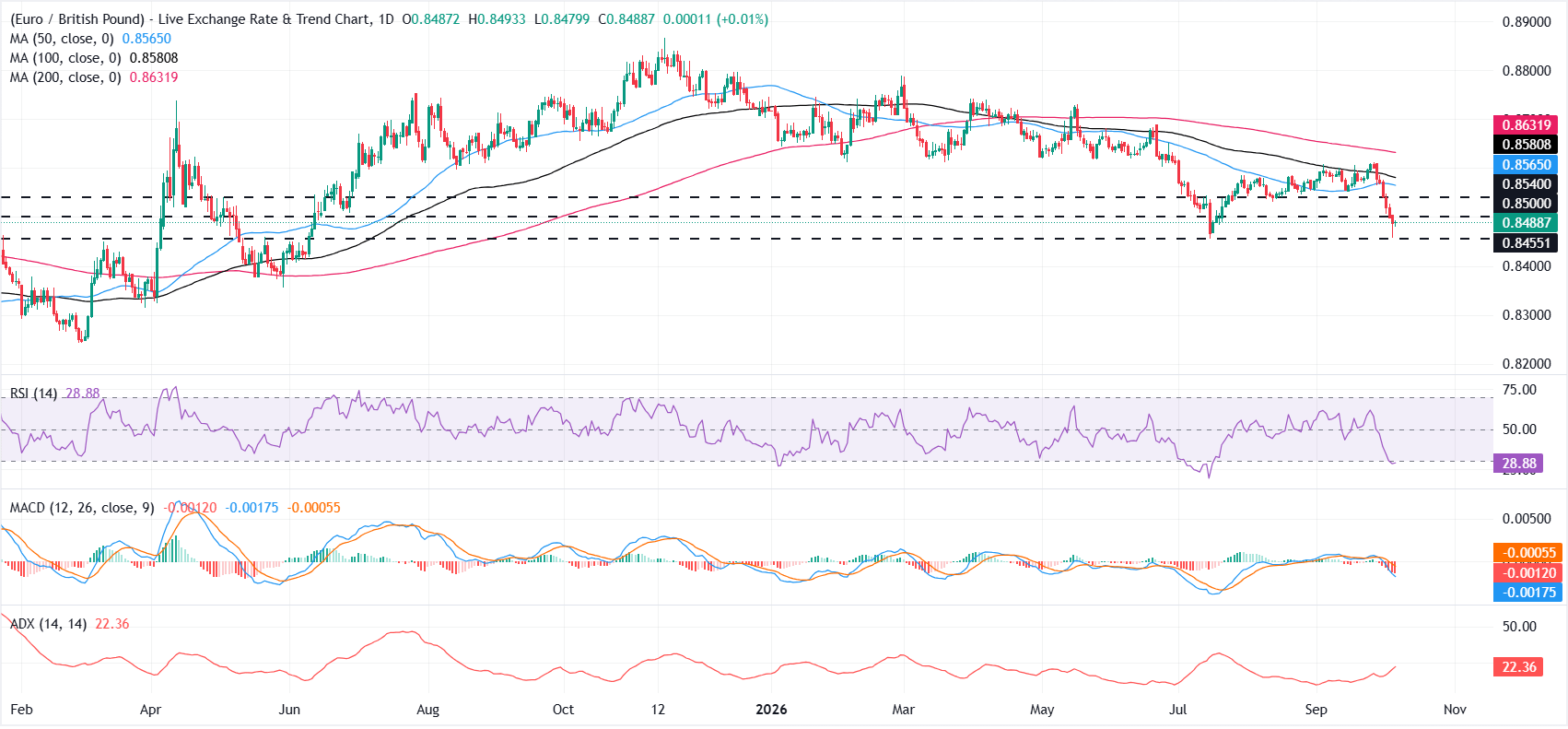
On the daily chart, EUR/GBP maintains a bearish near-term tone as it trades below the 50-, 100- and 200-day Simple Moving Averages (SMAs), clustered between roughly 0.8565 and 0.8632. Momentum indicators support the downside bias, with the Relative Strength Index (RSI) hovering near oversold territory around 29, while the Moving Average Convergence Divergence (MACD) remains below zero with a negative reading and subdued Average Directional Index (ADX) near 22, suggesting a developing but not yet strong trend.
On the topside, initial resistance appears at the 0.8500 psychological mark, followed by a stronger barrier near 0.8540. Further gains would bring the 50-day SMA at 0.8565 and the 100-day SMA at 0.8581 into focus, reinforcing a broader resistance zone ahead of the 200-day SMA at 0.8632.
On the downside, immediate support is seen near 0.8455, the July low. A sustained break below this level could expose the 0.8400 psychological mark. Overall, the prevailing technical setup leaves EUR/GBP vulnerable to further losses while the pair remains below its stacked daily SMAs.
(The technical analysis of this story was written with the help of an AI tool. Know more.)
Euro FAQs
The Euro is the currency for the 20 European Union countries that belong to the Eurozone. It is the second most heavily traded currency in the world behind the US Dollar. In 2022, it accounted for 31% of all foreign exchange transactions, with an average daily turnover of over $2.2 trillion a day. EUR/USD is the most heavily traded currency pair in the world, accounting for an estimated 30% off all transactions, followed by EUR/JPY (4%), EUR/GBP (3%) and EUR/AUD (2%).
The European Central Bank (ECB) in Frankfurt, Germany, is the reserve bank for the Eurozone. The ECB sets interest rates and manages monetary policy. The ECB’s primary mandate is to maintain price stability, which means either controlling inflation or stimulating growth. Its primary tool is the raising or lowering of interest rates. Relatively high interest rates – or the expectation of higher rates – will usually benefit the Euro and vice versa. The ECB Governing Council makes monetary policy decisions at meetings held eight times a year. Decisions are made by heads of the Eurozone national banks and six permanent members, including the President of the ECB, Christine Lagarde.
Eurozone inflation data, measured by the Harmonized Index of Consumer Prices (HICP), is an important econometric for the Euro. If inflation rises more than expected, especially if above the ECB’s 2% target, it obliges the ECB to raise interest rates to bring it back under control. Relatively high interest rates compared to its counterparts will usually benefit the Euro, as it makes the region more attractive as a place for global investors to park their money.
Data releases gauge the health of the economy and can impact on the Euro. Indicators such as GDP, Manufacturing and Services PMIs, employment, and consumer sentiment surveys can all influence the direction of the single currency. A strong economy is good for the Euro. Not only does it attract more foreign investment but it may encourage the ECB to put up interest rates, which will directly strengthen the Euro. Otherwise, if economic data is weak, the Euro is likely to fall. Economic data for the four largest economies in the euro area (Germany, France, Italy and Spain) are especially significant, as they account for 75% of the Eurozone’s economy.
Another significant data release for the Euro is the Trade Balance. This indicator measures the difference between what a country earns from its exports and what it spends on imports over a given period. If a country produces highly sought after exports then its currency will gain in value purely from the extra demand created from foreign buyers seeking to purchase these goods. Therefore, a positive net Trade Balance strengthens a currency and vice versa for a negative balance.
Artículos destacados
1Polish Zloty: Policy on hold as inflation stays near band – ING2Japanese Yen: Range trade holds against US Dollar as Fed path questioned – Rabobank3Japanese Yen underperforms despite signals of further BoJ tightening4Gold: Downtrend eyes $4,000 support zone – Societe Generale5Indian Rupee: Bearish bias with RBI support – DBS6US Dollar: Resilient but upside seen limited – TD Securities7Japanese Yen: Range-bound trade persists against US Dollar – UOB8US ADP Employment Change 4-week average increases to 23.750K9Ripple Price Forecast: XRP gathers strength around $1.50 after 43% returns in Q3
COTIZACIONES EN VIVO


¡Comience ahora!
Regístrese y acceda a los mercados globales en menos de 3 minutos

Conéctese con nosotros









Contactos
Teléfono: +61 2 8036 8388
Fax: +61 2 8036 8388
Correo electrónico: support@tmgm.com



La información proporcionada en este sitio web es únicamente de carácter general y no constituye asesoramiento financiero personal. Antes de actuar sobre cualquier información de este sitio web, debe considerar la idoneidad de la información en relación con sus objetivos, situación financiera y necesidades. Invertir en CFD y contratos de margen de FX conlleva riesgos significativos y no es adecuado para todos los inversores. Puede perder más que su depósito inicial. Usted no posee ni tiene ningún interés en el activo subyacente. Le recomendamos que busque asesoramiento independiente y se asegure de comprender plenamente los riesgos involucrados antes de operar. Es importante que lea y considere el documento de divulgación antes de adquirir cualquier producto listado en el sitio web. La información y los anuncios ofrecidos en este sitio web no están destinados al uso por parte de ninguna persona en ningún país o jurisdicción donde dicho uso sea contrario a las leyes y regulaciones locales. Los productos y servicios ofrecidos en este sitio web no están destinados a residentes de Estados Unidos, Malasia y Tailandia.
TMGM está autorizado y regulado en varias jurisdicciones.
Trademax Australia Limited, que opera como TMGM, está regulada por la Comisión Australiana de Valores e Inversiones (ASIC), AFSL n.º 436416, y está ubicada en Level 28, One International Tower, 100 Barangaroo Avenue, 2000 Sydney, NSW Australia.
Correo electrónico: support@tmgm.com.au
Trademax Global Limited, que opera como TMGM, está autorizada y regulada por la Comisión de Servicios Financieros de Vanuatu (VFSC), número de registro 40356, y está registrada en 1276, Kumul Highway, Port Vila, Vanuatu, República de Vanuatu.
Correo electrónico: support@tmgm.com
Trademax Global Markets (SE) Limited, que opera como TMGM, está autorizada y regulada por la Autoridad de Servicios Financieros (FSA) de Seychelles, con número de licencia SD224. La empresa está registrada en Office No 13, Providence Estate ABIS Centre, Mahe, Seychelles.
Correo electrónico: support@tmgm.com
Trademax Global Markets (International) Pty Ltd, que opera como TMGM, está autorizada y regulada por la Comisión de Servicios Financieros de Mauricio (FSC) con licencia n.º GB22201012, y está registrada en 33, Edith Cavell Street C/o IQ EQ Fund Services (Mauritius) Ltd Port Louis, 11324 Mauricio.
Correo electrónico: support@tmgm.com
Copyright © TMGM. Todos los derechos reservados