

Rising gilt yields are not saving the British Pound
- GBP/USD trades just under 1.3500, roughly 1.5% below the August peak.
- UK 10-year gilt yields sit at their highest since 2008.
- Private payrolls printed 38K in August against a 47K consensus.
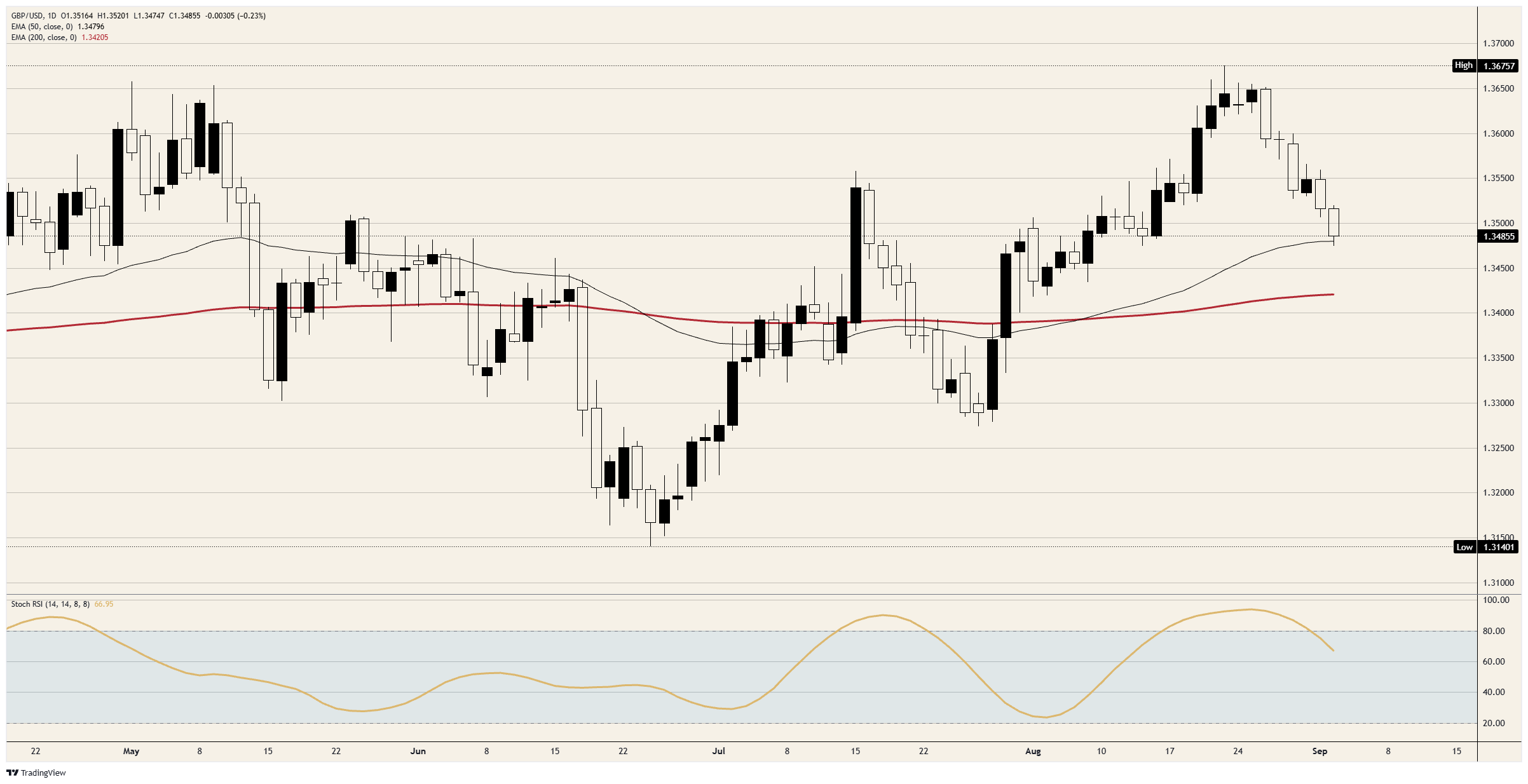
Sterling has spent Wednesday handing back the last of its August rally, with GBP/USD trading just under 1.3500 after a session low a shade beneath 1.3475. That is roughly 1.5% below the peak short of 1.3700 the pair reached in the final days of August, and it leaves the tape at its weakest in three weeks. The awkward part of the decline is what British bond yields have been doing the entire way down.

The wrong kind of yield rise
UK 10-year borrowing costs pushed above 5.20% this week, the highest since 2008, with the long end making fresh eighteen-year highs alongside them. A currency is normally supposed to treat that as an invitation, because higher yields pay foreign holders to show up and take the paper. Sterling has done the opposite all week, and the answer is in what the yield is compensating for.
The September 17 meeting compounds the problem rather than relieving it, because it is a supply event as well as a rate event. The Monetary Policy Committee publishes its annual decision on the pace of gilt sales alongside the decision itself, which puts the one variable the long end actually cares about into the same announcement as the one Sterling cares about. A market already unwilling to buy eighteen-year yields is unlikely to enjoy being told how much more paper is coming.
Nothing in the British rate path has moved enough to justify a repricing of this size. Three of nine votes went for 4% at the July meeting, the September 17 decision reads as a live possibility rather than a base case, and most forecasters still have Bank Rate unchanged through year end. What has moved is the fiscal question, with a first Budget due October 28 from a finance minister who has pledged to keep the borrowing rules he inherited. Yields that rise on supply and debt service do not buy a currency bid. They price a discount.
The Dollar leg has an actual rate story
The private payrolls survey landed at 38K for August against a 47K consensus and a 46K prior, a clear miss, and the Dollar did not blink. Six weeks ago a number like that would have trimmed hike expectations and taken the Greenback down with them. The reaction function changed at the Jackson Hole keynote, where the chair argued inflation had not slowed meaningfully, and pricing for a hike at the September 16 meeting roughly doubled inside an afternoon to around two thirds.
The energy channel is what keeps that framing alive. Renewed American strikes on Iranian targets and Iranian retaliation across the Gulf have held Crude Oil above $90.00, which feeds straight into the price data the committee has told the market it is watching. Factory Orders for July at 0.9% against a 0.6% consensus gave the other side of the argument nothing to work with. The Beige Book at 18:00 GMT is the session's last word.
What the rest of the week can still change
Thursday brings the services survey at 14:00 GMT, with the Institute for Supply Management (ISM) Purchasing Managers Index (PMI) seen at 54.3 against 54.1, and a prices paid component that ran at 70.3 last month. Initial jobless claims at 12:30 GMT carry a 205K consensus against 203K, and the Challenger layoff count at 09:30 GMT follows a prior reading of 33.429K. Two Federal Reserve officials speak either side of the American session. Neither is likely to decide the argument alone, though the prices paid line is the one that matters most to a committee reading energy costs into its inflation forecast.
Friday's payrolls report is the only release this week heavy enough to move the pair on its own. Nonfarm payrolls at 12:30 GMT carry a 58K consensus against a prior reading of 23K jobs lost, with the unemployment rate seen holding at 4.1% and average hourly earnings at 0.3% on the month and 3% YoY. The British side offers almost nothing to counter it, with Monetary Policy Report hearings on Thursday and a speech from the Bank of England Governor at 08:50 GMT Friday, four hours before the American number lands. Sterling is a passenger this week.
Levels and bias
Resistance: The 1.3500 area is the first hurdle and the 50-day Exponential Moving Average (EMA) sits inside it, which makes Wednesday's high a rejection rather than a probe. Above that, 1.3550 caps any first serious recovery attempt, and only the late-August peak short of 1.3700 would put the August trend back in play.
Support: The 200-day EMA near 1.3400 is the last technical object between the current tape and open ground. A daily close beneath it opens 1.3350, then 1.3300, with 1.3200 the objective on an extension and the late-June basing area near 1.3150 behind it.
Bias: Bearish. The Stochastic Relative Strength Index (Stoch RSI) has rolled over from near 90 without going anywhere close to oversold, the pair is pinned between two moving averages it has stopped respecting on the upside, and the only British catalyst before September 17 is a Budget eight weeks out. Rallies into 1.3500 are for selling until a daily close above 1.3550 says otherwise.
GBP/USD daily chart
Pound Sterling FAQs
The Pound Sterling (GBP) is the oldest currency in the world (886 AD) and the official currency of the United Kingdom. It is the fourth most traded unit for foreign exchange (FX) in the world, accounting for 12% of all transactions, averaging $630 billion a day, according to 2022 data. Its key trading pairs are GBP/USD, also known as ‘Cable’, which accounts for 11% of FX, GBP/JPY, or the ‘Dragon’ as it is known by traders (3%), and EUR/GBP (2%). The Pound Sterling is issued by the Bank of England (BoE).
The single most important factor influencing the value of the Pound Sterling is monetary policy decided by the Bank of England. The BoE bases its decisions on whether it has achieved its primary goal of “price stability” – a steady inflation rate of around 2%. Its primary tool for achieving this is the adjustment of interest rates. When inflation is too high, the BoE will try to rein it in by raising interest rates, making it more expensive for people and businesses to access credit. This is generally positive for GBP, as higher interest rates make the UK a more attractive place for global investors to park their money. When inflation falls too low it is a sign economic growth is slowing. In this scenario, the BoE will consider lowering interest rates to cheapen credit so businesses will borrow more to invest in growth-generating projects.
Data releases gauge the health of the economy and can impact the value of the Pound Sterling. Indicators such as GDP, Manufacturing and Services PMIs, and employment can all influence the direction of the GBP. A strong economy is good for Sterling. Not only does it attract more foreign investment but it may encourage the BoE to put up interest rates, which will directly strengthen GBP. Otherwise, if economic data is weak, the Pound Sterling is likely to fall.
Another significant data release for the Pound Sterling is the Trade Balance. This indicator measures the difference between what a country earns from its exports and what it spends on imports over a given period. If a country produces highly sought-after exports, its currency will benefit purely from the extra demand created from foreign buyers seeking to purchase these goods. Therefore, a positive net Trade Balance strengthens a currency and vice versa for a negative balance.














