

Trading
Explorez une large gamme de marchés avec des prix compétitifs, une liquidité profonde et des outils de trading avancés.
En savoir plus 
Plateforme
Tradez en toute fluidité avec la plateforme puissante de TMGM, conçue pour la vitesse, la précision et une expérience de trading supérieure.
En savoir plus Plateforme de trading
Outils de trading
Académie
Apprenez les fondamentaux du trading avec des ressources adaptées aux débutants, incluant des guides, des webinaires et des analyses de marché.
En savoir plus Actualités et analyses
Obtenez des mises à jour de marché en temps réel et des analyses d'experts pour anticiper les opportunités de trading
En savoir plus Actualités et analyses
À propos
Découvrez ce qui distingue TMGM — notre présence mondiale, notre solidité réglementaire et notre engagement envers l'innovation dans le trading.
En savoir plus Pourquoi choisir TMGM
Australian Dollar remains weak despite hawkish RBA minutes
- The Australian Dollar weakens against its major peers even as RBA minutes build case for more rate hikes.
- Investors keenly await the US CPI and the Australian employment data.
- A drop in US Treasury Yields has weighed on the US Dollar.
The Australian Dollar (AUD) trades lower against its major currency peers, except the US Dollar (USD), during the European trading session on Tuesday. The antipodean is under pressure even as Reserve Bank of Australia (RBA) minutes of the September policy meeting remains hawkish.

Australian Dollar Price Today
The table below shows the percentage change of Australian Dollar (AUD) against listed major currencies today. Australian Dollar was the weakest against the New Zealand Dollar.
| USD | EUR | GBP | JPY | CAD | AUD | NZD | CHF | |
|---|---|---|---|---|---|---|---|---|
| USD | -0.28% | -0.24% | -0.32% | -0.19% | -0.21% | -0.42% | -0.25% | |
| EUR | 0.28% | 0.03% | -0.04% | 0.10% | 0.05% | -0.14% | 0.03% | |
| GBP | 0.24% | -0.03% | -0.08% | 0.04% | 0.02% | -0.18% | 0.01% | |
| JPY | 0.32% | 0.04% | 0.08% | 0.13% | 0.10% | -0.11% | 0.08% | |
| CAD | 0.19% | -0.10% | -0.04% | -0.13% | -0.02% | -0.24% | -0.05% | |
| AUD | 0.21% | -0.05% | -0.02% | -0.10% | 0.02% | -0.21% | -0.03% | |
| NZD | 0.42% | 0.14% | 0.18% | 0.11% | 0.24% | 0.21% | 0.19% | |
| CHF | 0.25% | -0.03% | -0.01% | -0.08% | 0.05% | 0.03% | -0.19% |
The heat map shows percentage changes of major currencies against each other. The base currency is picked from the left column, while the quote currency is picked from the top row. For example, if you pick the Australian Dollar from the left column and move along the horizontal line to the US Dollar, the percentage change displayed in the box will represent AUD (base)/USD (quote).
RBA focus on inflation sharpened as weaker Aussie raises imported price risks
Analysts at Commerzbank note that the minutes released early this morning “make clear just how strongly the RBA’s focus has shifted towards inflation,” with the central bank increasingly preoccupied by mounting price pressures. According to the bank, the RBA is worried about inflation “for several reasons,” starting with global developments “over which it has no control but to which it nevertheless has to respond.”
From an FX perspective, Commerzbank highlights that “another argument was particularly interesting.” The RBA “expressed concern that a weaker AUD could contribute to elevated price pressures through imported inflation,” and pointed out that “a rise in the global neutral interest rate could cause the AUD to depreciate if Australia’s neutral rate had not increased by a similar amount,” even though the minutes suggest the RBA “appeared to assume that it had.”
Regarding the monetary policy outlook, Commerzbank argues that “three factors are therefore likely to be crucial for the RBA,” with the first being “what other central banks do.” In particular, “if they raise rates more aggressively than expected, the RBA could feel compelled to tighten further as well to prevent an excessive depreciation of the AUD,” underscoring the growing interplay between global rate settings, currency dynamics and the RBA’s inflation mandate.
Going forward, investors will focus on the Australian labor market data for September, which will be released on Thursday. The labor market report will likely show that the economy created 20K fresh jobs, lower than 39.5K in August. The Unemployment Rate is seen remaining steady at 4.6%.
Against the US Dollar, the Australian currency is up 0.27% to near 0.6976 during the European trade. The Aussie pair gains as the US Dollar faces selling pressure due to a drop in United States (US) Treasury Yields.
As of writing, the US Dollar Index (DXY), which gauges the Greenback’s value against six major currencies, trades 0.3% lower to near 102.27.
Meanwhile, investors await the US Consumer Price Index (CPI) data for September, which is scheduled for Wednesday.
AUD/USD Technical Analysis
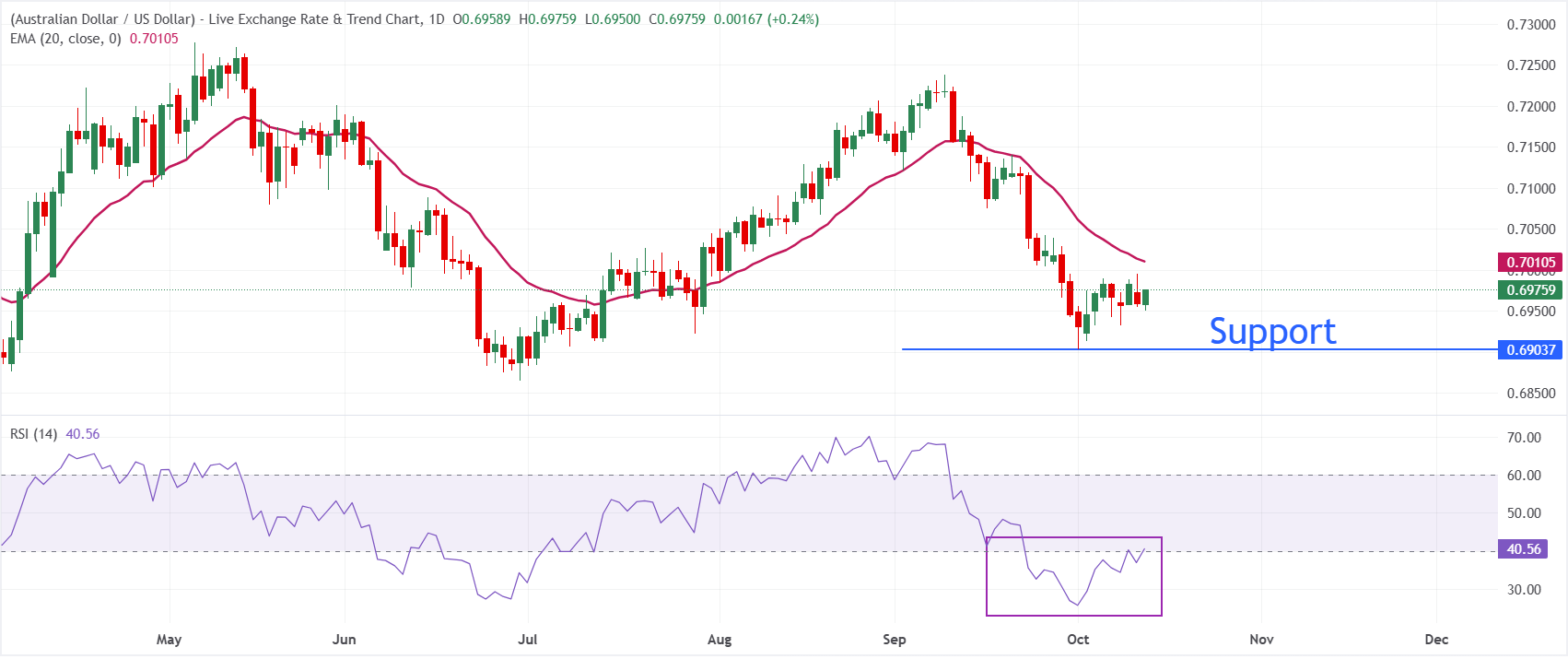
In the daily chart, AUD/USD trades at 0.6976, keeping a bearish near-term tone as spot holds beneath the 20-period exponential moving average (EMA) at 0.7011. The pair’s rejection below this short-term trend proxy suggests rallies are being capped by nearby overhead supply, while the Relative Strength Index (RSI) around 40 leans modestly bearish without yet reaching oversold territory.
On the topside, initial resistance stands at the 20-day EMA at 0.7011, and a sustained break above this barrier would be needed to ease immediate selling pressure and allow a recovery toward higher levels. On the downside, with no nearby technical supports from the available dataset, any fresh decline below 0.6976 would expose the pair to further downside extension, leaving price action vulnerable to momentum-driven selling until new structural floors emerge.
(The technical analysis of this story was written with the help of an AI tool. Know more.)
Economic Indicator
Employment Change s.a.
The Employment Change released by the Australian Bureau of Statistics is a measure of the change in the number of employed people in Australia. The statistic is adjusted to remove the influence of seasonal trends. Generally speaking, a rise in Employment Change has positive implications for consumer spending, stimulates economic growth, and is bullish for the Australian Dollar (AUD). A low reading, on the other hand, is seen as bearish.
Read more.Next release: Thu Oct 15, 2026 00:30
Frequency: Monthly
Consensus: 20K
Previous: 39.5K
Source: Australian Bureau of Statistics
ARTICLES POPULAIRES
1Australian Dollar: RBA inflation focus shapes outlook – Commerzbank2Japanese Yen: Weakness may deepen toward 159.05 against US Dollar – UOB3US ADP Employment Change 4-week average drops to 24.75K4Copper: El Niño risks cap African supply growth – Societe Generale5EUR/GBP Price Forecast: Downtrend remains firm despite deeply oversold RSI6Ripple Price Forecast: XRP rebounds but muted ETF demand, low on-chain activity cap upside7Indian Rupee: RBI measures support near term – MUFG8British Pound: Firmer ground with BoE hike risk – ING9WTI Oil extends its pullback to $91.00 amid US imports of Russian Diesel
COTATIONS EN DIRECT

TOUT SUR FOREX
Commencez !
Inscrivez-vous et accédez aux Marchés Mondiaux en moins de 3 minutes

Connectez-vous avec Nous









Contacts
Téléphone: +61 2 8036 8388
Fax: +61 2 8036 8388
Email: support@tmgm.com



Les informations fournies sur ce site web sont de nature générale uniquement et ne constituent pas un conseil financier personnalisé. Avant d’agir sur la base de toute information figurant sur ce site web, vous devez évaluer la pertinence de ces informations au regard de vos objectifs, de votre situation financière et de vos besoins. Investir dans les CFD et les contrats de marge sur le Forex comporte des risques importants et ne convient pas à tous les investisseurs. Vous pouvez perdre plus que votre dépôt initial. Vous ne détenez pas, et n’avez, aucun droit de propriété ou intérêt sur l’actif sous-jacent. Nous vous recommandons de solliciter un avis indépendant et de vous assurer que vous comprenez pleinement les risques encourus avant de trader. Il est important que vous lisiez et preniez en considération le document d’information avant d’acquérir tout produit présenté sur le site web. Les informations et publicités proposées sur ce site web ne sont pas destinées à être utilisées par toute personne dans tout pays ou toute juridiction où une telle utilisation serait contraire aux lois et réglementations locales. Les Produits et Services proposés sur ce site web ne sont pas destinés aux résidents des États-Unis, de la Malaisie et de la Thaïlande.
TMGM est autorisé et réglementé dans diverses juridictions.
Trademax Australia Limited, opérant sous le nom de TMGM, est réglementé par l'Australian Securities and Investments Commission (ASIC), AFSL no. 436416 et est situé au Level 28, One International Tower, 100 Barangaroo Avenue, 2000 Sydney, NSW Australie.
Email: support@tmgm.com.au
Trademax Global Limited, opérant sous le nom de TMGM, est autorisé et réglementé par la Vanuatu Financial Services Commission (VFSC), numéro d'enregistrement 40356 et enregistré au 1276, Kumul Highway, Port Vila, Vanuatu, République de Vanuatu.
Email: support@tmgm.com
Trademax Global Markets (SE) Limited, exerçant sous le nom TMGM, est autorisée et régulée par la Financial Services Authority (FSA) des Seychelles, sous le numéro de licence SD224. La société est enregistrée au bureau n° 13, Providence Estate ABIS Centre, Mahé, Seychelles.
Email: support@tmgm.com
Trademax Global Markets (International) Pty Ltd, opérant sous le nom de TMGM, est autorisé et réglementé par la Financial Services Commission, Maurice (FSC) avec la licence no. GB22201012, et enregistré au 33, Edith Cavell Street C/o IQ EQ Fund Services (Mauritius) Ltd Port Louis, 11324 Maurice.
Email: support@tmgm.com
Copyright © TMGM. Tous droits réservés