

Сауда
Бәсекеге қабілетті бағалар, жоғары өтімділік және озық сауда құралдары арқылы нарықтардың кең ауқымын зерттеңіз.
Толығырақ 
Платформа
TMGM-нің жылдамдыққа, дәлдікке және жоғары деңгейлі сауда тәжірибесіне арналған қуатты платформасымен сауданы кедергісіз жүргізіңіз.
Толығырақ Сауда платформасы
Академия
Бастауыштарға арналған нұсқаулықтар, вебинарлар және нарық талдаулары сияқты ресурстар арқылы сауданың негіздерін үйреніңіз.
Толығырақ TMGM Академиясы
Жаңалықтар және талдау
Сауда мүмкіндіктерінен алда болу үшін нақты уақыттағы нарық жаңартулары мен сараптамалық талдауды алыңыз
Толығырақ Жаңалықтар және талдау
Туралы
TMGM-ді ерекшелендіретін жайттарды біліңіз — біздің жаһандық ауқымымыз, реттеушілік беріктігіміз және трейдингтегі инновацияларға деген адалдығымыз.
Толығырақ Неліктен TMGM-ді таңдау керек
Bitcoin Price Forecast: BTC slides below $80,000 as Fed holds rates steady with a hawkish tone
- Bitcoin erases most weekly gains, retreating below $80,000 on Thursday as the Fed kept rates unchanged with a hawkish tone.
- US-listed spot ETFs recorded an inflow of $137.33 million on Wednesday, marking three consecutive days of positive flows.
- Market participants now await US September PCE and Q3 GDP data on Thursday for fresh clues on the health of the economy.
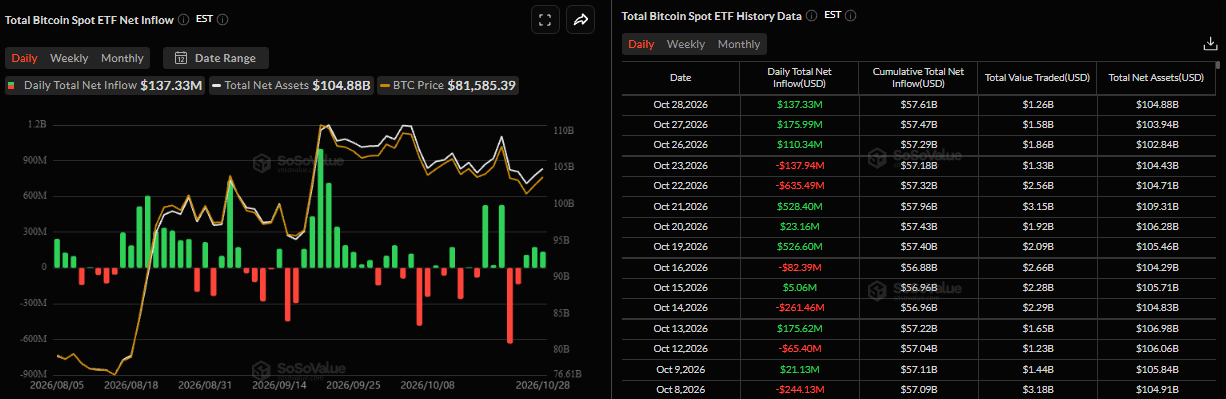
Bitcoin (BTC) slips below $80,000 on Thursday, erasing most of its weekly gains after the Federal Reserve (Fed) held interest rates steady while signaling a hawkish policy stance. Despite the price correction, institutional demand remained modest so far this week, with spot Bitcoin Exchange Traded Funds (ETFs) recording $137.33 million on Wednesday, marking three consecutive days of positive flows.
Meanwhile, traders now remain cautious ahead of the US September Personal Consumption Expenditures (PCE) inflation report and Q3 Gross Domestic Product (GDP) data, both due later on Thursday, for fresh clues on the health of the economy.
Fed leaves rates unchanged with a clear warning on inflation
The Fed held its policy rate steady at 3.75%-4.00% at its two-day October policy meeting on Wednesday. The decision wasn’t unanimous. Among the two officials who wanted a 25-basis-point hike were Lisa Cook and Beth Hammack, while Chair Kevin Warsh said the Fed would use the coming flow of information to decide whether further action is needed.
Warsh said during his press conference that officials have “made clear our readiness to act as circumstances require, and we have shown our willingness to act.”
“It’s our responsibility to get inflation down,” Warsh said. “That’s the reason the FOMC’s discussion over the last couple of days focused mainly on the price stability side of our remit,” he added.
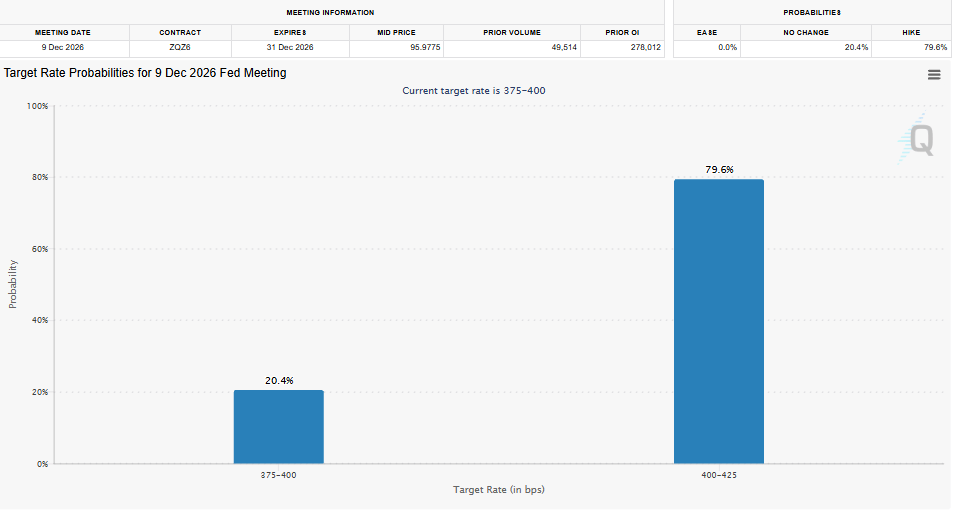
Market participants had already priced in steady rates, but the hawkish undertone and inflation concerns in forward guidance add to a cautious market backdrop and weigh on risky assets such as Bitcoin. According to the CME FedWatch Tool, the probability of the Fed tightening at the December 9 meeting rose slightly to 79.6% on Thursday, up from 78.33% on Tuesday. The shift toward tighter monetary policy is mildly supporting safe-haven assets, with the 10-year Treasury yield holding above 5% and the US Dollar Index (DXY) above $102, while weighing on risky assets such as BTC, which slid below $80,000 on Thursday.
Meanwhile, USD bulls seem hesitant and are waiting for more cues before placing fresh bets. Hence, the focus will remain glued to US economic releases – the Advance Q3 GDP report and the Personal Consumption Expenditures (PCE) Price Index on Thursday. These key data will play a major role in shaping USD price dynamics, offer fresh clues on economic health and insights into the monetary policy path, which could give a directional bias for BTC.
Institutional investors’ demand remains modest
Institutional demand for Bitcoin remains cautiously bullish. SoSoValue data showed that spot Bitcoin ETFs recorded inflows of $137.33 million on Wednesday, marking the third consecutive week of inflows. These daily inflows so far indicate modest institutional buying interest but remain less substantial than last week, suggesting investors are taking a cautious approach. If this inflow trend continues and intensifies this week, BTC could rebound.
Bitcoin technical outlook: BTC slips below $80,000
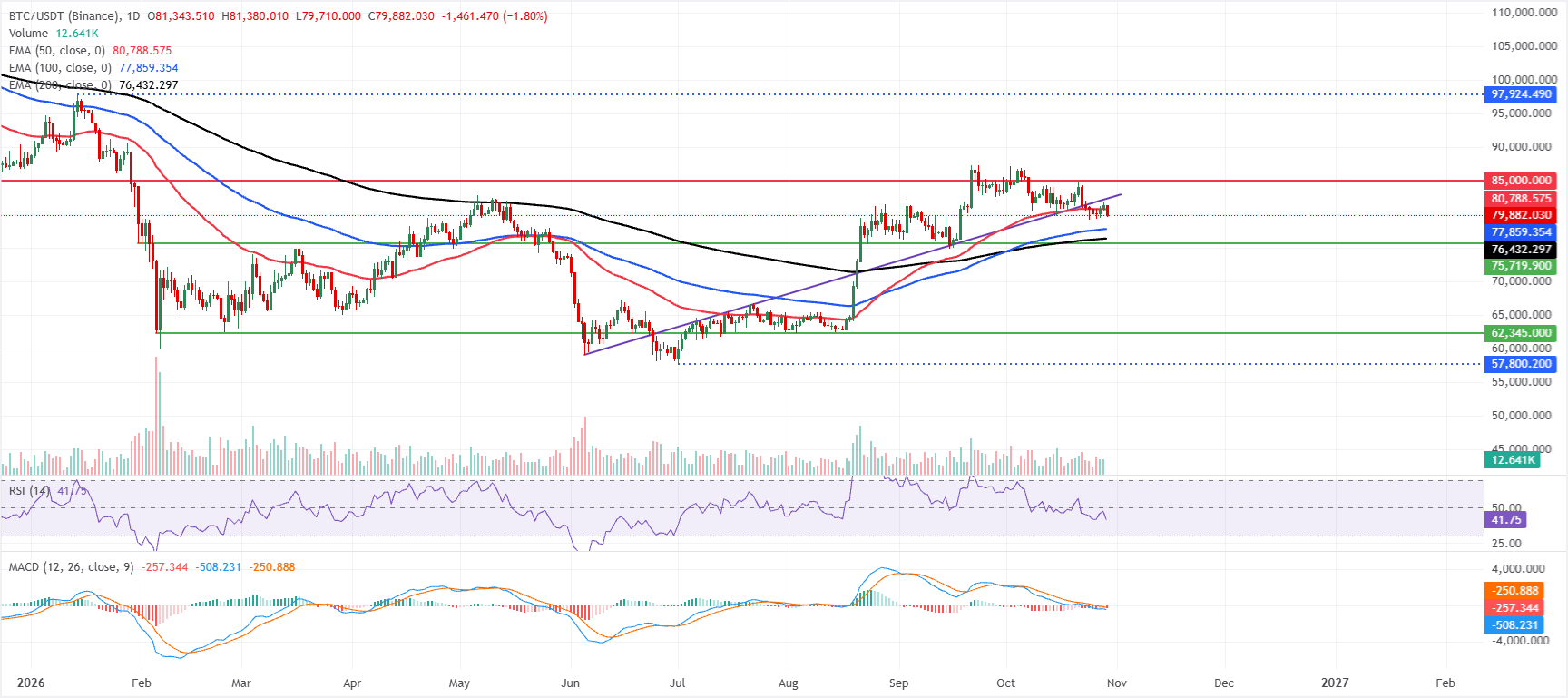
Bitcoin price trades at $79,882 on Thursday, holding above the 100-day and 200-day Exponential Moving Averages (EMAs) at $77,859 and $76,432, which underpin the broader uptrend. Still, the pair is increasingly capped by the 50-day EMA at $80,788.
The Relative Strength Index (RSI) has slipped toward the low-40s. Meanwhile, the Moving Average Convergence Divergence (MACD) remains in negative territory with subdued momentum, suggesting a consolidative, mildly bearish tone as buyers struggle to reclaim the short-term average.
On the topside, immediate resistance is located at the 50-day EMA near $80,788, followed by the horizontal barrier at $85,000, where fresh supply could emerge if price extends higher.
On the downside, initial support is the 100-day EMA around $77,859, with a deeper floor at the 200-day EMA near $76,432; a daily close below these averages would significantly weaken the current structure and open the door to a broader corrective phase.
(The technical analysis of this story was written with the help of an AI tool. Know more.)
Bitcoin, altcoins, stablecoins FAQs
Bitcoin is the largest cryptocurrency by market capitalization, a virtual currency designed to serve as money. This form of payment cannot be controlled by any one person, group, or entity, which eliminates the need for third-party participation during financial transactions.
Altcoins are any cryptocurrency apart from Bitcoin, but some also regard Ethereum as a non-altcoin because it is from these two cryptocurrencies that forking happens. If this is true, then Litecoin is the first altcoin, forked from the Bitcoin protocol and, therefore, an “improved” version of it.
Stablecoins are cryptocurrencies designed to have a stable price, with their value backed by a reserve of the asset it represents. To achieve this, the value of any one stablecoin is pegged to a commodity or financial instrument, such as the US Dollar (USD), with its supply regulated by an algorithm or demand. The main goal of stablecoins is to provide an on/off-ramp for investors willing to trade and invest in cryptocurrencies. Stablecoins also allow investors to store value since cryptocurrencies, in general, are subject to volatility.
Bitcoin dominance is the ratio of Bitcoin's market capitalization to the total market capitalization of all cryptocurrencies combined. It provides a clear picture of Bitcoin’s interest among investors. A high BTC dominance typically happens before and during a bull run, in which investors resort to investing in relatively stable and high market capitalization cryptocurrency like Bitcoin. A drop in BTC dominance usually means that investors are moving their capital and/or profits to altcoins in a quest for higher returns, which usually triggers an explosion of altcoin rallies.
Үздік мақалалар
1Top Altcoins Price Forecast: Ripple and Solana under pressure as Hyperliquid recovers2Euro: ECB caution with tighter conditions – MUFG3The Federal Reserve holds rates and two officials vote for a hike: Why the US Dollar stayed flat anyway4Canadian Dollar: Limited upside against US Dollar despite BoC hike - ING5US Dollar: Strong US data may reinforce Fed hawkishness - BBH6Australian Dollar: Upside capped at 0.7070 against US Dollar - UOB7ECB President Lagarde to resign on February 7, 20278USD/CHF Price Forecast: US Dollar maintains its constructive bias while above 0.82709Gold weakens ahead of US PCE inflation amid hawkish Fed outlook


Бастау!
Тіркеліп, 3 минуттан аз уақытта жаһандық нарықтарға қол жеткізіңіз

Бізбен байланысыңыз









Байланыстар
Телефон: +61 2 8036 8388
Факс: +61 2 8036 8388
Эл. пошта: support@tmgm.com



Осы веб-сайтта берілген ақпарат тек жалпы сипатта ғана ұсынылады және жеке қаржылық кеңес болып табылмайды. Осы веб-сайттағы кез келген ақпаратқа сүйенбес бұрын, оның сіздің мақсаттарыңызға, қаржылық жағдайыңызға және қажеттіліктеріңізге сәйкестігін бағалауыңыз керек. CFD және FX Margin Contracts-қа инвестиция салу елеулі тәуекелдермен байланысты және барлық инвесторлар үшін қолайлы емес. Сіз бастапқы салымыңыздан артық қаражат жоғалтуыңыз мүмкін. Сіз базалық активке ешқандай меншік құқығына немесе үлеске ие болмайсыз. Сауда жасамас бұрын тәуелсіз кеңес алуды және тәуекелдерді толық түсінуді ұсынамыз. Веб-сайтта көрсетілген кез келген өнімді сатып алмас бұрын, ақпараттық құжатты оқып, оны мұқият қарастыру маңызды. Осы веб-сайтта ұсынылған ақпарат пен жарнамалар жергілікті заңдар мен ережелерге қайшы келетін кез келген елде немесе юрисдикцияда тұратын адамдардың пайдалануына арналмаған. Осы веб-сайтта ұсынылатын Өнімдер мен Қызметтер Америка Құрама Штаттары, Малайзия және Таиланд тұрғындарына арналмаған.
TMGM әртүрлі юрисдикцияларда уәкілетті және реттеледі.
Trademax Australia Limited, TMGM атауымен жұмыс істейді, Австралияның Бағалы қағаздар және инвестициялар жөніндегі комиссиясымен (ASIC) реттеледі, AFSL № 436416 және мына мекенжайда орналасқан: Level 28, One International Tower, 100 Barangaroo Avenue, 2000 Sydney, NSW Australia.
Электрондық пошта: support@tmgm.com.au
Trademax Global Limited, TMGM атауымен жұмыс істейді, Вануату Қаржылық қызметтер комиссиясымен (VFSC) уәкілетті және реттеледі, тіркеу нөмірі 40356, тіркелген мекенжайы: 1276, Kumul Highway, Port Vila, Vanuatu, Republic of Vanuatu.
Электрондық пошта: support@tmgm.com
Trademax Global Markets (SE) Limited, TMGM атауымен жұмыс істейді, Сейшел аралдарының Қаржылық қызметтер басқармасы (FSA) тарапынан уәкілетті және реттеледі, лицензия нөмірі SD224. Компания мына мекенжайда тіркелген: Office No 13, Providence Estate ABIS Centre, Mahe, Seychelles.
Электрондық пошта: support@tmgm.com
Trademax Global Markets (International) Pty Ltd, TMGM атауымен жұмыс істейді, Mauritius Қаржылық қызметтер комиссиясымен (FSC) № GB22201012 лицензиясы бойынша уәкілетті және реттеледі, тіркелген мекенжайы: 33, Edith Cavell Street C/o IQ EQ Fund Services (Mauritius) Ltd Port Louis, 11324 Mauritius.
Электрондық пошта: support@tmgm.com
Авторлық құқық © TMGM. Барлық құқықтар қорғалған