


Australian Dollar clings to early recovery near 0.6970, US data takes centre stage
- Australian Dollar remains supported near 0.6970 as the Australian Dollar remains under pressure.
- Further acceleration in Australian inflation reinforces hawkish RBA expectations.
- The US Dollar trades lower ahead of key US data.
The Australian Dollar (AUD) holds onto its early recovery move at around 0.6970 against the US Dollar (USD) during the European trading session on Wednesday. Still, the Aussie pair is down 0.19% to near 0.6970.
Australian Dollar Price Today
The table below shows the percentage change of Australian Dollar (AUD) against listed major currencies today. Australian Dollar was the weakest against the British Pound.
| USD | EUR | GBP | JPY | CAD | AUD | NZD | CHF | |
|---|---|---|---|---|---|---|---|---|
| USD | -0.13% | -0.49% | -0.17% | -0.07% | 0.21% | -0.15% | 0.01% | |
| EUR | 0.13% | -0.33% | -0.07% | 0.06% | 0.32% | -0.03% | 0.14% | |
| GBP | 0.49% | 0.33% | 0.27% | 0.41% | 0.67% | 0.32% | 0.49% | |
| JPY | 0.17% | 0.07% | -0.27% | 0.10% | 0.39% | 0.00% | 0.20% | |
| CAD | 0.07% | -0.06% | -0.41% | -0.10% | 0.28% | -0.09% | 0.10% | |
| AUD | -0.21% | -0.32% | -0.67% | -0.39% | -0.28% | -0.36% | -0.18% | |
| NZD | 0.15% | 0.03% | -0.32% | 0.00% | 0.09% | 0.36% | 0.18% | |
| CHF | -0.01% | -0.14% | -0.49% | -0.20% | -0.10% | 0.18% | -0.18% |
The heat map shows percentage changes of major currencies against each other. The base currency is picked from the left column, while the quote currency is picked from the top row. For example, if you pick the Australian Dollar from the left column and move along the horizontal line to the US Dollar, the percentage change displayed in the box will represent AUD (base)/USD (quote).

The pair attracted bids near 0.6958 after a weak opening, following the release of the hot Australian Consumer Price Index (CPI) data for August, which would reinforce expectations of more interest rate hikes by the Reserve Bank of Australia (RBA) in the near term even after raising them 100 basis points (bps) to 4.6% so far this year.
Analysts at Commerzbank argue that the latest inflation data underscore why market pricing for “1.5 additional rate hikes by the RBA, as the market was still expecting yesterday”. One day after the RBA’s monetary policy meeting, they note that the CPI figures released today reinforce the case for a more cautious stance.
While acknowledging that “there’s no question that inflation is still too high, and it will take a while before it returns to the middle of the target range, the Commerzbank is still not satisfied with hawkish RBA expectations and sees limited likelihood of further policy tightening.
The CPI report showed that inflationary pressures accelerated to 4% Year-on-Year (YoY), as expected, from 3.5% in July.
Meanwhile, the US Dollar is also under pressure ahead of the United States (US) ADP Employment Change data for September and the Personal Consumption Expenditure (PCE) Price Index data for August, which will be published in the North American session.
AUD/USD Technical Analysis
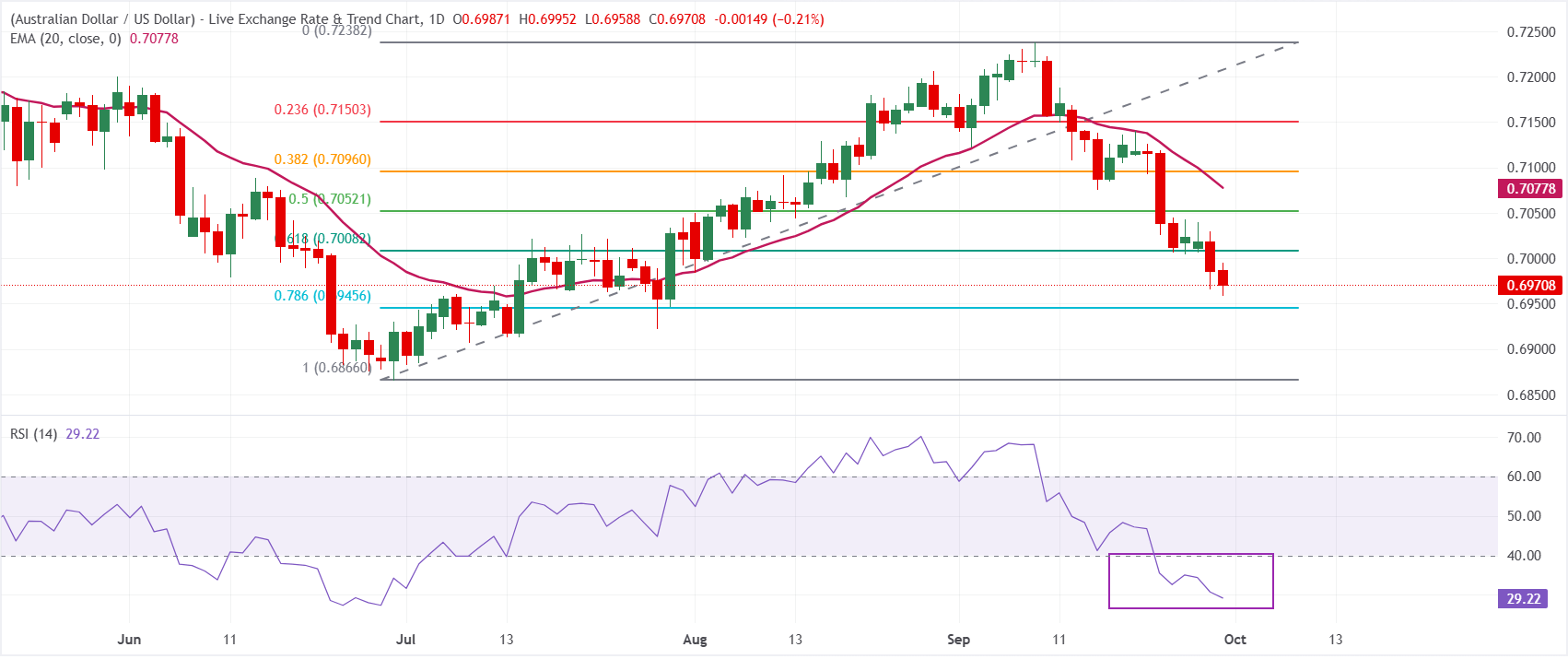
In the daily chart, AUD/USD trades at 0.6971, extending its slide below the 20-day exponential moving average (EMA) at 0.7078 and shifting the near-term bias firmly bearish. The pair has also fallen back under the 61.8% Fibonacci retracement at 0.7008, highlighting renewed downside pressure, while the Relative Strength Index (RSI) at 29.2 slips into oversold territory, which hints that the recent decline may be stretched but not yet decisively exhausted.
On the topside, initial resistance emerges at the 61.8% retracement at 0.7008, followed by the 50.0% level at 0.7052 and the 20-day EMA at 0.7078, with the 38.2% retracement at 0.7096 and the 23.6% level at 0.7150 reinforcing a broader cap ahead of the cycle high anchor near 0.7238. On the downside, immediate support is seen at the 78.6% retracement at 0.6946, ahead of the 100.0% Fibonacci anchor at 0.6866, where sellers could pause to reassess the trend if oversold conditions start to attract profit-taking.
(The technical analysis of this story was written with the help of an AI tool. Know more.)
RBA FAQs
The Reserve Bank of Australia (RBA) sets interest rates and manages monetary policy for Australia. Decisions are made by a board of governors at 11 meetings a year and ad hoc emergency meetings as required. The RBA’s primary mandate is to maintain price stability, which means an inflation rate of 2-3%, but also “..to contribute to the stability of the currency, full employment, and the economic prosperity and welfare of the Australian people.” Its main tool for achieving this is by raising or lowering interest rates. Relatively high interest rates will strengthen the Australian Dollar (AUD) and vice versa. Other RBA tools include quantitative easing and tightening.
While inflation had always traditionally been thought of as a negative factor for currencies since it lowers the value of money in general, the opposite has actually been the case in modern times with the relaxation of cross-border capital controls. Moderately higher inflation now tends to lead central banks to put up their interest rates, which in turn has the effect of attracting more capital inflows from global investors seeking a lucrative place to keep their money. This increases demand for the local currency, which in the case of Australia is the Aussie Dollar.
Macroeconomic data gauges the health of an economy and can have an impact on the value of its currency. Investors prefer to invest their capital in economies that are safe and growing rather than precarious and shrinking. Greater capital inflows increase the aggregate demand and value of the domestic currency. Classic indicators, such as GDP, Manufacturing and Services PMIs, employment, and consumer sentiment surveys can influence AUD. A strong economy may encourage the Reserve Bank of Australia to put up interest rates, also supporting AUD.
Quantitative Easing (QE) is a tool used in extreme situations when lowering interest rates is not enough to restore the flow of credit in the economy. QE is the process by which the Reserve Bank of Australia (RBA) prints Australian Dollars (AUD) for the purpose of buying assets – usually government or corporate bonds – from financial institutions, thereby providing them with much-needed liquidity. QE usually results in a weaker AUD.
Quantitative tightening (QT) is the reverse of QE. It is undertaken after QE when an economic recovery is underway and inflation starts rising. Whilst in QE the Reserve Bank of Australia (RBA) purchases government and corporate bonds from financial institutions to provide them with liquidity, in QT the RBA stops buying more assets, and stops reinvesting the principal maturing on the bonds it already holds. It would be positive (or bullish) for the Australian Dollar.
인기 기사
1EUR/GBP Price Forecast: Reaching oversold levels at six-week lows sub-0.85502What is driving the US Dollar to multi-month highs against the Euro as PCE data approaches?3EUR/USD Price Forecast: At make or a break near 1.13304Australian Dollar: Softer CPI keeps RBA pricing in check – BBH5British Pound: Fiscal tightening risks dovish BOE repricing – BBH6Crypto Today: Bitcoin holds $83K as Ethereum remains below $2,700 and XRP consolidates7Gold struggles for direction ahead of Fed’s preferred PCE inflation data8Australian Dollar clings to early recovery near 0.6970, US data takes centre stage9Experts agree: The fundamental background hints at further US Dollar appreciation
실시간 시세


소셜 미디어












이 웹사이트에 제공된 정보는 일반적인 성격의 정보일 뿐이며 개인 맞춤형 금융 자문을 구성하지 않습니다. 이 웹사이트의 정보를 바탕으로 행동하기 전에, 귀하의 목표, 재정 상황 및 필요에 비추어 해당 정보의 적합성을 고려해야 합니다. CFD 및 FX 마진 계약에 대한 투자는 상당한 위험을 수반하며 모든 투자자에게 적합하지 않을 수 있습니다. 귀하는 최초 예치금보다 더 큰 손실을 입을 수 있습니다. 귀하는 기초자산에 대한 소유권이나 어떠한 이해관계도 보유하지 않습니다. 거래를 시작하기 전에 독립적인 자문을 구하고 관련 위험을 충분히 이해하시기를 권장합니다. 웹사이트에 기재된 상품을 취득하기 전에 공시 문서를 읽고 검토하는 것이 중요합니다. 이 웹사이트에서 제공되는 정보 및 광고는 그러한 사용이 현지 법률 및 규정에 위배되는 국가 또는 관할권의 개인이 사용하도록 의도된 것이 아닙니다. 이 웹사이트에서 제공되는 상품 및 서비스는 미국, 말레이시아 및 태국 거주자를 대상으로 하지 않습니다.
TMGM은 다양한 관할권에서 승인 및 규제를 받고 있습니다.
TMGM으로 거래하는 Trademax Australia Limited는 호주 증권투자위원회(ASIC)의 규제를 받으며, AFSL 번호 436416이고 Level 28, One International Tower, 100 Barangaroo Avenue, 2000 Sydney, NSW Australia에 위치하고 있습니다.
이메일: support@tmgm.com.au
TMGM으로 거래하는 Trademax Global Limited는 바누아투 금융서비스위원회(VFSC)의 승인 및 규제를 받으며, 등록 번호 40356이고 1276, Kumul Highway, Port Vila, Vanuatu, Republic of Vanuatu에 등록되어 있습니다.
이메일: support@tmgm.com
Trademax Global Markets (SE) Limited(이하 TMGM)는 세이셸 금융청(FSA)의 인가 및 규제를 받으며, 허가 번호는 SD224입니다. 회사는 세이셸 마헤, 프로비던스 에스테이트 ABIS 센터, 사무실 번호 13에 등록되어 있습니다.
이메일: support@tmgm.com
TMGM으로 거래하는 Trademax Global Markets (International) Pty Ltd는 모리셔스 금융서비스위원회(FSC)의 승인 및 규제를 받으며 라이선스 번호 GB22201012이고, 33, Edith Cavell Street C/o IQ EQ Fund Services (Mauritius) Ltd Port Louis, 11324 Mauritius에 등록되어 있습니다.
이메일: support@tmgm.com
Copyright © TMGM. All rights reserved