

Торговля
Изучите широкий спектр рынков с конкурентными ценами, высокой ликвидностью и передовыми торговыми инструментами.
Узнать больше 
Платформа
Торгуйте без сбоев на мощной платформе TMGM, созданной для скорости, точности и превосходного торгового опыта.
Узнать больше Торговая платформа
Торговые инструменты
Академия
Изучите основы торговли с помощью материалов для начинающих, включая руководства, вебинары и аналитические обзоры рынка.
Узнать больше Новости и аналитика
Получайте актуальные рыночные обновления и экспертную аналитику, чтобы быть на шаг впереди торговых возможностей
Узнать больше Новости и аналитика
О нас
Узнайте, что отличает TMGM — наше глобальное присутствие, надежное регулирование и приверженность инновациям в трейдинге.
Узнать больше Почему выбирают TMGM
Спонсорство
Top 3 Price Predictions: Bitcoin, Ethereum, Ripple – BTC tests critical support, ETH struggles below resistance, XRP extends losses
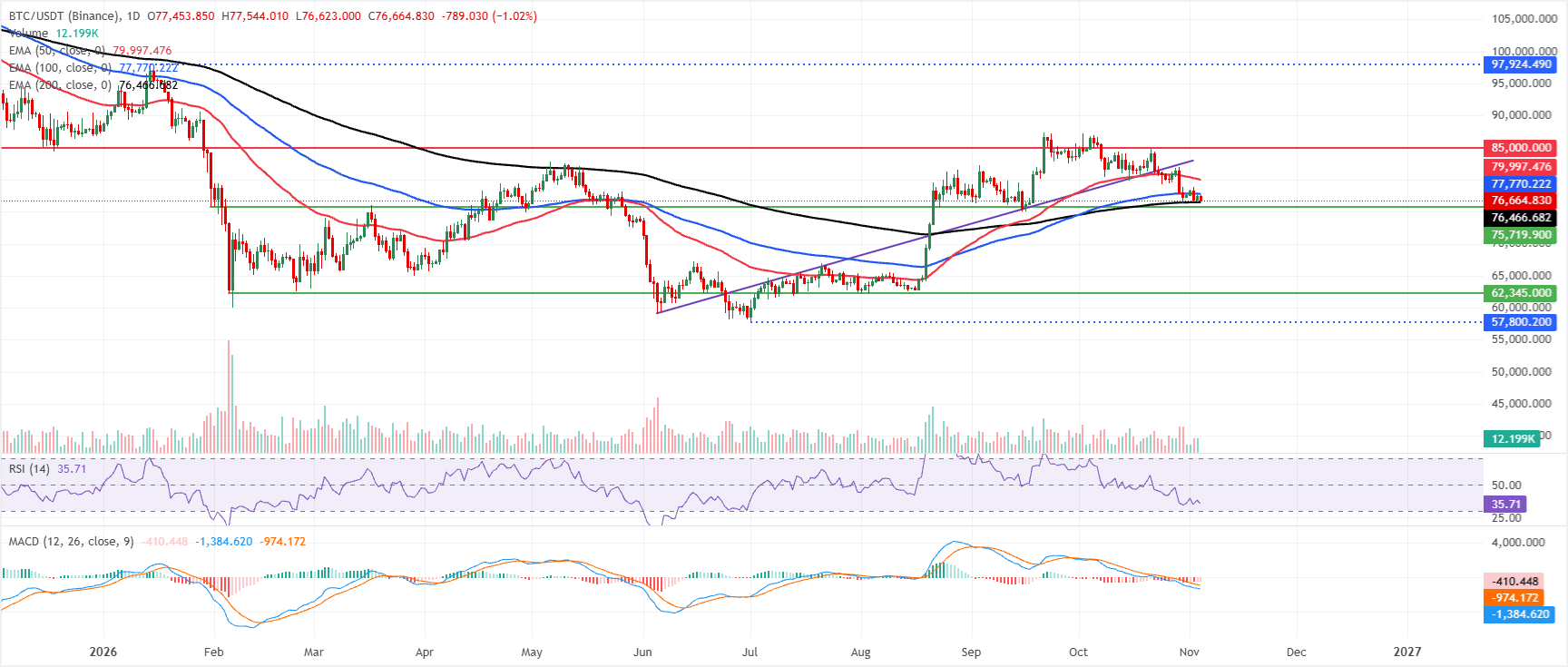
- Bitcoin slides to the key 200-day EMA around $76,466 on Wednesday, with a decisive close below, suggesting deeper losses.
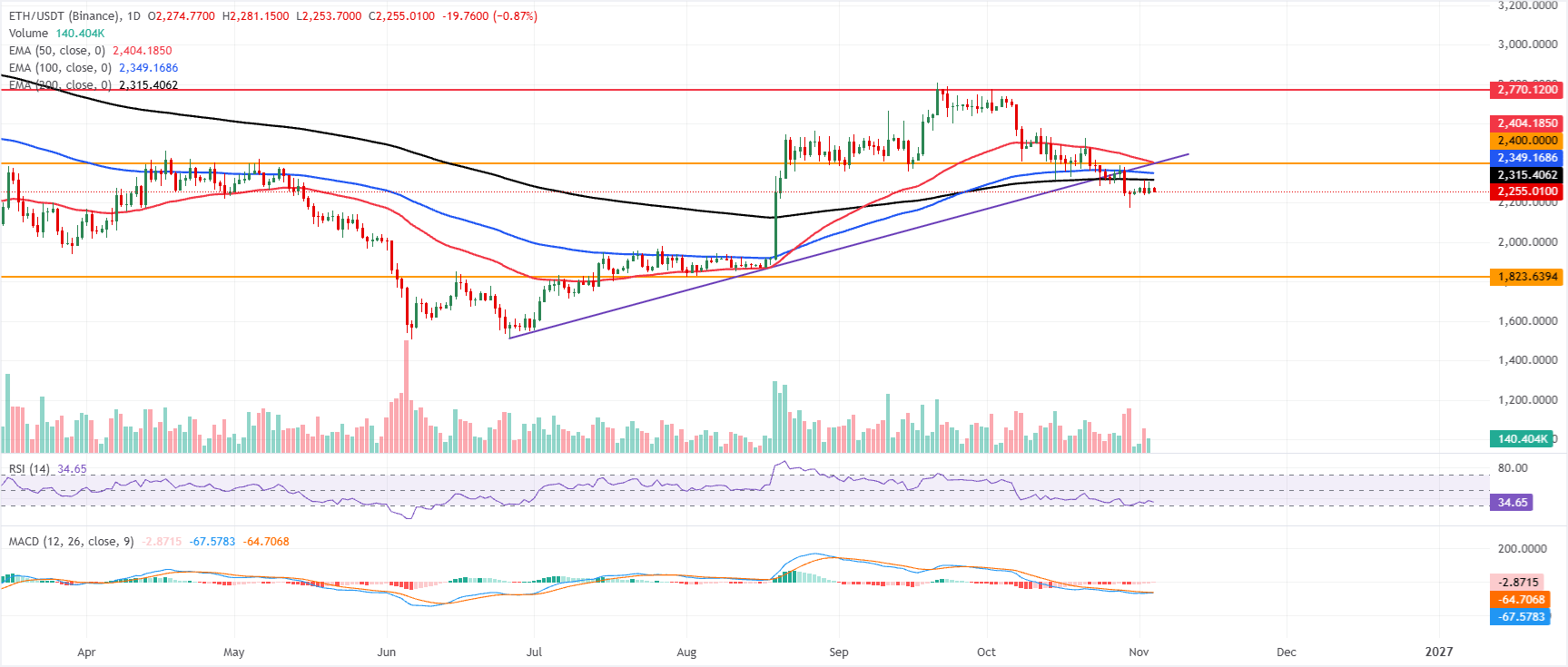
- Ethereum remains under pressure, trading near $2,255 after failing to secure a close above a key resistance zone.
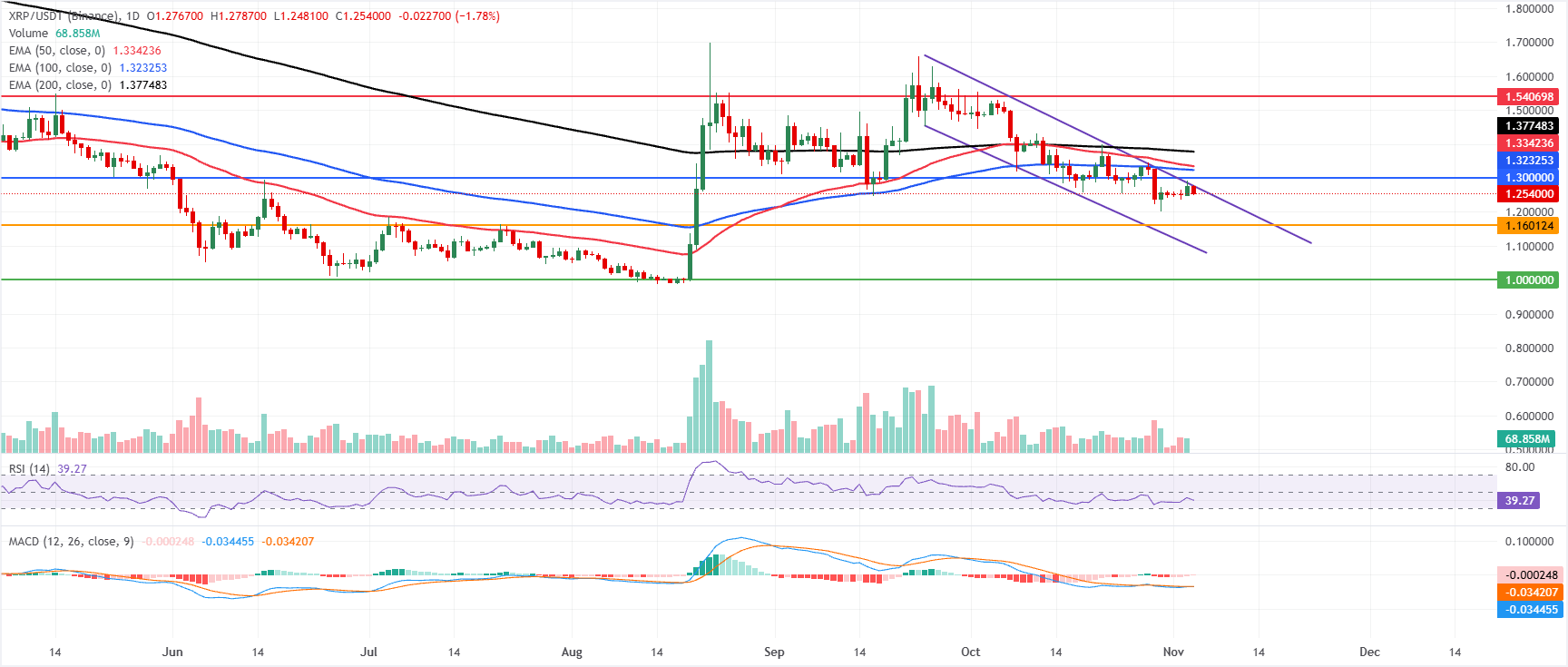
- XRP trades below $1.25, facing rejection from the upper trendline of the falling channel pattern.
Bitcoin (BTC), Ethereum (ETH) and Ripple (XRP) remain under pressure on Wednesday as bearish momentum continues to weigh on prices. BTC approaches key support around $76,466, and a decisive close below could open the door to deeper losses. Meanwhile, ETH struggles below key resistance while XRP faces rejection at the upper trendline of a falling channel pattern, all hinting at deeper losses.

Bitcoin could extend deeper correction if it closes below 200-day EMA
Bitcoin price trades at $76,664 on Wednesday, maintaining a bearish near-term bias as it holds just above the 200-day Exponential Moving Average (EMA) at $76,466 but remains capped by the 100-day EMA at $77,770.
The 50-day EMA near $79,997 reinforces a topside cap, while the Relative Strength Index (RSI) around 35 hints at waning downside pressure without a clear recovery signal. The Moving Average Convergence Divergence (MACD) stays below zero with a negative reading suggesting that bearish momentum still dominates despite the tentative stabilization over the 200-day EMA.
On the topside, initial resistance is seen at the 100-day EMA at $77,770, followed by the 50-day EMA around $79,997, with a more significant hurdle at the horizontal barrier near $85,000.
On the downside, immediate support is provided by the 200-day EMA at $76,466; a decisive break below this zone would likely expose BTC to deeper corrective pressure in the coming sessions.
Ethereum fails to close above key resistance
Ethereum price trades at $2,255 on Wednesday, keeping a bearish near-term tone as it holds below the 200-day and 100-day EMAs at $2,315 and $2,349. ETH has also slipped below the broken rising trendline, now acting as resistance near $2,399. Meanwhile, the RSI at 34 remains near oversold territory, and the MACD stays negative, suggesting lingering downside pressure despite a slowdown in bearish momentum.
On the topside, initial resistance aligns at the 200-day EMA at $2,315, followed by the 100-day EMA at $2,349 and the former trendline barrier around $2,399, with a nearby horizontal cap at $2,400; a stronger recovery would face the 50-day EMA at $2,404 before the higher ceiling at $2,770.
On the downside, the key structural floor is the horizontal support zone around $1,824, where buyers would be expected to show more interest if the current decline extends.
XRP holds a bearish outlook
XRP trades at $1.254 on Wednesday, maintaining a bearish near-term bias as it holds below the key EMAs. The 50-day EMA at $1.334, the 100-day EMA at $1.323 and the 200-day EMA at $1.377 all sit overhead as layered resistance, reinforcing the downside tone while price remains capped beneath the prior downward trendline break at $1.275.
Momentum is soft, with the RSI hovering around 39 and the MACD marginally negative, suggesting selling pressure still dominates, even if immediate downside follow-through is not aggressive.
On the topside, initial resistance appears at the former trendline break around $1.275, followed by the horizontal barrier at $1.300, then the clustered EMAs at $1.323 and $1.334, and the higher ceiling at $1.377, which deepens the broader corrective structure. A more substantial recovery would likely face further supply near $1.540 and $1.900.
On the downside, support appears first at $1.160, with a deeper floor at $1.000, and a sustained break below these levels would open the door to a more pronounced bearish extension in the coming sessions.
(The technical analysis of this story was written with the help of an AI tool. Know more.)
Cryptocurrency prices FAQs
Token launches influence demand and adoption among market participants. Listings on crypto exchanges deepen the liquidity for an asset and add new participants to an asset’s network. This is typically bullish for a digital asset.
A hack is an event in which an attacker captures a large volume of the asset from a DeFi bridge or hot wallet of an exchange or any other crypto platform via exploits, bugs or other methods. The exploiter then transfers these tokens out of the exchange platforms to ultimately sell or swap the assets for other cryptocurrencies or stablecoins. Such events often involve an en masse panic triggering a sell-off in the affected assets.
Macroeconomic events like the US Federal Reserve’s decision on interest rates influence crypto assets mainly through the direct impact they have on the US Dollar. An increase in interest rate typically negatively influences Bitcoin and altcoin prices, and vice versa. If the US Dollar index declines, risk assets and associated leverage for trading gets cheaper, in turn driving crypto prices higher.
Halvings are typically considered bullish events as they slash the block reward in half for miners, constricting the supply of the asset. At consistent demand if the supply reduces, the asset’s price climbs.
Лучшие статьи
1EUR/JPY Price Forecast: Trades below 177.50 after pulling back from descending channel top2Breaking: Democrats win control of Senate3US Dollar Index (DXY) dives to late September lows near 101.25 on US election results4Gold edges higher as US midterm election results trigger sudden USD fall5Silver Price Forecast: XAG/USD trades near $49.00, one-year lows amid US political shift6India Gold price today: Gold rises, according to FXStreet data7Iran’s IRGC says four tankers destroyed after hitting mines near Strait of Hormuz8Top 3 Price Predictions: Bitcoin, Ethereum, Ripple – BTC tests critical support, ETH struggles below resistance, XRP extends losses9Bitcoin struggles to capitalize on US Dollar weakness as Democrats advance in US midterms

Начать!
Зарегистрируйтесь и получите доступ к глобальным рынкам менее чем за 3 минуты

Свяжитесь с нами









Контакты
Телефон: +61 2 8036 8388
Факс: +61 2 8036 8388
Эл. почта: support@tmgm.com
Веб-сайт: https://www.tmg-max.com



Информация, представленная на этом веб-сайте, носит исключительно общий характер и не является персональной финансовой консультацией. Прежде чем действовать на основании любой информации на этом веб-сайте, вам следует оценить ее уместность с учетом ваших целей, финансового положения и потребностей. Инвестирование в CFD и маржинальные контракты на FX сопряжено со значительными рисками и подходит не всем инвесторам. Вы можете потерять больше, чем ваш первоначальный депозит. Вы не владеете базовым активом и не имеете в нем какой-либо доли. Мы рекомендуем вам обратиться за независимой консультацией и убедиться, что вы полностью понимаете связанные с этим риски, прежде чем начинать торговлю. Важно прочитать и принять во внимание документ с раскрытием информации, прежде чем приобретать любой продукт, указанный на веб-сайте. Информация и рекламные материалы, предлагаемые на этом веб-сайте, не предназначены для использования любым лицом в любой стране или юрисдикции, где такое использование противоречило бы местным законам и нормативным актам. Продукты и услуги, предлагаемые на этом веб-сайте, не предназначены для резидентов США, Малайзии и Таиланда.
TMGM уполномочена и регулируется в различных юрисдикциях.
Trademax Australia Limited, работающая под брендом TMGM, регулируется Australian Securities and Investments Commission (ASIC), AFSL № 436416 и находится по адресу: Level 28, One International Tower, 100 Barangaroo Avenue, 2000 Sydney, NSW Australia.
Email: support@tmgm.com.au
Trademax Global Limited, работающая под брендом TMGM, уполномочена и регулируется Vanuatu Financial Services Commission (VFSC), регистрационный номер 40356, и зарегистрирована по адресу: 1276, Kumul Highway, Port Vila, Vanuatu, Republic of Vanuatu.
Email: support@tmgm.com
Trademax Global Markets (SE) Limited, работающая под брендом TMGM, уполномочена и регулируется Financial Services Authority (FSA) Сейшельских Островов, номер лицензии SD224. Компания зарегистрирована по адресу: Office No 13, Providence Estate ABIS Centre, Mahe, Seychelles.
Email: support@tmgm.com
Trademax Global Markets (International) Pty Ltd, работающая под брендом TMGM, уполномочена и регулируется Financial Services Commission, Mauritius (FSC), лицензия № GB22201012, и зарегистрирована по адресу: 33, Edith Cavell Street C/o IQ EQ Fund Services (Mauritius) Ltd Port Louis, 11324 Mauritius.
Email: support@tmgm.com
Авторское право © TMGM. Все права защищены