

Trading
Tuklasin ang malawak na hanay ng mga merkado na may competitive na presyo, malalim na liquidity, at advanced na trading tools.
Matuto Pa 
Platform
Mag-trade nang walang sagabal gamit ang malakas na platform ng TMGM, na ginawa para sa bilis, katumpakan, at superior na trading experience.
Matuto Pa Trading Platform
Mga Trading Tools
Academy
Matuto ng mga pangunahing kaalaman sa trading gamit ang mga beginner-friendly na resources, kasama ang mga gabay, webinars, at market insights.
Matuto Pa TMGM Academy
Balita at Analysis
Makakuha ng real-time na mga update sa merkado at expert analysis upang manatiling nangunguna sa mga trading opportunities
Matuto Pa Balita at Analysis
Tungkol
Alamin kung ano ang nagpapangiiba sa TMGM — ang aming global presence, regulatory strength, at commitment sa innovation sa trading.
Matuto Pa Bakit Piliin ang TMGM
Sponsorship
Dollar Index breaks its June peak as the Euro sinks on dearer Crude Oil
- DXY breaks above 102.00 to its highest since April 2025 as the Euro sinks.
- The Euro below 1.1300 against the Dollar for the first time since May 2025.
- Odds of an October Fed hike under 40%, down from about 70% on Monday.
The odds of an October Fed rate hike have roughly halved since Monday, and the Dollar Index has risen on every one of those days. It trades near 102.10, its highest since April 2025. The index is moving with Crude Oil and the Euro rather than with the odds for the Fed's next meeting.

Close to four hikes still priced, and only October in doubt
The Fed raised its rate to 3.75-4.00% on September 16, and Fed Chair Warsh said inflation had been too high for too long. New York Fed President Williams said on Tuesday there was no need for urgency in raising it again, though he expects another increase this year.
Job openings and consumer confidence both came in soft the same day, and core Personal Consumption Expenditures (PCE) prices rose 0.2% in August, less than forecast. Minneapolis Fed President Kashkari said on Thursday he has no strong view on October and still expects more hikes. His own projection has one more quarter-point this year and another in 2027.
Futures put the chance of an October hike at about 70% on Monday and under 40% after the PCE release. They still price another hike this year and close to four by the end of 2027, so the market has moved the next hike rather than cancelled it. President Williams asked for no urgency, and traders applied that to October and to nothing after it.
The 10-year Treasury yield set a 24-year high above 5.30% on Wednesday, with the 30-year at 5.65%. Every step higher pays foreign buyers more to hold Dollar assets. Factories reported paying more in September too. The Institute for Supply Management (ISM) prices index jumped to 77.9, close to the 78.3 it recorded in March at the start of the war, and readings like that keep the later hikes in the price.
Europe buys more of its Crude Oil and fuel from the US than from anyone else
The Euro fell below 1.1300 against the Dollar on Thursday for the first time since May 2025, its fourth straight loss, and it makes up 57.6% of the Dollar Index. Worries over French government debt have added to the selling. It's possible that hotter September inflation in Germany, France, Italy and Spain will push the European Central Bank (ECB) to act, though the Euro fell on the day all four were published.
The European Union imports 96.6% of the Crude Oil and fuel it uses, and the US supplied 16% of those imports in 2024, more than any other country. Japan, 13.6% of the index, has almost no Crude Oil of its own, so the economies behind 71.2% of the basket face the same bill.
The US now exports more Crude Oil and fuel than it imports, a record 5.8 million barrels a day net in April. Each rise in Crude Oil is a cost for Europe and Japan and income for US exporters, which moves the Dollar Index whatever the Fed decides.
Crude Oil rose on Thursday on China's fuel export halt and on the Pentagon report of a third carrier group, and the Dollar Index set its session high on the second. Both stories add to the import bill in Europe and Japan, and neither depends on what the Fed does at its next meeting.
Pay has trailed prices for five months, and Friday is expected to add another
Nonfarm Payrolls (NFP) for September are due on Friday at 12:30 GMT, forecast at 94K after 162K in August, with the unemployment rate forecast at 4.1% for a third month. Average hourly earnings are forecast to rise 0.3% on the month. Payroll firm Automatic Data Processing (ADP) counted 90K private jobs on Wednesday against a 70K forecast, and announced layoffs fell to about 43K in September, down 18% from August.
The euro area's first estimate of September inflation comes out earlier the same day. A strong payroll number puts October back in play before the Fed decides on October 28, and a weak one pushes the next hike to a later meeting. For an index pricing the destination rather than the date, that is a choice between a hike and a hike.
Levels and bias
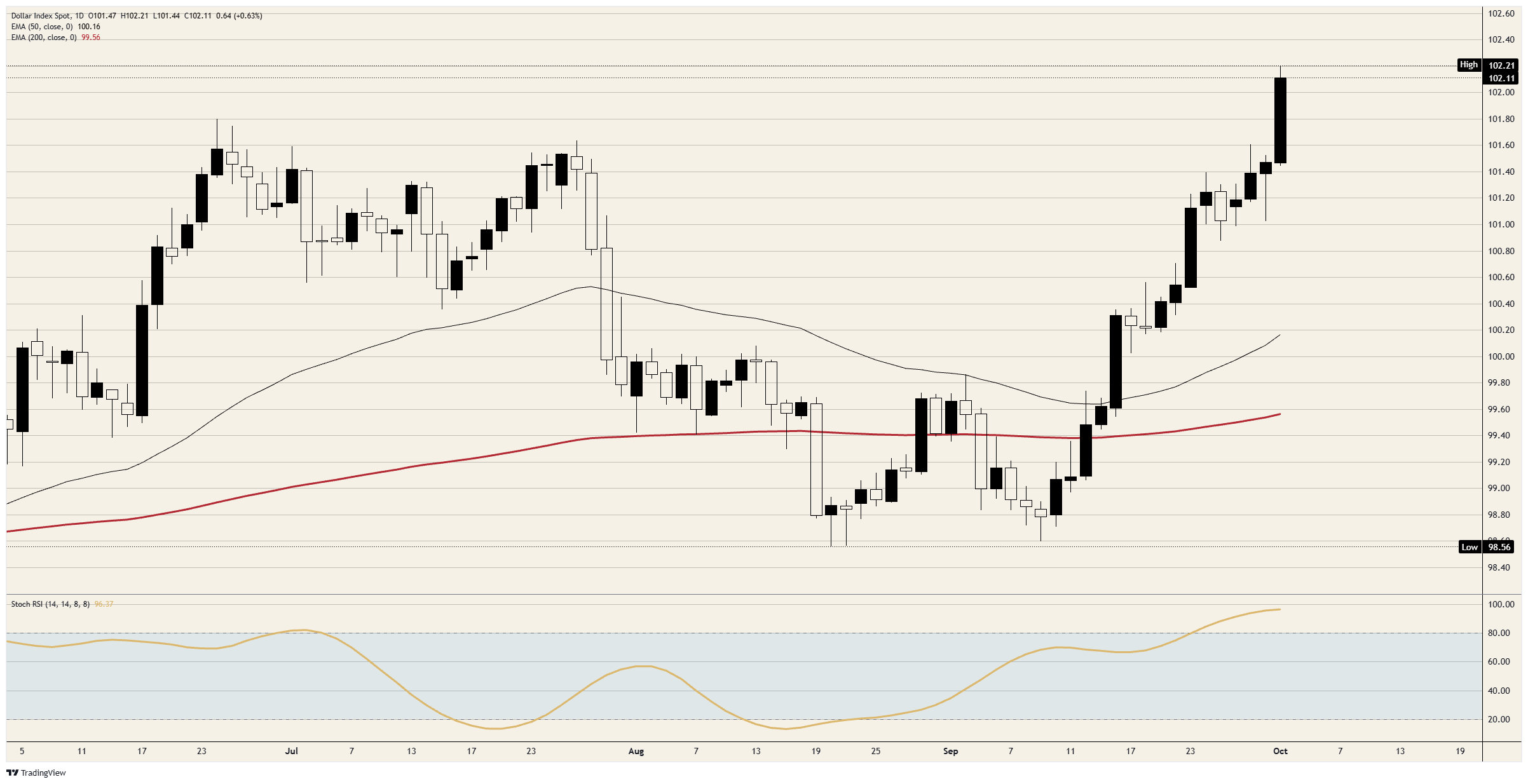
Resistance: Thursday's high just above 102.20 is where the push on the carrier report stopped. Above it, 102.50 and 103.00 are round levels the index hasn't traded since April 2025.
Support: 102.00 has held since Thursday's break above it. Below it, the June peak near 101.80 capped the index from June 24 until Thursday, then Wednesday's high near 101.50, where Thursday's run started.
Bias: The lean is long above 101.80, with 102.50 the first objective and 103.00 after it. Momentum on the daily Stochastic Relative Strength Index (Stoch RSI) is near 96 as the index heads for a fourth straight gain, so a dip toward 102.00 could come without breaking the run. A daily close back under 101.50 takes the index back into its late-September range and ends the trade.
DXY daily chart
US Dollar FAQs
The US Dollar (USD) is the official currency of the United States of America, and the ‘de facto’ currency of a significant number of other countries where it is found in circulation alongside local notes. It is the most heavily traded currency in the world, accounting for over 88% of all global foreign exchange turnover, or an average of $6.6 trillion in transactions per day, according to data from 2022. Following the second world war, the USD took over from the British Pound as the world’s reserve currency. For most of its history, the US Dollar was backed by Gold, until the Bretton Woods Agreement in 1971 when the Gold Standard went away.
The most important single factor impacting on the value of the US Dollar is monetary policy, which is shaped by the Federal Reserve (Fed). The Fed has two mandates: to achieve price stability (control inflation) and foster full employment. Its primary tool to achieve these two goals is by adjusting interest rates. When prices are rising too quickly and inflation is above the Fed’s 2% target, the Fed will raise rates, which helps the USD value. When inflation falls below 2% or the Unemployment Rate is too high, the Fed may lower interest rates, which weighs on the Greenback.
In extreme situations, the Federal Reserve can also print more Dollars and enact quantitative easing (QE). QE is the process by which the Fed substantially increases the flow of credit in a stuck financial system. It is a non-standard policy measure used when credit has dried up because banks will not lend to each other (out of the fear of counterparty default). It is a last resort when simply lowering interest rates is unlikely to achieve the necessary result. It was the Fed’s weapon of choice to combat the credit crunch that occurred during the Great Financial Crisis in 2008. It involves the Fed printing more Dollars and using them to buy US government bonds predominantly from financial institutions. QE usually leads to a weaker US Dollar.
Quantitative tightening (QT) is the reverse process whereby the Federal Reserve stops buying bonds from financial institutions and does not reinvest the principal from the bonds it holds maturing in new purchases. It is usually positive for the US Dollar.
Sikat na Artikulo
1Fed’s Jefferson says economy near maximum employment2Dollar Index breaks its June peak as the Euro sinks on dearer Crude Oil3US Dollar Index Price Forecast: DXY reaches fresh yearly high, but RSI turns overbought4Fed’s Kashkari keeps October open, still sees more hikes ahead5Fed’s Jefferson signals patience as next rate move stays data-driven6Banxico survey sees lower inflation, stronger growth and 6.50% hold7Mexican Peso rout deepens as USD/MXN blasts through 18.308Forex Today: US NFP takes centre stage9Near Protocol slides below $5.00 after Near Intents $4M exploit
LIVE QUOTES


LAHAT TUNGKOL SA FOREX
Magsimula!
Mag-sign up at ma-access ang Global Markets sa loob ng 3 minuto

Makipag-ugnayan sa Amin









Mga Kontak
Telepono: +61 2 8036 8388
Fax: +61 2 8036 8388
Email: support@tmgm.com



Ang impormasyong ibinigay sa website na ito ay pangkalahatang impormasyon lamang at hindi bumubuo ng personal na payong pinansyal. Bago kumilos batay sa anumang impormasyon sa website na ito, dapat mong isaalang-alang ang pagiging angkop ng impormasyon kaugnay ng iyong mga layunin, kalagayang pinansyal, at mga pangangailangan. Ang pag-iinvest sa CFDs at FX Margin Contracts ay may kaakibat na malalaking panganib at hindi angkop para sa lahat ng mamumuhunan. Maaari kang mawalan ng higit pa sa iyong paunang deposito. Wala kang pagmamay-ari o anumang interes sa pinagbabatayang asset. Inirerekomenda namin na humingi ka ng independiyenteng payo at tiyaking lubos mong nauunawaan ang mga panganib na kasangkot bago makipagkalakalan. Mahalaga na basahin at isaalang-alang mo ang dokumento ng pagsisiwalat bago ka kumuha ng anumang produktong nakalista sa website. Ang impormasyon at mga patalastas na inaalok sa website na ito ay hindi nilalayong gamitin ng sinumang tao sa alinmang bansa o hurisdiksyon kung saan ang ganitong paggamit ay labag sa mga lokal na batas at regulasyon. Ang mga Produkto at Serbisyong inaalok sa website na ito ay hindi nilalayong para sa mga residente ng United States, Malaysia, at Thailand.
Ang TMGM ay awtorisado at pinangangasiwaan sa iba't ibang hurisdiksyon.
Ang Trademax Australia Limited, na nag-trading bilang TMGM, ay pinangangasiwaan ng Australian Securities and Investments Commission (ASIC), AFSL no. 436416 at matatagpuan sa Level 28, One International Tower, 100 Barangaroo Avenue, 2000 Sydney, NSW Australia.
Email: support@tmgm.com.au
Ang Trademax Global Limited, na nag-trading bilang TMGM, ay awtorisado at pinangangasiwaan ng Vanuatu Financial Services Commission (VFSC), registration number 40356 at nakarehistro sa 1276, Kumul Highway, Port Vila, Vanuatu, Republic of Vanuatu.
Email: support@tmgm.com
Ang Trademax Global Markets (SE) Limited, na kilala bilang TMGM, ay awtorisado at nire-regulahan ng Financial Services Authority (FSA) ng Seychelles, na may lisensya bilang SD224. Ang kumpanya ay nakarehistro sa Office Blg. 13, Providence Estate ABIS Centre, Mahe, Seychelles.
Email: support@tmgm.com
Ang Trademax Global Markets (International) Pty Ltd, na nag-trading bilang TMGM, ay awtorisado at pinangangasiwaan ng Financial Services Commission, Mauritius (FSC) na may license no. GB22201012, at nakarehistro sa 33, Edith Cavell Street C/o IQ EQ Fund Services (Mauritius) Ltd Port Louis, 11324 Mauritius.
Email: support@tmgm.com
Copyright © TMGM. Lahat ng karapatan ay nakalaan