

Savdo
Raqobatbardosh narxlar, chuqur likvidlik va ilg‘or savdo vositalari bilan keng turdagi bozorlarni kashf eting.
Batafsil ma’lumot 
Platforma
TMGM’ning tezlik, aniqlik va yuqori savdo tajribasi uchun yaratilgan kuchli platformasi bilan uzluksiz savdo qiling.
Batafsil ma’lumot Savdo platformasi
Savdo vositalari
Akademiya
Boshlovchilar uchun qulay resurslar, jumladan qo‘llanmalar, vebinarlar va bozor tahlillari orqali savdoning asoslarini o‘rganing.
Batafsil ma’lumot Yangiliklar va tahlil
Savdo imkoniyatlaridan oldinda bo‘lish uchun bozor yangilanishlari va ekspert tahlillarini real vaqt rejimida oling
Batafsil ma’lumot Yangiliklar va tahlil
Haqida
TMGMni boshqalardan ajratib turadigan jihatlarni bilib oling — bizning global mavjudligimiz, tartibga solishdagi mustahkamligimiz va savdoda innovatsiyalarga sodiqligimiz.
Batafsil ma’lumot Nega TMGMni tanlash kerak
Euro trades close to 19-month low below 1.1000 against US Dollar, US data in focus
- Euro slumps to a fresh 19-month low at around 1.0985 against the US Dollar as the latter trades broadly firm.
- The AI unwinding trade has improved the US Dollar’s safe-haven demand.
- Investors await German ZEW Survey – Economic Sentiment data, and the US Retail Sales and FOMC Minutes data.
The Euro (EUR) hits a fresh 19-month low at around 1.0985 against the US Dollar (USD) during the European trading session on Tuesday. The major currency pair has been consistently under pressure as the US Dollar outperforms amid a significant improvement in its safe-haven demand.

As of writing, the US Dollar Index (DXY), which gauges the Greenback’s value against six major currencies, trades close to its fresh 19-month high of 103.70 posted during the day.
What has strengthened US Dollar?
Analysts at ING highlight that the recent “drop in US tech stocks has done little to dent the Dollar’s strong momentum.” They argue this is largely because “the sell-off has spilled over sufficiently into broader US and global equities for the Dollar to benefit from its safe-haven role.
Looking ahead, ING cautions that “we still think further weakness in tech/AI stocks should make additional greenback appreciation less sustainable as it drives more dovish Fed repricing,” suggesting the Dollar’s current strength may be harder to extend if the AI complex comes under renewed pressure.
Going forward, investors will pay attention to the United States (US) Retail Sales data for October at 13:30 GMT and Federal Open Market Committee (FOMC) minutes of the October policy meeting, which will be released on Friday.
ING points out that “October US retail sales are due today. Expectations are for a slowdown from September, but still slightly positive MoM growth: 0.1% in the headline and 0.3% ex auto and gas. October industrial production is also expected at 0.1% MoM.” However, the bank downplays their market impact, noting that “these aren't tier-one releases, and equity market dynamics still have a greater chance of driving FX moves today.”
On the Euro front, investors await key German ZEW Survey – Economic Sentiment data for November, which will be published at 10:00 GMT. German ZEW Survey – Economic Sentiment is expected to have improved to 29.0 from 28.1 in October.
EUR/USD Technical Analysis
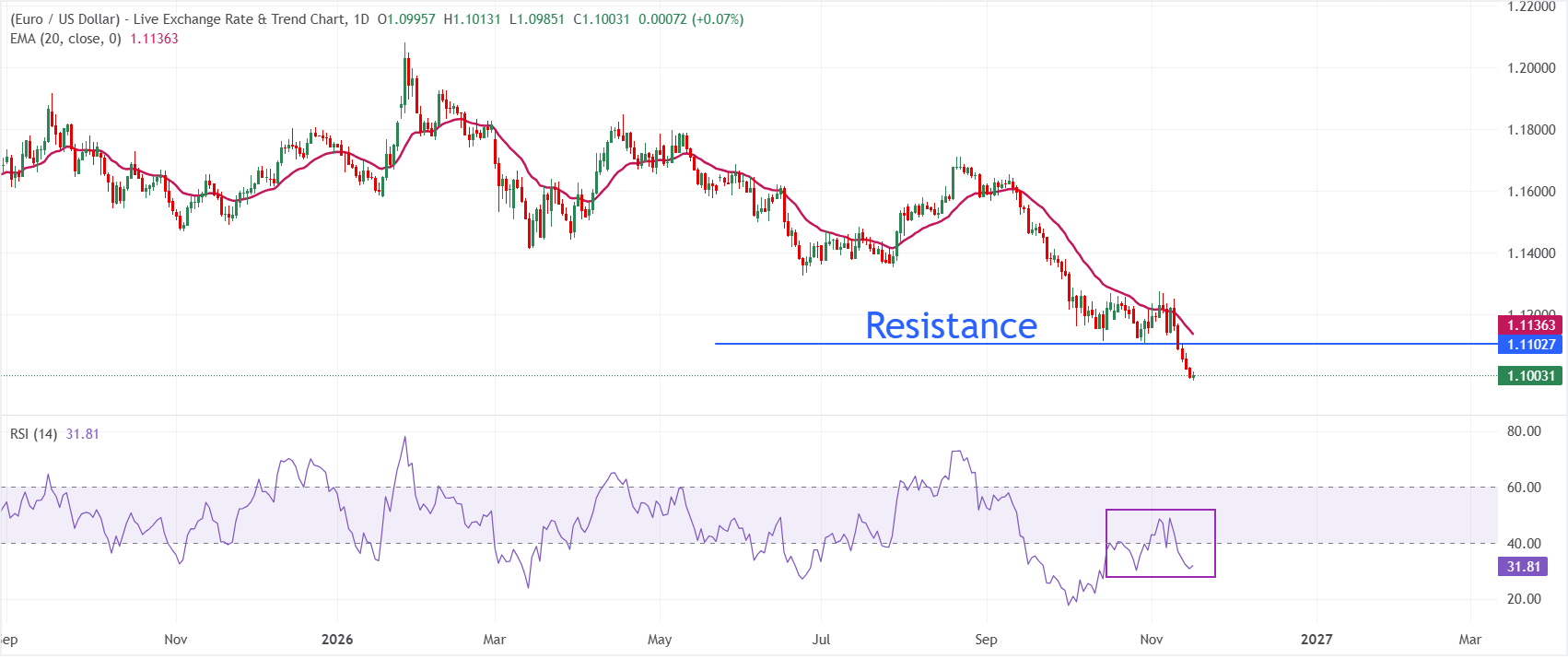
In the daily chart, EUR/USD trades at 1.1003, keeping a bearish near-term tone as spot remains below the 20-day exponential moving average (EMA) at 1.1136. The pair is entrenched under this dynamic barrier, suggesting rallies are likely to be capped while downside pressure persists. The Relative Strength Index (RSI) at 31.8 hovers just above oversold territory, hinting at stretched conditions but not yet signaling a robust recovery.
On the topside, immediate resistance is located at the 20-day EMA at 1.1136, which acts as the first hurdle for any corrective bounce. A daily close above this level would ease the current bearish bias and open the door for a broader recovery phase, while failure to reclaim it keeps risks skewed toward further losses, even in the absence of clearly defined nearby support levels.
(The technical analysis of this story was written with the help of an AI tool. Know more.)
Economic Indicator
ZEW Survey – Economic Sentiment
The Economic Sentiment published by the Zentrum für Europäische Wirtschaftsforschung measures the institutional investor sentiment, reflecting the difference between the share of investors that are optimistic and the share of analysts that are pessimistic. Generally speaking, an optimistic view is considered as positive (or bullish) for the EUR, whereas a pessimistic view is considered as negative (or bearish).
Read more.Next release: Tue Nov 17, 2026 10:00
Frequency: Monthly
Consensus: 29
Previous: 28.1
Eng yaxshi maqolalar
1AUD/JPY narx prognozi: pasayish signallari pastga yo‘nalgan kayfiyatni kuchaytirishi fonida 109,50 dan pastladi2Oktyabrda Xitoy savdo profitsiti qisqargani fonida Avstraliya dollari sustligicha qolmoqda3Xitoyning savdo profitsiti oktyabrda kutilganidan ko‘proq qisqarib, 712,72 mlrd CNYni tashkil etdi.4AQSh dollari indeksi (DXY) 101,70 atrofida barqaror, Eron borasidagi noaniqlik fonida AQSh CPI hisobotini kutmoqda5Xitoy eksporti yillik hisobda oktyabrda 35,2%ni tashkil etib, 33,5%lik prognozdan yuqori boʻldi.6Xitoy importi (yillik hisobda) oktyabrda kutilganidan yuqori: prognoz 32%, amaldagi ko‘rsatkich 41,6%7Xitoyning AQSh dollaridagi savdo balansi oktabrda $105,28 mlrdni tashkil etdi, bu kutilgan $125,8 mlrd ko‘rsatkichidan past.8Xitoyning savdo balansi (CNY) oktabrda 712,78 mlrdni tashkil etib, kutilgan 859 mlrdlik ko‘rsatkichdan past bo‘ldi.9Xitoy eksporti (yillik, CNY) oktyabrda avvalgi 29,6% dan 28,7% gacha pasaydi.


Boshlang!
Ro‘yxatdan o‘ting va 3 daqiqadan kamroq vaqt ichida Global bozorlariga kirish imkoniga ega bo‘ling

Biz bilan bog‘laning









Kontaktlar
Telefon: +61 2 8036 8388
Faks: +61 2 8036 8388
Email: support@tmgm.com



Ushbu veb-saytda taqdim etilgan ma’lumotlar faqat umumiy xususiyatga ega bo‘lib, shaxsiy moliyaviy maslahat hisoblanmaydi. Ushbu veb-saytdagi har qanday ma’lumot asosida harakat qilishdan oldin, ma’lumotning sizning maqsadlaringiz, moliyaviy ahvolingiz va ehtiyojlaringizga mosligini ko‘rib chiqishingiz kerak. CFD va FX Margin shartnomalariga sarmoya kiritish sezilarli xavflarni o‘z ichiga oladi va barcha investorlar uchun mos emas. Siz boshlang‘ich depozitingizdan ko‘proq yo‘qotishingiz mumkin. Siz asosiy aktivga egalik qilmaysiz va unda hech qanday manfaatga ega emassiz. Savdo qilishdan oldin mustaqil maslahat olishni va ishtirok etuvchi xavflarni to‘liq tushunishingizni tavsiya qilamiz. Veb-saytda keltirilgan har qanday mahsulotni xarid qilishdan oldin oshkor qilish hujjatini o‘qib chiqishingiz va ko‘rib chiqishingiz muhimdir. Ushbu veb-saytda taklif etilgan ma’lumotlar va reklama materiallari bunday foydalanish mahalliy qonunlar va qoidalarga zid bo‘ladigan har qanday mamlakat yoki yurisdiksiyadagi shaxslar tomonidan foydalanish uchun mo‘ljallanmagan. Ushbu veb-saytda taklif etilgan Mahsulotlar va Xizmatlar AQSh, Malayziya va Tailand rezidentlari uchun mo‘ljallanmagan.
TMGM turli yurisdiksiyalarda vakolatli va tartibga solinadi.
Trademax Australia Limited, TMGM nomi ostida faoliyat yuritadi, Avstraliya Qimmatli qog‘ozlar va investitsiyalar komissiyasi (ASIC) tomonidan tartibga solinadi, AFSL raqami 436416 va manzili: Level 28, One International Tower, 100 Barangaroo Avenue, 2000 Sydney, NSW Australia.
Email: support@tmgm.com.au
Trademax Global Limited, TMGM nomi ostida faoliyat yuritadi, Vanuatu Moliyaviy Xizmatlar Komissiyasi (VFSC) tomonidan vakolatli va tartibga solinadi, ro‘yxatga olish raqami 40356 va ro‘yxatdan o‘tgan manzili: 1276, Kumul Highway, Port Vila, Vanuatu, Vanuatu Respublikasi.
Email: support@tmgm.com
Trademax Global Markets (SE) Limited, TMGM nomi ostida faoliyat yuritadi, Seyshel orollari Moliyaviy Xizmatlar Boshqarmasi (FSA) tomonidan 224-sonli SD litsenziyasi bilan vakolatli va tartibga solinadi. Kompaniya Office No 13, Providence Estate ABIS Centre, Mahe, Seychelles manzilida ro‘yxatdan o‘tgan.
Email: support@tmgm.com
Trademax Global Markets (International) Pty Ltd, TMGM nomi ostida faoliyat yuritadi, Mauritius Moliyaviy Xizmatlar Komissiyasi (FSC) tomonidan GB22201012 litsenziya raqami bilan vakolatli va tartibga solinadi hamda 33, Edith Cavell Street C/o IQ EQ Fund Services (Mauritius) Ltd Port Louis, 11324 Mauritius manzilida ro‘yxatdan o‘tgan.
Email: support@tmgm.com
Mualliflik huquqi © TMGM. Barcha huquqlar himoyalangan