

Savdo
Raqobatbardosh narxlar, chuqur likvidlik va ilg‘or savdo vositalari bilan keng turdagi bozorlarni kashf eting.
Batafsil ma’lumot 
Platforma
TMGM’ning tezlik, aniqlik va yuqori savdo tajribasi uchun yaratilgan kuchli platformasi bilan uzluksiz savdo qiling.
Batafsil ma’lumot Savdo platformasi
Savdo vositalari
Akademiya
Boshlovchilar uchun qulay resurslar, jumladan qo‘llanmalar, vebinarlar va bozor tahlillari orqali savdoning asoslarini o‘rganing.
Batafsil ma’lumot Yangiliklar va tahlil
Savdo imkoniyatlaridan oldinda bo‘lish uchun bozor yangilanishlari va ekspert tahlillarini real vaqt rejimida oling
Batafsil ma’lumot Yangiliklar va tahlil
Haqida
TMGMni boshqalardan ajratib turadigan jihatlarni bilib oling — bizning global mavjudligimiz, tartibga solishdagi mustahkamligimiz va savdoda innovatsiyalarga sodiqligimiz.
Batafsil ma’lumot Nega TMGMni tanlash kerak
Indian Rupee gains further as oil prices correct sharply
- Indian Rupee extends its upside against the US Dollar as oil prices retreat significantly.
- The US signals that it prefers diplomatic resolution with Iran over resuming military action.
- Investors shift their focus to US midterm elections.
The Indian Rupee (INR) extends previous trading day’s gains against the US Dollar (USD) on Monday on the back of a sharp correction in oil prices. In the opening trade, the USD/INR pair is down 0.23% to near 94.72.
At the start of the week, the MCX Crude Oil contract expiring on November 19 is significantly down, almost 4% to near Rs. 9,545. The oil price has corrected from its multi-month high of Rs. 9,972 posted on Friday.
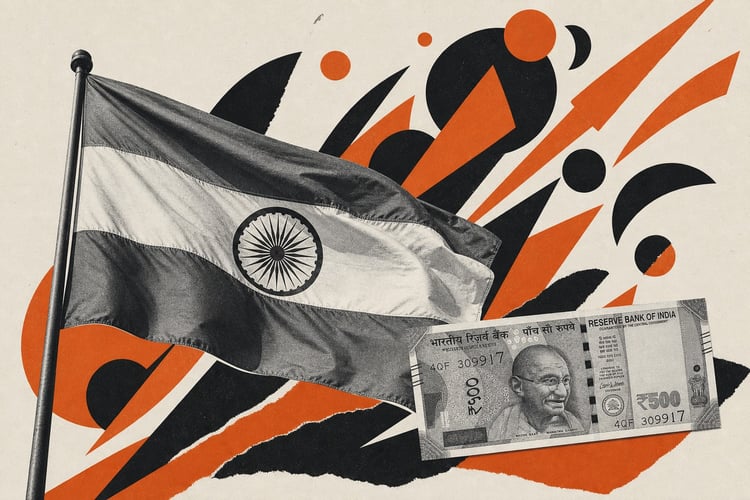
A corrective move in oil prices bodes well for currencies from economies, such as India, which rely heavily on oil imports to meet its energy needs.
What led to the significant correction in oil prices?
Oil prices open sharply lower on renewed hopes of a diplomatic resolution between the United States (US) and Iran.
Over the weekend, US Secretary of State Marco Rubio said that Washington hasn’t made any decision to renew strikes on Tehran and that President Donald Trump prefers a diplomatic resolution. However, Rubio warned that the US retains the capabilities to achieve whatever military objective Trump decides to pursue.
The indication from the US that it is ready for peace rather than pursuing joint military action with Israel after midterm elections, as previously stated, has eased fears of prolonged energy supply risks.
Meanwhile, the comments from Iran that it can reopen the Strait of Hormuz, a vital passage to almost 20% of global energy supply, has also diminished fears of energy supply risks.
Iran’s Foreign Minister Abbas Araghchi said talks are ongoing with Qatari mediators on a plan to reopen the Strait of Hormuz within two days if the US cooperates, Al Jazeera reported.
US midterm elections – key trigger for US Dollar
This week, the major trigger for the US Dollar and even global markets will be US midterm elections on Tuesday.
Analysts at ING argue that political risk around the upcoming US midterm elections is now the key near-term driver for the Dollar. They highlight that “the main risk for the dollar today is some precautionary unwinding of net-long positions ahead of Tuesday’s US midterm elections,” with positioning vulnerable to a shift in the political landscape.
ING notes that “a Democratic sweep is trading around 68% in prediction markets,” and warns this outcome “could be seen as slightly negative for the US dollar from a few angles, from higher risk of government shutdown and gridlock on debt ceiling negotiations to potential damage to already shaky AI-related sentiment.” Against that backdrop, the bank concludes that investors should avoid becoming overly optimistic on the greenback in the very short term, stating: “We’d be cautious in chasing the USD upside in the next few days.”
USD/INR Technical Analysis
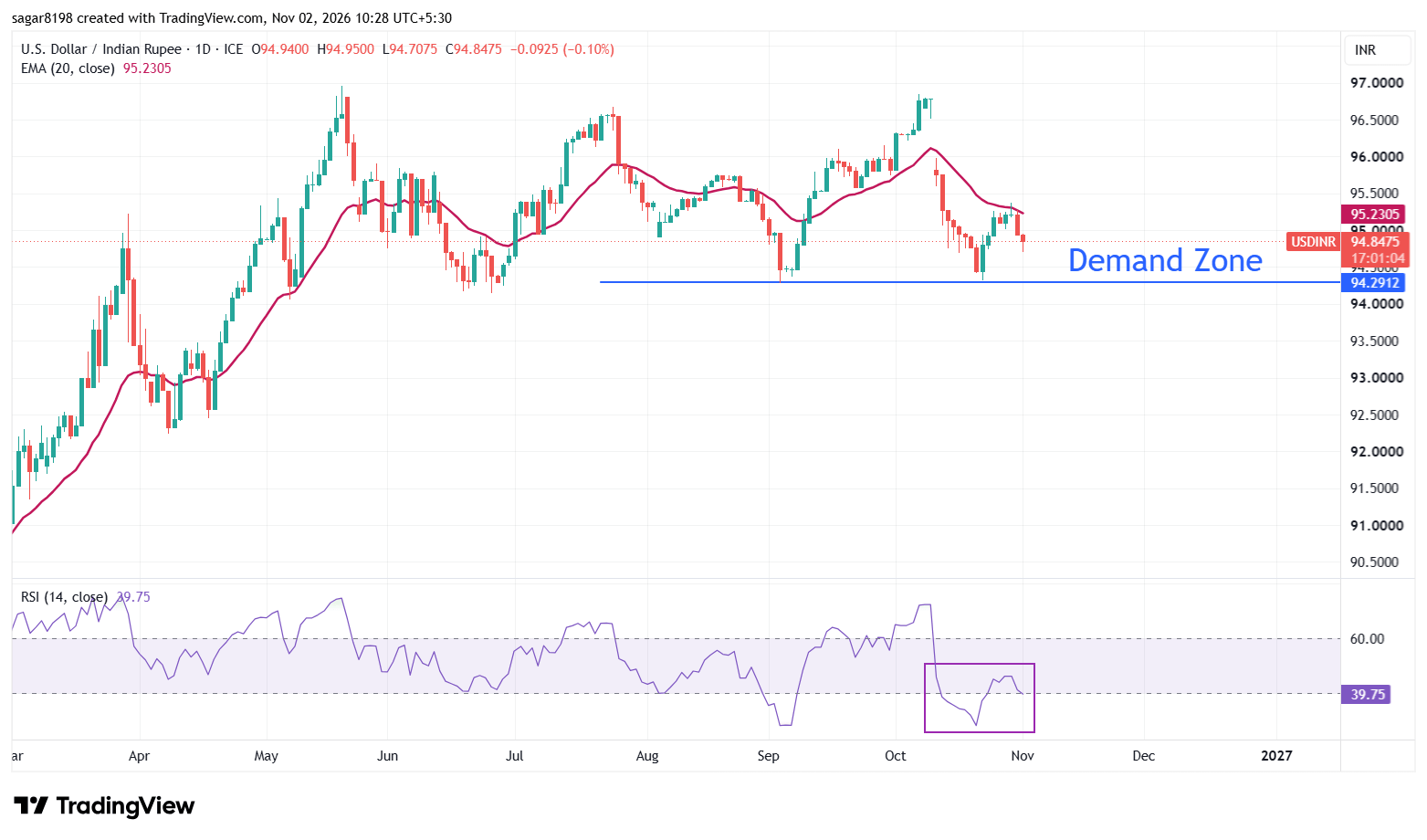
USD/INR declines to near 94.70 on Monday. The pair reflects a bearish near-term tone as spot remains below the 20-day Exponential Moving Average (EMA) at 95.23.
The pair continues to be pressured by this short-term EMA acting as immediate overhead supply, while the Relative Strength Index (14) around 40 suggests subdued momentum without reaching oversold extremes, hinting at further downside risk.
On the topside, initial resistance is located at the 20-day EMA near 95.23, which would need to be decisively overcome to ease the current bearish bias and open the way for a broader recovery. On the downside, the September low at 94.28 would act as a key demand zone for the pair.
(The technical analysis of this story was written with the help of an AI tool. Know more.)
Indian Rupee FAQs
The Indian Rupee (INR) is one of the most sensitive currencies to external factors. The price of Crude Oil (the country is highly dependent on imported Oil), the value of the US Dollar – most trade is conducted in USD – and the level of foreign investment, are all influential. Direct intervention by the Reserve Bank of India (RBI) in FX markets to keep the exchange rate stable, as well as the level of interest rates set by the RBI, are further major influencing factors on the Rupee.
The Reserve Bank of India (RBI) actively intervenes in forex markets to maintain a stable exchange rate, to help facilitate trade. In addition, the RBI tries to maintain the inflation rate at its 4% target by adjusting interest rates. Higher interest rates usually strengthen the Rupee. This is due to the role of the ‘carry trade’ in which investors borrow in countries with lower interest rates so as to place their money in countries’ offering relatively higher interest rates and profit from the difference.
Macroeconomic factors that influence the value of the Rupee include inflation, interest rates, the economic growth rate (GDP), the balance of trade, and inflows from foreign investment. A higher growth rate can lead to more overseas investment, pushing up demand for the Rupee. A less negative balance of trade will eventually lead to a stronger Rupee. Higher interest rates, especially real rates (interest rates less inflation) are also positive for the Rupee. A risk-on environment can lead to greater inflows of Foreign Direct and Indirect Investment (FDI and FII), which also benefit the Rupee.
Higher inflation, particularly, if it is comparatively higher than India’s peers, is generally negative for the currency as it reflects devaluation through oversupply. Inflation also increases the cost of exports, leading to more Rupees being sold to purchase foreign imports, which is Rupee-negative. At the same time, higher inflation usually leads to the Reserve Bank of India (RBI) raising interest rates and this can be positive for the Rupee, due to increased demand from international investors. The opposite effect is true of lower inflation.
Eng yaxshi maqolalar
1British Pound: Resistance at 1.3435 caps upside against US Dollar – UOB2Forex Today: US Dollar edges lower as mood improves ahead of midterm elections3Euro pares gains against British Pound after Germany’s Retail Sales unexpectedly fall in September4Germany’s Retail Sales falls by 2.0% in September, vs. 0.4% expected5Gold: Recovery toward 2027 despite near-term pressure - OCBC6Oil: Geopolitical risk premium holds as midterms loom – ING7WTI Price Forecast: Extends correction below $1008Euro: Policy risks could revive swings against US Dollar - Commerzbank9Dogecoin Price Forecast: DOGE risks deeper slide as whales diverge

Boshlang!
Ro‘yxatdan o‘ting va 3 daqiqadan kamroq vaqt ichida Global bozorlariga kirish imkoniga ega bo‘ling

Biz bilan bog‘laning









Kontaktlar
Telefon: +61 2 8036 8388
Faks: +61 2 8036 8388
Email: support@tmgm.com



Ushbu veb-saytda taqdim etilgan ma’lumotlar faqat umumiy xususiyatga ega bo‘lib, shaxsiy moliyaviy maslahat hisoblanmaydi. Ushbu veb-saytdagi har qanday ma’lumot asosida harakat qilishdan oldin, ma’lumotning sizning maqsadlaringiz, moliyaviy ahvolingiz va ehtiyojlaringizga mosligini ko‘rib chiqishingiz kerak. CFD va FX Margin shartnomalariga sarmoya kiritish sezilarli xavflarni o‘z ichiga oladi va barcha investorlar uchun mos emas. Siz boshlang‘ich depozitingizdan ko‘proq yo‘qotishingiz mumkin. Siz asosiy aktivga egalik qilmaysiz va unda hech qanday manfaatga ega emassiz. Savdo qilishdan oldin mustaqil maslahat olishni va ishtirok etuvchi xavflarni to‘liq tushunishingizni tavsiya qilamiz. Veb-saytda keltirilgan har qanday mahsulotni xarid qilishdan oldin oshkor qilish hujjatini o‘qib chiqishingiz va ko‘rib chiqishingiz muhimdir. Ushbu veb-saytda taklif etilgan ma’lumotlar va reklama materiallari bunday foydalanish mahalliy qonunlar va qoidalarga zid bo‘ladigan har qanday mamlakat yoki yurisdiksiyadagi shaxslar tomonidan foydalanish uchun mo‘ljallanmagan. Ushbu veb-saytda taklif etilgan Mahsulotlar va Xizmatlar AQSh, Malayziya va Tailand rezidentlari uchun mo‘ljallanmagan.
TMGM turli yurisdiksiyalarda vakolatli va tartibga solinadi.
Trademax Australia Limited, TMGM nomi ostida faoliyat yuritadi, Avstraliya Qimmatli qog‘ozlar va investitsiyalar komissiyasi (ASIC) tomonidan tartibga solinadi, AFSL raqami 436416 va manzili: Level 28, One International Tower, 100 Barangaroo Avenue, 2000 Sydney, NSW Australia.
Email: support@tmgm.com.au
Trademax Global Limited, TMGM nomi ostida faoliyat yuritadi, Vanuatu Moliyaviy Xizmatlar Komissiyasi (VFSC) tomonidan vakolatli va tartibga solinadi, ro‘yxatga olish raqami 40356 va ro‘yxatdan o‘tgan manzili: 1276, Kumul Highway, Port Vila, Vanuatu, Vanuatu Respublikasi.
Email: support@tmgm.com
Trademax Global Markets (SE) Limited, TMGM nomi ostida faoliyat yuritadi, Seyshel orollari Moliyaviy Xizmatlar Boshqarmasi (FSA) tomonidan 224-sonli SD litsenziyasi bilan vakolatli va tartibga solinadi. Kompaniya Office No 13, Providence Estate ABIS Centre, Mahe, Seychelles manzilida ro‘yxatdan o‘tgan.
Email: support@tmgm.com
Trademax Global Markets (International) Pty Ltd, TMGM nomi ostida faoliyat yuritadi, Mauritius Moliyaviy Xizmatlar Komissiyasi (FSC) tomonidan GB22201012 litsenziya raqami bilan vakolatli va tartibga solinadi hamda 33, Edith Cavell Street C/o IQ EQ Fund Services (Mauritius) Ltd Port Louis, 11324 Mauritius manzilida ro‘yxatdan o‘tgan.
Email: support@tmgm.com
Mualliflik huquqi © TMGM. Barcha huquqlar himoyalangan